
AI Automation Companies for Property Management Operations

AI automation companies are becoming a larger part of the property management technology stack.
For multifamily operators, the opportunity is not just automating isolated tasks. It is reducing operational friction across leasing, compliance, reporting, document workflows, and portfolio oversight.
The challenge is that “AI automation” can mean very different things depending on the provider.
Some AI automation service providers focus on communication workflows. Others focus on document processing, maintenance routing, reporting, or compliance monitoring. A smaller category focuses on operational intelligence across existing systems.
This guide explains how to evaluate AI automation companies for property management operations. It covers the types of providers in the market. It also explains where SurfaceAI fits into the automation landscape.
For broader automation context, see automating property management →

Why Property Management Teams Are Looking at AI Automation Companies
Property management teams are under pressure to operate larger portfolios without adding headcount at the same rate.
The recurring challenges are familiar:
- too much manual review
- disconnected systems
- delayed reporting
- repetitive administrative work
- inconsistent compliance checks
- revenue leakage hidden in lease and billing data
AI automation companies are emerging because operators need systems that can reduce manual workload while improving accuracy and visibility.
In property management, the strongest automation does not simply complete tasks faster. It helps teams catch issues earlier. It helps them standardize workflows. It helps them operate with better data.
Broader market shifts are driving the wave of interest in AI and automation. Operators face tighter margins, leaner staffing, and growing investor pressure for real-time visibility. Generative AI and machine learning now handle work that rule-based systems could not.
That includes complex, judgment-driven tasks. Document review, lease validation, and exception detection now sit firmly inside what AI workflows can handle.
AI ROI has been uneven across enterprises. Only 15% of AI decision-makers reported an EBITDA lift from AI in the past 12 months. Fewer than one-third can tie AI value to P&L changes. According to Forrester, enterprises are prioritizing function over flair in 2026.
The organizations that succeed with AI are the ones that integrate it into existing workflows. They measure ROI against specific operational outcomes rather than broad feature adoption.
What AI Automation Companies Actually Provide
AI automation companies provide technology or services that use artificial intelligence to automate parts of business operations.
In property management, this can include:
- leasing communication automation
- document classification and document processing
- lease data extraction
- maintenance routing
- workflow assignment
- compliance monitoring
- reporting alerts
- anomaly detection
- operational data validation
- AI integration with existing PMS and accounting systems
The workflow you want to automate determines the right provider.
A resident communication company solves a different problem than a lease audit automation company. The same goes for an acquisition due diligence platform. Each provider category has different strengths, different integration patterns, and different operational outcomes.
The label “AI automation” covers everything from simple chatbots to advanced intelligence automation platforms. Buyers who treat these as interchangeable usually end up with the wrong tool for their actual workflow.
Types of AI Automation Service Providers in Property Management
1. Communication Automation Providers
These providers automate resident or prospect communication.
Common use cases include:
- responding to leasing inquiries
- answering resident questions
- scheduling tours
- sending reminders
- routing messages to onsite teams
- customer service support for resident requests
This category is useful for high-volume leasing environments. It does not usually address financial accuracy, lease compliance, or operational risk.
Most communication automation tools use AI agents trained to handle a narrow conversational scope. They work well for repetitive interactions. They do not validate data or surface operational issues.
2. Workflow Automation Providers
These providers focus on repetitive operational workflows.
Examples include:
- task assignment
- maintenance routing
- rent reminders
- escalation workflows
- approval routing
Workflow automation helps teams standardize processes across properties. It reduces variability and saves time on routine coordination work. The best providers offer automation services that connect cleanly with existing tools rather than creating yet another standalone system.
For a deeper workflow view, see how property management workflow automation transforms operations →
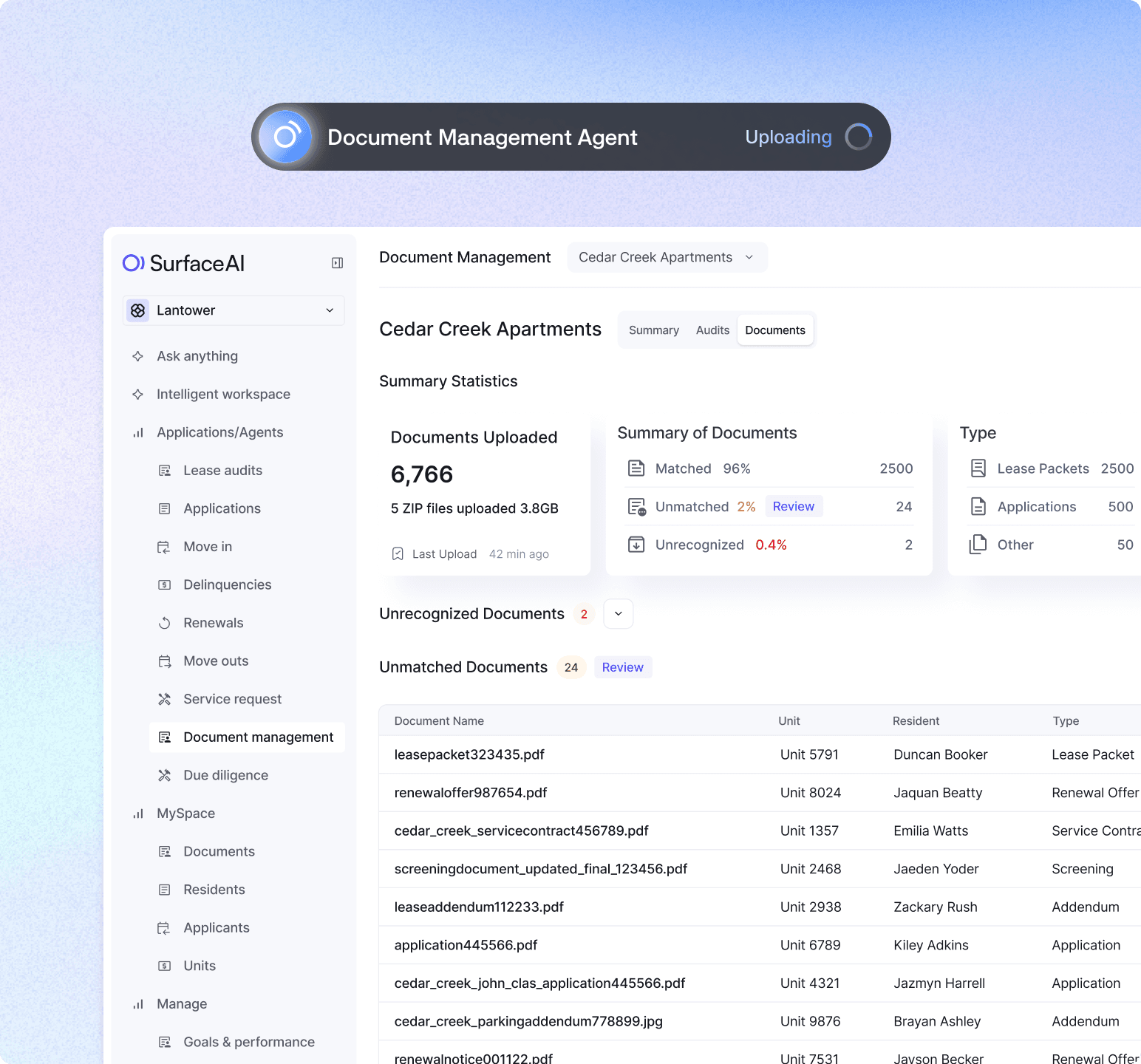
3. Document Automation Providers
Document automation providers help process, classify, and route documents.
In property management, this may include:
- lease files
- addenda
- resident records
- compliance forms
- acquisition documents
These tools are especially useful when teams are managing large document sets during transitions, audits, or acquisitions. They reduce the manual work of sorting and tagging files. Stronger providers also extract structured data from documents. Downstream systems then use that data.
For related context, see document automation tools for real estate operations →
4. Compliance Monitoring Providers
Compliance-focused AI automation service providers help teams detect operational exceptions earlier.
This may include:
- missing lease documents
- incorrect billing terms
- incomplete addenda
- policy exceptions
- inconsistent lease execution
This category is especially relevant for multifamily portfolios where small compliance issues can scale quickly across many units. A single missing addendum at one property is a minor issue. The same gap across 200 properties is a portfolio-wide risk.
5. Operational Intelligence Providers
Operational intelligence providers go beyond task automation.
They help operators identify whether the data and workflows inside existing systems are accurate.
This category includes platforms that support:
- lease validation
- rent roll reconciliation
- revenue leakage detection
- portfolio monitoring
- exception-based workflows
- operational risk visibility
This is where SurfaceAI fits most naturally. The category is smaller than the others. But it tends to deliver outsized impact on NOI because it catches issues that other automation categories ignore.
AI Automation Companies vs AI Management Platforms
It is important to separate AI automation companies from AI management platforms.
AI automation companies often solve a specific workflow.
An AI management platform coordinates intelligence and oversight across multiple workflows.
For example:
- an automation provider may route maintenance requests
- an AI management platform may monitor exceptions across systems
- an operational intelligence layer may validate whether lease, billing, and reporting data align
For a broader orchestration view, see AI management platforms for multifamily operations →
This distinction matters because operators often need both point automation and centralized oversight. Most teams start with one or two automation tools. Over time, they realize they also need a layer that connects and validates those tools. That is when the conversation shifts from buying more automation platforms to building a coordinated operational stack.
How to Evaluate AI Automation Companies
When evaluating AI automation companies, property management leaders should focus on operational outcomes rather than feature lists.
1. What Workflow Does the Provider Automate?
Start with the specific operational problem.
Examples:
- leasing communication
- lease audits
- compliance monitoring
- document processing
- reporting alerts
- acquisition diligence
The clearer the workflow, the easier it is to evaluate ROI. A provider that claims to automate “everything” rarely automates anything well.
2. Does It Integrate With Existing Systems?
AI automation should not create another disconnected workflow.
Evaluate whether the provider can connect with:
- PMS platforms
- accounting systems
- document storage
- reporting tools
- operational dashboards
Integration determines whether automation is actually usable inside daily operations. The strongest providers offer pre-built integrations with the systems multifamily teams already run. Custom AI deployments without clear integration paths often stall before they reach full adoption.
3. Does It Improve Accuracy or Just Speed?
Speed matters, but accuracy matters more.
A tool that automates the wrong data faster can create more operational risk.
The strongest providers help improve:
- data quality
- lease accuracy
- compliance visibility
- reporting confidence
Accuracy is what makes automation safe to scale. Without it, every workflow becomes a source of new exceptions rather than a way to reduce them.
4. Can It Handle Portfolio Scale?
A tool may work well for one property but fail across a large portfolio.
Operators should evaluate:
- unit volume
- property count
- document volume
- workflow complexity
- reporting needs
Scalability should be tested before implementation. Pilot projects on a handful of properties do not always predict how a tool performs at portfolio scale.
5. Does It Support Exception Management?
Good automation does not require teams to inspect every workflow manually.
It should surface exceptions clearly.
Examples include:
- missing charges
- incomplete documents
- unusual billing patterns
- compliance gaps
- unresolved operational issues
Exception-based workflows help teams prioritize what matters. They are the difference between automation that creates noise and automation that creates clarity.
6. Does It Align With Long Term Business Goals?
Short-term task automation is easy to justify. Long term value requires that the system continues to deliver as the portfolio grows and operational needs evolve.
The strongest AI automation companies design their products with this longer arc in mind. They invest in real time data infrastructure. They build integrations rather than walls. And they provide enough visibility for operators to trust the outputs over time.
The pressure on AI budgets is rising. 71% of global CIOs say they will freeze or cut their AI budgets if teams cannot demonstrate value within two years. Harvard Business Review identifies seven factors that drive returns on AI investments.
The list includes clarity on the kind of value the team is pursuing. It also includes using all available AI tools rather than just one. And it stresses integrating AI into both products and processes rather than treating it as a standalone initiative.

Where SurfaceAI Fits Among AI Automation Companies
SurfaceAI fits into the operational intelligence and validation category. It is not a resident chatbot or a generic workflow automation tool.
We help multifamily operators automate high-value review and monitoring workflows across lease, document, and operational data.
SurfaceAI supports teams by helping:
- validate lease terms against system records
- detect revenue leakage
- identify compliance gaps
- reconcile lease data with rent rolls
- support acquisition due diligence
- monitor operational discrepancies across portfolios
SurfaceAI works best for operators who already have core systems in place. They need better visibility into whether those systems are accurate.
Teams that combine SurfaceAI with automated lease audit workflows get continuous validation across the lease portfolio. That continuous validation is what separates intelligence automation from simple task automation.
For related controls, see lease compliance monitoring setup for multifamily →
Common Mistakes When Choosing AI Automation Service Providers
Choosing based on AI branding alone. Many providers now describe their tools as AI-powered. That does not mean they solve a material operational problem. Ask what the tool actually does and how it integrates with existing systems.
Automating before standardizing. Automation works best when workflows are clearly defined first. If the process is inconsistent, automation may amplify the inconsistency. Standardize the workflow, then automate it.
Ignoring data quality. AI automation depends on the quality of underlying data. Operators should evaluate whether a provider validates data, not just processes it.
Adding too many point solutions. Too many disconnected AI tools can create more complexity rather than less. Operators should consider how each provider fits into the broader property management automation stack.
Treating AI integration as an afterthought. The best results come when teams integrate AI workflows into existing tools from day one. Bolt-on integrations rarely deliver the same operational lift as planned ones.
Skipping reference checks. Most top AI automation agencies have customer case studies and reference contacts. Ask for them. A provider that cannot point to real customers running at scale is a higher-risk choice.
When AI Automation Companies Create the Most Value
AI automation companies tend to create the most value when workflows are:
- repetitive
- high-volume
- document-heavy
- compliance-sensitive
- time-sensitive
- difficult to scale manually
This is why AI is increasingly useful in areas like lease auditing, acquisition diligence, and document workflows.
These are processes where manual review creates bottlenecks. Missed issues can directly affect revenue. A small percentage of automated catch rate translates into meaningful NOI protection at portfolio scale.
The same logic applies to compliance work. Manual compliance reviews scale linearly with portfolio size. Automated reviews scale much more efficiently.
AI automation pays off most in two situations. The workflow must be repeatable. And the cost of missing something must be high.
How AI Automation Fits Into the Broader Real Estate Technology Stack
Property management automation does not exist in isolation. It connects to leasing systems, accounting platforms, reporting tools, and asset management workflows. Operators who treat AI automation as a standalone purchase often miss the broader picture.
The strongest stacks combine:
- automation services for repetitive workflows
- intelligence automation for validation and exception detection
- AI agents for resident and prospect communication
- integration layers that move data cleanly between systems
- reporting layers that turn operational data into decisions
This kind of integrated stack supports better long term portfolio performance. It also gives leadership real-time visibility. Teams can act on issues as they appear rather than weeks later.
For broader category context on how AI sits in the corporate real estate stack, see corporate real estate technology →
Key Takeaway
AI automation companies can help property management teams reduce manual work, improve workflow consistency, and gain better operational visibility.
But not all providers solve the same problem.
The best AI automation service providers are the ones that:
- integrate with existing systems
- improve accuracy
- surface exceptions
- support portfolio scale
- strengthen operational decision-making
- align with long term business goals
For multifamily operators, the biggest value often comes from automation that improves data trust and operational control.
Conclusion
Property management automation is moving beyond simple task completion.
Operators now need AI automation companies that can do three things.
- Monitor workflows.
- Validate operational data.
- Surface risks before they affect NOI or reporting.
If your team is evaluating AI automation service providers, book a demo. SurfaceAI supports smarter property management automation with better lease accuracy, compliance visibility, and operational intelligence.
Frequently Asked Questions About AI Automation Companies