
Property Risk Management: How to Identify, Assess, and Control Risk

Every property carries risk.
Some risks are obvious:
- deferred maintenance,
- rising insurance costs
- delinquency
- a major compliance issue
Others are harder to see. A recurring fee may be missing from dozens of leases. Resident files may be incomplete. Operational data may conflict across systems.
That is why effective property risk management cannot stop at insurance policies and annual audits. Reacting only when something goes wrong is not a strategy. It requires a repeatable process. That means identifying risk, understanding its impact, putting controls in place, and monitoring whether those controls work.
That process matters more as portfolios grow. More decisions now depend on data spread across multiple systems, and multifamily owners and operators feel that shift directly.
This guide covers three things. How to approach risk management in real estate, the major categories of property risk, and how to build a practical framework that works across a portfolio.
What Is Property Risk Management?
Property risk management is the process of identifying, evaluating, controlling, and monitoring events or conditions that could negatively affect a real estate asset.
Those risks may influence revenue, operating expenses, compliance, resident experience, property condition, legal exposure, asset value, and portfolio performance.
The goal is not to eliminate every possible risk. That is impossible. The goal is narrower. Understand which risks matter, determine how likely they are, estimate their impact, and take reasonable steps to reduce exposure.
Why Risk Management in Real Estate Is Different
Real estate risk is unusually broad because a property is many things at once. It is a physical asset, an operating business, a source of recurring revenue, a regulated environment, a set of contractual obligations, and a resident experience.
A single issue can therefore create several consequences. An inaccurate lease record may look like an administrative problem at first. But it can also lead to incorrect billing, lost revenue, reporting errors, resident disputes, and compliance exposure.
Strong risk management in the real estate industry looks beyond isolated incidents. It considers how operational problems affect the entire asset.
The Major Types of Real Estate Risk
A practical property risk analysis should consider several categories.
Financial risk relates to the property’s ability to generate expected returns: revenue shortfalls, delinquency, unexpected operating expenses, interest-rate exposure, and capital overruns. Many financial problems start elsewhere. A billing discrepancy or missing recurring charge becomes a financial issue even when it begins as a data problem.
Operational risk comes from the processes required to run a property. Examples include inconsistent leasing procedures, staffing gaps, incomplete resident records, manual data entry errors, and weak internal controls. Individual incidents may look minor until the same weakness appears across thousands of units.
Compliance risk arises when properties fail to meet legal, regulatory, contractual, or internal requirements. Common areas include resident documentation, lease disclosures, affordable housing requirements, and fair housing procedures. Compliance controls belong inside normal operations, not just audit prep.
Physical asset risk comes from the buildings themselves. Examples include deferred maintenance, roof failure, HVAC problems, structural damage, and fire and life safety concerns. These usually require both preventative maintenance and long-term capital planning.
Market risk can change even when a property performs well operationally. Drivers include new supply, rent pressure, employment shifts, interest rates, and local economic conditions. It cannot always be controlled, but it can inform investment and operating decisions.
Data risk is becoming a major category. Property teams rely on information stored across property management systems, lease documents, accounting systems, spreadsheets, and document repositories. When those sources disagree, leadership may be making decisions on inaccurate information. Data risk can affect nearly every other category.
Real estate risk management increasingly depends on having reliable portfolio-level data. RICS highlights the importance of centralized data systems that can capture, aggregate, and analyze information across real estate portfolios, helping teams identify outliers, capital needs, and assets that may require attention. See RICS’s analysis of risk, resilience, and technology in real estate →
The Property Risk Management Process
An effective program generally follows five stages.
1. Identify the Risk
Real estate risk identification begins with understanding where problems originate. Teams should review property operations, financial records, lease documentation, resident files, maintenance systems, vendor relationships, compliance requirements, and market conditions.
Risk identification should be systematic rather than dependent on individual employees noticing problems. The most dangerous risks are often the ones nobody is actively looking for.
2. Assess the Risk
Once identified, a real estate risk assessment considers two questions. How likely is the risk to occur? And how significant would the impact be?
A missing document affecting one resident represents limited exposure. A portfolio-wide process that consistently fails to capture recurring charges represents a much larger financial risk. This distinction helps leadership avoid treating every issue as equally urgent.
3. Prioritize the Risk
Property teams have limited time and resources, so findings need to be prioritized. A basic framework sorts issues into four tiers.
Critical means immediate financial, legal, safety, or compliance exposure. High could materially affect performance. Moderate should be corrected but is not immediately harmful. Low is routine.
4. Control the Risk
Real estate risk control means taking action to reduce the likelihood or impact of a problem. Controls may include standardized operating procedures, approval workflows, automated validation, required documentation, preventative maintenance, financial reserves, insurance, staff training, and exception monitoring.
The right control depends on the risk. Insurance may protect against certain physical losses. A lease-data discrepancy is better addressed through validation and operational controls. Material risks should also have clear escalation thresholds.
That way, property-level issues reach regional or corporate leadership when they matter.
5. Monitor the Risk
Risk management is not complete once a control is in place. Teams need to know whether it keeps working. Ongoing monitoring might track delinquency trends, missing documentation, lease discrepancies, compliance exceptions, insurance claims, resident turnover, and recurring charge errors.
Continuous monitoring helps operators detect changes before they become larger problems.

A Practical Real Estate Risk Assessment Framework
One simple way to evaluate risk is to score each issue across several dimensions.
Factor |
Question |
|---|---|
| Likelihood | How likely is this issue to occur? |
| Financial Impact | How much could it cost? |
| Operational Impact | How significantly could it disrupt operations? |
| Compliance Impact | Could it create regulatory or legal exposure? |
| Scope | Does it affect one unit, one property, or the entire portfolio? |
| Detectability | How easily would the organization know the problem exists? |
A small issue can still become a high-priority risk. Difficulty detecting it, combined with repetition across a portfolio, is what raises the stakes. That is why scale matters.
Risk Management in Property Management
Property managers are often the first line of defense against operational risk. Day-to-day decisions affect lease accuracy, resident documentation, billing, maintenance, compliance, and vendor management.
Strong risk management in property management works on two levels. It requires clear procedures at the property level and visibility at the regional or corporate level.
The challenge is consistency. A policy may exist centrally while execution differs across communities. Portfolio-level monitoring helps leadership see where procedures are actually followed and where operational risk is accumulating.
For the acquisition-specific version of this review, see our hidden lease risk checklist →
The Problem With Reactive Risk Management
Many property organizations operate reactively. A risk usually becomes visible through an external trigger. A resident disputes a charge, an auditor requests a missing record, a lender identifies an inconsistency, or a buyer discovers an issue during due diligence.
At that point, the organization is managing the consequence rather than the underlying risk. Proactive property risk management changes the timing. Instead of waiting for issues to surface externally, teams continuously look for indicators that something is wrong.
How Technology Changes Property Risk Analysis
Historically, risk reviews depended on spreadsheets, reports, and manual sampling. Those methods have limits when portfolios contain thousands of units and large volumes of documentation.
Technology makes it possible to analyze more information continuously. Modern systems can aggregate operational data, compare records across sources, detect unusual patterns, track exceptions, and provide portfolio-wide visibility.
Artificial intelligence adds another layer by bringing unstructured documents, such as leases and addenda, into the risk review. That matters because many important operational facts do not live neatly inside a database. They live inside documents.
AI is also changing how organizations detect and monitor risk. ISACA notes that AI can automate data validation and reconciliation, analyze large datasets for anomalies, and support real-time monitoring that surfaces potential financial, operational, and compliance risks earlier. See ISACA’s analysis of AI and dynamic risk management.
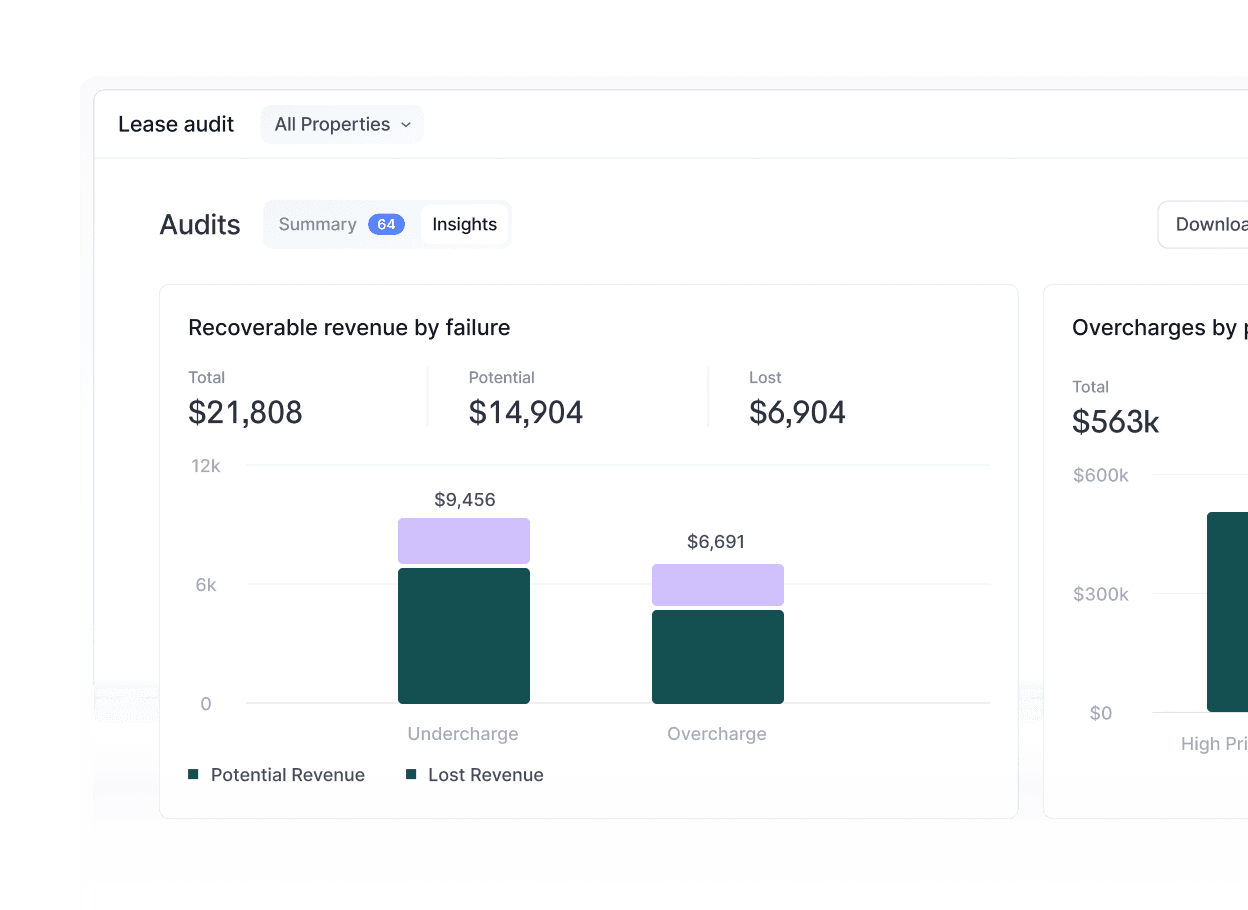
Moving From Reports to Exception-Based Risk Management
Traditional reporting tells leadership what has already happened. Risk management requires identifying what deserves attention next. Exception-based workflows bridge that gap.
A regional manager does not have to review every lease or resident file. Technology can identify records that do not match expected conditions:
- a lease amount that does not match the rent roll
- a required document that cannot be found
- a recurring charge that appears in the lease but not the PMS
- conflicting lease dates
- an unusual concession
Teams can then investigate those exceptions instead of searching manually across the portfolio.
This is where platforms such as SurfaceAI fit into a broader property risk management strategy. Examining lease documents alongside operational records surfaces inconsistencies early. Otherwise, those issues stay buried until an audit, acquisition, resident dispute, or financial review exposes them.
The value is not another dashboard. It is earlier visibility into operational signals that may represent financial or compliance risk.
For related workflows, see our guides to preventing lease revenue leakage and due diligence and compliance. For product context, see the SurfaceAI Lease Audit Agent and Document Management Agent →
Risk Management Automation: What to Automate and Why
The sections above describe technology that surfaces risk. It is worth being specific about what risk management automation actually means for a property portfolio, and where it delivers the most value.
Risk management automation is the use of software to continuously perform risk checks that teams would otherwise run manually and infrequently. Instead of a quarterly spreadsheet review, automated risk management runs the same checks constantly and flags only what falls outside expected conditions.
For multifamily operators, a few areas are the highest-value candidates to automate.
Data validation. Automatically compare lease terms against the rent roll, ledgers, and PMS records. This is where most operational and financial risk originates, and it is the most repetitive to check by hand.
Document completeness. Automatically scan resident files for missing leases, addenda, disclosures, and compliance records rather than discovering gaps during an audit.
Exception detection. Automate risk monitoring so the system continuously watches for records that do not match expected conditions, then routes those exceptions to the right person.
Compliance tracking. Automatically check that required documentation exists across the portfolio, so compliance risk is caught inside normal operations rather than during audit prep.
The goal of automated risk management is not to remove human judgment. It is to remove the manual searching that consumes it. When software handles continuous monitoring, teams spend their time evaluating the exceptions that actually matter rather than hunting for them across thousands of units.
That shift, from periodic manual review to continuous automated monitoring, is what lets a risk program scale with the portfolio instead of falling behind it.
Common Property Risk Management Mistakes
Even sophisticated operators weaken their risk programs through a few common mistakes:
- Treating risk as a once-a-year exercise. Annual reviews provide only a snapshot; operational risk changes continuously.
- Looking only at financial reports. Financial statements reveal the outcome of a problem rather than its source.
- Reviewing properties in isolation. Patterns are easier to spot when information is evaluated across the portfolio.
- Depending too heavily on manual checks. Manual processes become inconsistent as portfolios grow.
- Collecting risk data without acting on it. Reports only create value when findings lead to remediation.
- Treating every finding equally. Without prioritization, teams spend time on low-impact issues while significant risks go unresolved.
Property Risk Management Checklist
Use this framework as a starting point for portfolio reviews:
- Identify major financial risks
- Review operational processes for control gaps
- Assess lease and resident documentation completeness
- Validate key property data across systems
- Review compliance requirements
- Evaluate physical asset condition
- Assess current market exposure
- Score risks by likelihood and potential impact
- Assign an owner to material risks
- Establish appropriate controls
- Define escalation thresholds
- Monitor exceptions and trends
- Review whether existing controls remain effective
- Reassess portfolio risk regularly
Conclusion
Property risk management is not about predicting every problem that could affect a real estate asset. It is about creating enough visibility to recognize important risks early. Understand their impact, then respond before they become expensive.
For multifamily operators, that means looking beyond traditional financial and physical risk. Lease data, resident documentation, operating procedures, compliance records, and system inconsistencies all influence property performance. The strongest programs connect those signals across the portfolio and turn them into clear priorities.
If your team wants better visibility into lease, document, compliance, and revenue-related risks across multifamily properties, book a demo. SurfaceAI supports a more proactive approach to property risk management.
Frequently Asked Questions About Property Risk Management