
Best Property Data Solutions for Real Estate Investors

Real estate investors depend on data before they depend on a model.
A financial model can be sophisticated. But if the property data behind it is incomplete, outdated, or disconnected from operating reality, the analysis becomes unreliable.
That is why property data solutions have become a core part of the modern real estate investment stack.
Investors and acquisitions teams use real estate data platforms to evaluate markets and identify opportunities. Asset managers and operators use them to validate property records, assess risk, and support investment decisions.
But not every real estate data service solves the same problem.
Some providers focus on market data. Others focus on ownership records, property search solutions, rent comps, transaction history, tenant data, portfolio analytics, or operational intelligence.
This guide explains how to evaluate the best property data solutions for real estate. It covers the types of providers that exist. It also explains where SurfaceAI fits into the broader data and operational intelligence workflow.
For broader analytics context, see real estate reporting software for portfolio visibility →
Why Property Data Solutions Matter
Real estate decisions are only as strong as the information behind them.
Investors use data to answer questions such as:
- Which markets are worth pursuing?
- How does a property compare to similar assets?
- Are rent assumptions realistic?
- Who owns the property?
- What transactions have occurred nearby?
- What operating risks may affect performance?
- Is the rent roll supported by the lease records?
- Are there discrepancies that could affect underwriting?
The challenge is that real estate data is often fragmented.
Information may sit across:
- public records
- broker materials
- MLS or listing platforms
- property management systems
- lease files
- rent rolls
- operating statements
- market reports
- underwriting models
A strong real estate data platform organizes fragmented information into something teams can actually use. It turns scattered records into an informed decision.
Real estate technology has splintered into dozens of apps and platforms. Each one solves a single problem while creating more handoffs and data silos across the stack. Every problem got its own product. But nobody stopped to look at what the whole pile looked like from the outside.
According to HousingWire, this fragmentation is now hurting real estate transactions. The next wave of proptech is shifting toward consolidation and connected data infrastructure rather than more point solutions.

The Main Types of Real Estate Data Solutions
Not every real estate data provider belongs in the same category.
The right solution depends on the decision your team is trying to support.
1. Property Search Solutions
Property search solutions help teams identify and screen assets.
They may include:
- property ownership data
- asset characteristics
- transaction history
- parcel records
- assessed values
- location details
- market availability
- sales history
These tools are useful at the top of the investment funnel. Investors use them when sourcing opportunities or researching target markets.
2. Market Data Platforms
Market data platforms help investors understand supply, demand, pricing, and competitive positioning.
They may include data on:
- rent trends
- occupancy
- concessions
- new supply
- employment growth
- demographic shifts
- submarket performance
- comparable properties
This type of real estate data service is useful when teams evaluate whether a market supports the investment thesis.
3. Ownership and Transaction Data Providers
Some real estate data providers focus heavily on ownership records and transaction history.
These tools help teams identify:
- current owners
- prior sale dates
- sale prices
- portfolio ownership structures
- refinancing events
- potential acquisition targets
- foreclosure data
Investors, brokers, and business development teams use these tools to build acquisition pipelines. They support bulk data queries and large scale property research.
4. Investment and Underwriting Data Platforms
Investment-focused data platforms help teams analyze properties financially.
They may support:
- revenue assumptions
- expense benchmarking
- cap rate analysis
- comparable transactions
- debt assumptions
- valuation modeling
- sensitivity analysis
These platforms become especially valuable when paired with internal operating data.
For related investment workflows, see real estate investment property analysis →
5. Operational Data and Intelligence Solutions
Operational data solutions help teams validate what is happening inside the property.
This includes data from:
- lease documents
- rent rolls
- PMS records
- ledgers
- resident files
- compliance documents
- billing data
This category is especially important for multifamily investors and operators because operating records directly affect NOI, reporting accuracy, and post-close execution.
This is where SurfaceAI fits most naturally.
What Makes the Best Property Data Solutions for Real Estate?
The best property data solutions are not simply the ones with the largest databases.
They are the ones that help teams make better decisions.
A strong platform should improve at least one of the following:
- sourcing
- market analysis
- underwriting confidence
- operational visibility
- risk identification
- portfolio monitoring
- investment execution
The most valuable data solutions are practical, accurate, and tied to real workflows.
How to Evaluate a Real Estate Data Platform
Data Coverage
Coverage matters.
Teams should evaluate whether the platform includes the markets, asset classes, and data categories they need.
For example, a multifamily investor may need different data than a commercial broker, developer, or single-family investor. Commercial real estate data has different structures than residential property information.
Useful coverage may include:
- property records
- ownership data
- transaction history
- rent comps
- demographic data
- operating data
- lease-level data
- market trends
Data Accuracy
Data coverage is not enough. The data needs to be reliable.
Investors should ask:
- How often is the data updated?
- What are the original data sources?
- Can the platform identify stale records?
- Can users validate property-level information?
- Does the system reconcile conflicting data?
Bad data creates false confidence.
Workflow Fit
A real estate data platform should support the way the team actually works.
For investors, this may include:
- property search
- deal screening
- underwriting
- due diligence
- portfolio review
- asset management reporting
For operators, this may include:
- lease audits
- compliance monitoring
- document review
- rent roll validation
- operational reporting
The best real estate data solutions connect directly to the workflows where decisions are made.
Integration Capabilities
A strong real estate data solution should not create another silo.
Teams should evaluate whether the platform can connect with:
- property management software
- CRMs
- underwriting tools
- reporting dashboards
- document systems
- accounting platforms
Integration is especially important when teams need to compare external market data with internal operating data.
Risk Identification
Property data should help teams identify risk earlier.
Examples include:
- ownership complexity
- market softness
- unrealistic rent assumptions
- inconsistent operating records
- lease discrepancies
- compliance gaps
- missing documents
- revenue leakage
Risk identification is where data becomes operationally useful.
Market conditions have been more volatile over the last two years. What was true a quarter ago or even a month ago for the value of a property may not be true today. That leaves fund managers with an outdated view of their assets.
According to Altus Group, stale, inconsistent, or incomplete property data is one of the top three hurdles in real estate valuation. The quality of data used to make an investment decision can strongly impact the business outcome.
Real Estate Data Providers vs Internal Operating Data
External real estate data providers are useful for market intelligence, sourcing, and benchmarking.
But external data only tells part of the story.
Internal operating data shows what is actually happening inside the asset.
That includes:
- active lease terms
- billing records
- resident files
- concessions
- recurring charges
- rent roll accuracy
- compliance status
- document completeness
For investment teams, both types of data matter.
External data helps evaluate market opportunity. Internal operating data helps validate asset quality.
Why Property Data Must Connect to Investment Decisions
A property data solution should not simply create more dashboards.
It should support better decisions.
Examples:
- Property search data helps identify acquisition targets.
- Market data helps test rent growth assumptions.
- Transaction data helps benchmark pricing.
- Operational data helps validate income quality.
- Lease data helps identify revenue leakage or compliance risk.
When these data categories remain disconnected, teams may make decisions with partial visibility.
That is why the strongest real estate data platforms increasingly focus on connecting data to action.
Where SurfaceAI Fits in Real Estate Data Solutions
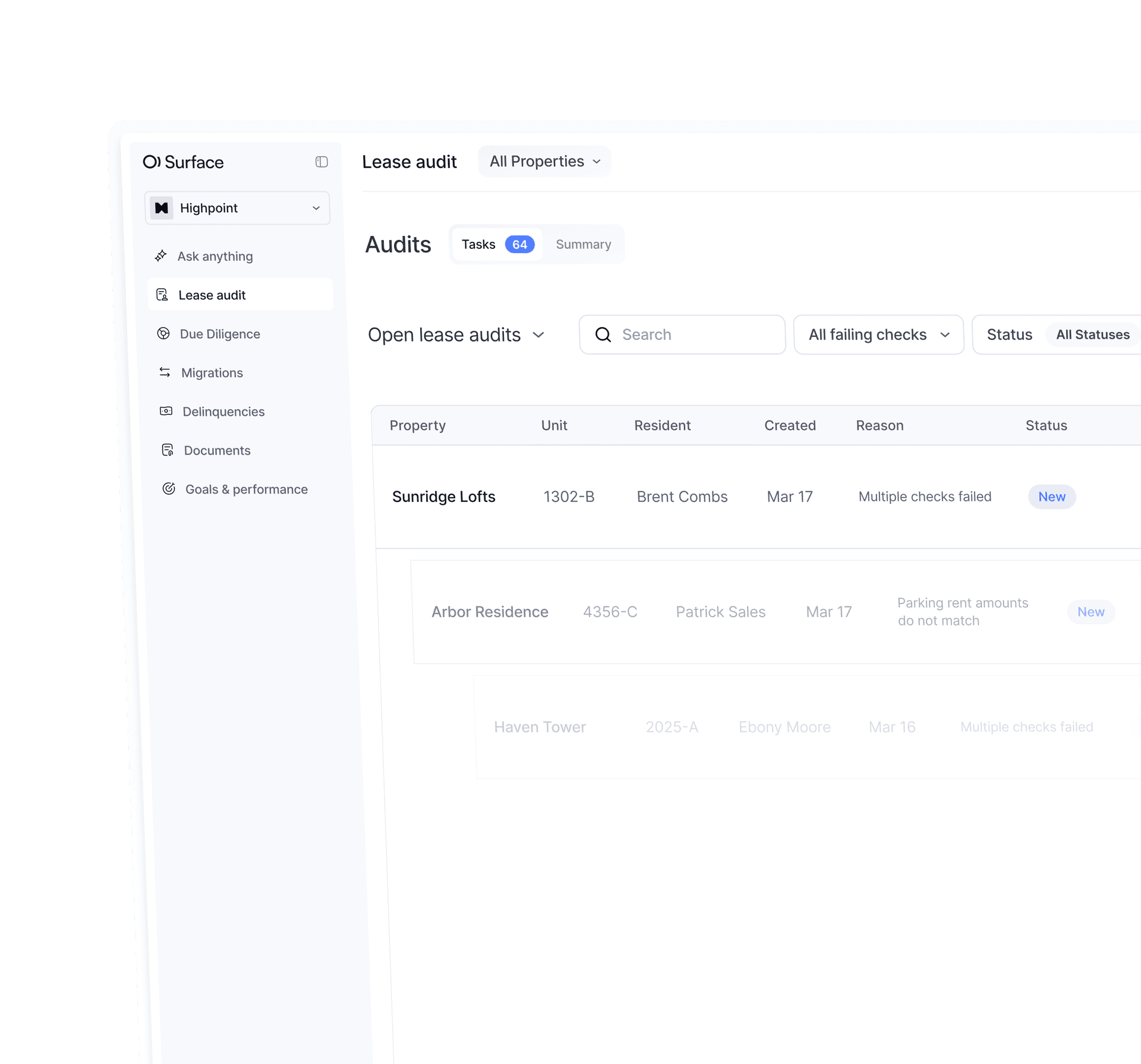
SurfaceAI supports the operational data and intelligence layer for multifamily real estate.
SurfaceAI is not a generic property search solution or market data provider. It helps teams validate the internal operating data that supports investment and management decisions.
SurfaceAI helps multifamily teams:
- analyze lease documents at scale
- compare lease terms against rent rolls and PMS records
- identify missing or inconsistent documents
- detect revenue leakage
- surface compliance gaps
- support acquisition due diligence
- improve portfolio-level operating visibility
This matters because many investment decisions depend on whether the asset’s internal records are accurate.
A market data platform may tell you what rents should be. SurfaceAI helps validate whether the property is actually billing and operating according to the lease records.
For product context, see the SurfaceAI Due Diligence Agent and Lease Audit Agent →

“This AI just works like magic, every time. Our teams are no longer in the dark after a takeover and can find everything they need in the PMS.”
Emily Carter, VP Operations
Property Search Solutions Are Only the Starting Point
Property search solutions help investors find opportunities.
But finding a property is only the beginning.
After identification, teams still need to evaluate:
- market assumptions
- rent roll accuracy
- lease quality
- operating expenses
- tenant records
- compliance exposure
- post-close execution risk
This is where property data solutions need to support the full investment lifecycle.
A strong data stack helps teams move from search to analysis to diligence to operation.
How Data Quality Affects Real Estate Investment Analysis
Real estate investment analysis depends heavily on data quality.
If rent, lease, expense, or occupancy data is wrong, the model may be wrong.
Common issues include:
- outdated rent rolls
- missing lease documents
- undocumented concessions
- billing discrepancies
- duplicate records
- incorrect unit status
- incomplete ledgers
- inconsistent resident data
These issues can affect NOI, valuation, debt assumptions, and post-close performance.
For a deeper investment analysis workflow, see real estate investment analysis tools. Also see our guide to AI tools for property investment analysis →
Common Mistakes When Choosing Real Estate Data Solutions
Choosing coverage without checking accuracy. A large database is not useful if the data cannot be trusted.
Using market data without asset-level validation. Market data can support assumptions, but operating data validates whether the property supports the model.
Treating data platforms as standalone systems. Data should flow into sourcing, underwriting, diligence, reporting, and asset management workflows.
Ignoring internal records. External data is valuable, but internal lease and operating records often reveal the most important risks.
Overvaluing dashboards. Dashboards are useful only if they lead to better decisions.
Property Data Solution Evaluation Checklist
When evaluating real estate data solutions, teams should ask:
- What asset classes does the platform support?
- Which markets are covered?
- How often is the data updated?
- What are the source records?
- Can data be validated?
- Does the platform integrate with existing workflows?
- Does it support property search, underwriting, or operations?
- Can it identify risks or only display records?
- Does it connect external market data with internal operating data?
- Can it scale across a portfolio?
This helps teams choose analytics tools based on decision quality rather than software visibility alone.
Key Takeaway
The best property data solutions for real estate are not just databases.
They help investors and operators make better decisions.
Strong real estate data solutions support property search, market analysis, underwriting, due diligence, asset management, and operational visibility.
For multifamily teams, the most valuable data stack combines external market intelligence with internal operating data validation.
Conclusion
Real estate data platforms are becoming essential for investors, operators, and asset managers.
But data only creates value when it improves decision-making.
The strongest property data solutions help teams identify opportunities, validate assumptions, surface risks, and connect property-level information to investment and operational workflows.
Book a demo to see how SurfaceAI helps turn property data into operational intelligence. See how it improves visibility into lease accuracy, rent roll quality, and operational risk across multifamily assets.
Frequently Asked Questions About Property Data Solutions for Real Estate Investors