How to Automate Multifamily Property Operations in 2026
Property management automation is becoming a core operating requirement for multifamily portfolios.
For years, operators have used software to manage leasing, accounting, maintenance, resident communication, and reporting. But many of the most important operational workflows still depend on manual review, spreadsheets, email threads, and disconnected systems.
That creates a major problem.
The most expensive issues in multifamily operations are often not caused by a lack of software. They are caused by gaps between systems.
Examples include:
- leases that do not match rent rolls
- fees that are approved but not billed
- missing documents during property takeovers
- compliance issues that are found too late
- acquisition data that does not align with operating records
- teams manually checking the same information across multiple platforms
The next phase of property management automation is not about replacing the property management system. It is about adding intelligent workflows around it.
For broader automation context, see how multifamily teams approach AI automation →
Why Multifamily Property Operations Need Automation
Multifamily teams are expected to manage more complexity with leaner teams.
Operators are dealing with:
- larger portfolios
- more multifamily acquisitions and transitions
- more resident documentation
- stricter regulatory compliance requirements
- more fragmented technology stacks
- higher expectations from ownership and asset management teams
Many operational processes still rely on people manually reviewing data across systems. That creates risk in four areas.
Revenue leakage. Revenue can be lost when charges, concessions, renewal terms, or fees are not reflected correctly in the PMS. That directly affects cash flow.
Compliance gaps. Missing documents, incomplete addenda, incorrect lease terms, or inconsistent records create compliance risk and legal exposure.
Transition delays. During multifamily acquisitions, onboarding and property takeovers often require thousands of documents to be reviewed, classified, matched, and uploaded.
Reporting inaccuracy. Portfolio-level reporting depends on accurate property-level data. If the source data is wrong, leadership decisions are affected.
Property management automation helps reduce these risks. It turns manual review into repeatable, software-supported workflows that reduce human errors and save time.
Automation ROI is measurable. In leasing alone, a 2.9-day reduction in days to move-in translates to roughly $110 per unit in recovered NOI.
According to Yardi, the impact compounds across a large portfolio. Gains in collections, retention, and fraud prevention add to the total. AI-powered automation is closing the gap between portfolio strategy and day-to-day operational execution.
What Property Management Automation Actually Means
Property management automation uses software to reduce manual work, standardize workflows, and improve operational accuracy across property operations.
In multifamily, this can include automation across:
- lease audit workflows
- document management
- resident file organization
- compliance monitoring
- rent roll reconciliation
- acquisition due diligence
- PMS updates
- operational reporting
- exception routing
- vendor management
The most effective automation does not simply move tasks faster. It improves control.
Teams can identify issues earlier, route exceptions to the right people, and maintain better visibility across the portfolio. An automated system that maintains clear audit trails also makes it easier to trigger corrective actions when discrepancies appear.
Start With the Workflows That Create the Most Risk
Not every workflow should be automated first.
Multifamily operators should prioritize workflows where manual review creates the most operational exposure.
The highest-impact areas are usually:
- lease audits
- acquisition document workflows
- takeover file organization
- compliance monitoring
- rent roll validation
- PMS data accuracy
- revenue leakage detection
These workflows are high-volume, document-heavy, and difficult to manage manually at scale. They are also time consuming when handled by hand.
Step 1: Automate Lease Audit Workflows
Lease audits are one of the clearest use cases for property management automation.
Traditional lease audits are often:
- periodic
- sample-based
- spreadsheet-driven
- dependent on manual review
- difficult to scale across portfolios
That creates gaps.
A lease may contain one rent amount, while the PMS shows another. A concession may be documented but not reflected properly. A recurring fee may be missing. Renewal dates may not align.
Modern lease audit tools automate the comparison between lease agreements, addenda, and rent rolls. They also compare PMS records, billing data, and resident records.
The goal is to identify discrepancies before they affect revenue, compliance, or reporting.
Automated lease audits are especially valuable for stabilized portfolios, recent acquisitions, property transitions, and operators managing large document volumes.
For a deeper audit framework, see automated lease audits to find revenue leaks →
Step 2: Automate Takeover Document Workflows
Multifamily acquisitions create a major document operations challenge.
When a property changes ownership or management, teams may need to process thousands of files. These include leases, addenda, resident records, and compliance documents. Applications, renewals, notices, and supporting documentation round out the volume.
Manual document handling can slow transitions and create errors during onboarding.
Document automation helps teams:
- classify files
- match documents to residents or units
- identify missing documents
- organize lease packages
- support PMS upload workflows
- reduce manual file review
This matters because property takeovers are time-sensitive. If teams do not organize documents quickly, visibility suffers across the board. Onsite teams, regional managers, compliance teams, and asset managers all operate with incomplete information. Automated workflows here also produce cleaner audit trails for post-close reference.
For related workflows, see document workflow automation for real estate →
Step 3: Connect Automation to Property Management Software Integration
Automation only works if it connects to the systems teams already use.
This is where property management software integration becomes critical.
Most multifamily operators rely on PMS platforms to manage rent rolls, resident records, and lease data. They also use them for billing, accounting workflows, and operational reporting.
Automation should work alongside these systems, not create another disconnected layer.
The strongest property management automation workflows integrate with existing systems so teams can:
- validate PMS data
- identify mismatches
- update workflows faster
- reduce duplicate entry
- improve reporting confidence
- maintain operational continuity
This is especially important in portfolios using platforms such as Yardi, RealPage, MRI, or Entrata. Cloud based automation tools are usually easier to integrate cleanly with these systems.
The PMS remains the system of record. Automation becomes the system of review, validation, and operational intelligence around it.
Step 4: Add Real-Time Compliance Monitoring
Compliance monitoring is one of the most important areas for automation.
In many multifamily portfolios, compliance issues are discovered too late because review is periodic or reactive.
Automated compliance monitoring helps teams identify:
- missing lease documents
- incomplete addenda
- incorrect lease terms
- expired concessions
- inconsistent resident records
- missing required disclosures
- billing discrepancies tied to lease terms
Instead of waiting for an audit, compliance teams can monitor exceptions continuously. This ensures consistency across the portfolio and helps ensure compliance without adding review headcount.
The workflow shifts from reactive cleanup to proactive oversight. That shift also supports better risk assessment because issues are surfaced with enough time for corrective action.
For a detailed setup framework, see lease compliance monitoring setup for multifamily →
Step 5: Use Exception-Based Review
One of the biggest mistakes in property management automation is trying to review everything the same way.
That is not scalable.
A better model is exception-based review. The system identifies the issues that require human attention, such as:
- high-value rent discrepancies
- missing charges
- incomplete lease files
- compliance exceptions
- conflicting lease and PMS data
- acquisition diligence findings
Then teams focus on resolving exceptions instead of manually checking every file. Property managers, compliance teams, and asset managers spend less time searching for issues. They spend more time resolving them. This drives improved efficiency across the portfolio.
Exception-based workflows are especially valuable during multifamily acquisitions, where speed and accuracy both matter.
For acquisition-related triage, see how to prioritize lease due diligence findings fast →
Property operations run on hundreds of daily tasks. Move-outs, lease renewals, ledger updates, lease audits, account adjustments, and exception tracking all pile up. Most operations teams are stretched thin managing repetitive work.
RealPage reports that AI-powered operations agents automate the backbone of day-to-day property management. They surface exceptions early, maintain compliance, and free teams to focus on higher-value oversight rather than routine review.
Step 6: Connect Acquisition Workflows to Operations
Multifamily acquisitions often create a gap between diligence and operations.
During diligence, teams review leases, rent rolls, documents, and financial assumptions. After closing, operations teams inherit the asset and need to manage the property based on that information.
If diligence findings do not transfer cleanly into operations, risks can be missed.
Property management automation helps connect:
- acquisition review
- lease audit findings
- document organization
- PMS setup
- compliance monitoring
- post-close operating workflows
This creates continuity from acquisition to operation. For multifamily operators, this is where automation becomes more than efficiency. It becomes a control layer across the asset lifecycle that supports long term operational reliability.
Step 7: Build a Portfolio-Level Automation Framework
Automation should not be implemented property by property without a broader operating model.
Portfolio managers should define four things.
Which workflows should be automated? Examples include lease audits, document intake, compliance monitoring, and rent roll validation.
Which systems need to connect? This may include the PMS, document storage, accounting systems, reporting tools, and operational intelligence platforms.
Who owns each exception? Findings should route clearly to property management, compliance, accounting, asset management, or acquisitions teams.
How will performance be measured? Useful metrics include discrepancies found, revenue leakage identified, documents processed, compliance exceptions resolved, time saved during transitions, and audit backlog reduction.
This helps automation become operational infrastructure rather than a one-off software project. It also reduces the risk of missing issues that would otherwise fall between teams.
Where SurfaceAI Fits in Property Management Automation
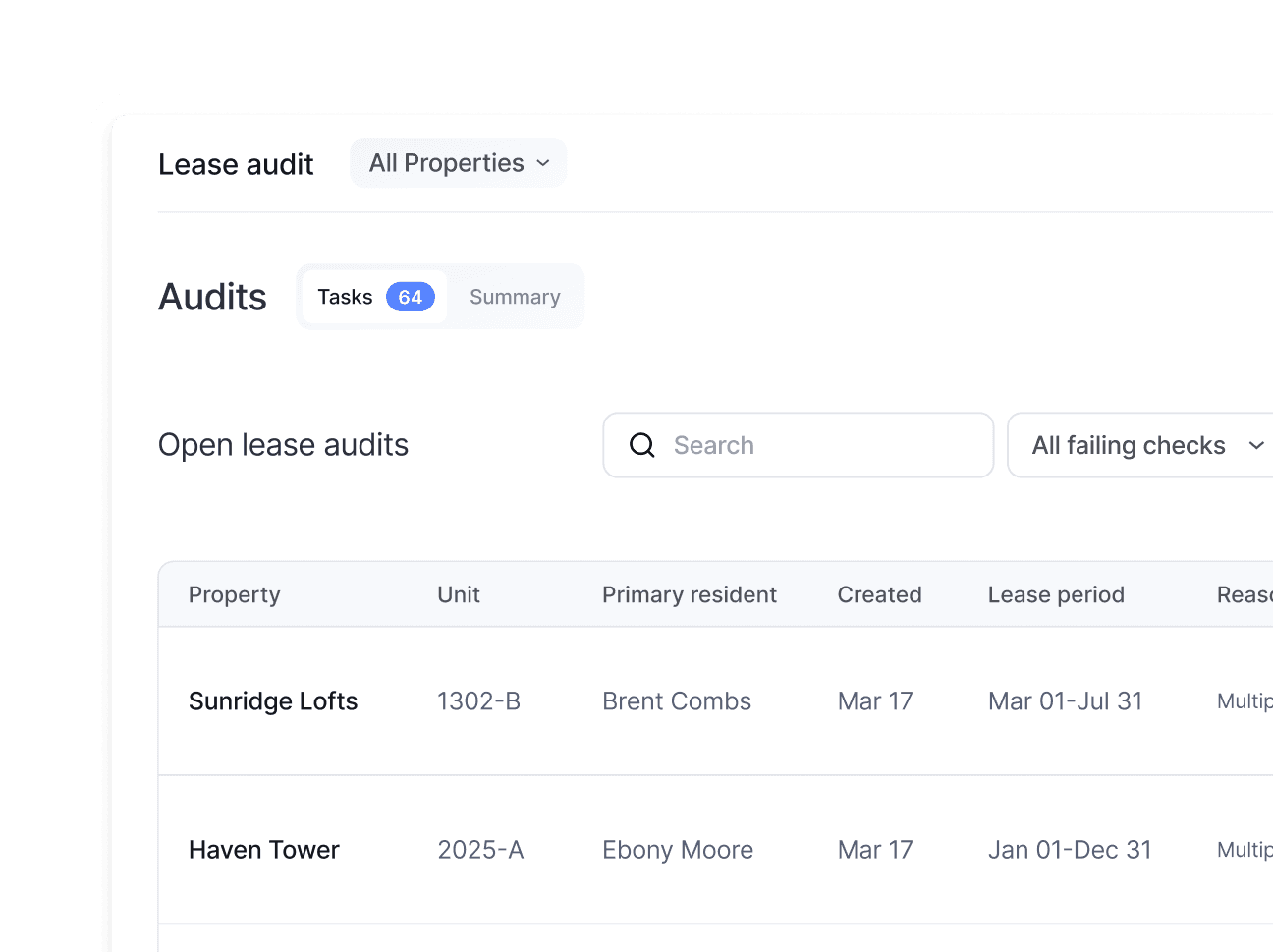
SurfaceAI fits into property management automation as an operational intelligence and validation layer for multifamily portfolios.
SurfaceAI does not replace the PMS. It works alongside existing systems to help teams automate high-value review workflows, including:
- lease audits
- rent roll validation
- document classification
- takeover document workflows
- compliance monitoring
- acquisition due diligence
- revenue leakage detection
- exception-based review
SurfaceAI compares lease documents, PMS data, rent rolls, and supporting records. It surfaces discrepancies that manual review may miss.
This is especially valuable for operators managing large portfolios, frequent acquisitions, or complex compliance workflows.
For product-specific context, see the SurfaceAI Lease Audit Agent and the SurfaceAI Due Diligence Agent →

“This AI just works like magic, every time. Our teams are no longer in the dark after a takeover and can find everything they need in the PMS.”
Emily Carter, VP Operations
What to Avoid When Automating Property Operations
Automating broken workflows. Automation works best when the underlying workflow is clearly defined. If a process is inconsistent across properties, automation may amplify that inconsistency.
Creating another data silo. Automation should connect to existing systems, not create another disconnected reporting layer.
Ignoring change management. Teams need clear ownership, training, and escalation workflows.
Measuring only time savings. Time savings matter. But the bigger value may come from revenue recovery, compliance control, and improved reporting accuracy.
Treating automation as a PMS replacement. The PMS remains central. Automation should enhance it.
Key Takeaway
Property management automation in 2026 is not just about reducing manual tasks.
It is about creating a more reliable operating model across multifamily portfolios.
The highest-value automation connects:
- lease audit tools
- document automation
- property management software integration
- compliance monitoring
- acquisition workflows
- operational intelligence
This helps teams reduce risk, improve accuracy, and scale operations without relying on manual review at every step.
Conclusion
Multifamily operations are becoming too complex for disconnected manual workflows.
Operators need automation that works alongside property management systems, validates operational data, and surfaces exceptions before they become costly.
The strongest property management automation strategies connect lease audits, takeover document workflows, compliance monitoring, and acquisition processes into one continuous operating model.
Book a demo to see how SurfaceAI supports smarter property management automation. See how it automates lease reviews, document workflows, compliance monitoring, and operational oversight across your portfolio.
Frequently Asked Questions On How to Automate Multifamily Property Operations