
Lease Audits Shouldn’t Be Occasional: Why Continuous Oversight Protects Your NOI
Periodic lease audits are standard practice in multifamily operations, but they no longer meet the demands of institutional ownership or the speed at which financial discrepancies emerge. Inaccuracies in lease data and rent rolls are among the most common and overlooked sources of revenue leakage in real estate portfolios.
Continuous auditing, a process that integrates real-time monitoring of lease data against financial systems, is gaining traction as a way to reduce NOI loss, mitigate compliance risk, and build trust with investors.
This article explores why traditional audits fall short, how continuous oversight improves performance, and what operators must do to implement it successfully.
How do automated lease audit tools catch compliance issues in real time? Automated lease audit tools catch compliance issues in real time by comparing executed lease documents against the rent roll and ledger continuously. They flag discrepancies the moment they appear, then route each exception to the right team for resolution.
Lease Errors Are More Common, and More Expensive, Than Most Realize
Most multifamily operators view lease audits as a one-time project, usually done annually or just before a transaction. Yet across the industry, evidence shows that lease discrepancies are a recurring, not occasional, problem. In a 2023 industry survey, 60 percent of respondents reported encountering lease or rent roll mismatches monthly, and another 40 percent said they found them quarterly. These errors range from misapplied fees to incorrect lease terms, and while individually small, they compound across portfolios.
For an owner managing 5,000 units, even a $25 monthly undercharge due to missed lease escalations results in $1.5 million in annualized revenue loss. What’s more, the longer these errors go undetected, the more difficult they are to correct retroactively. Standard auditing practices simply do not catch these issues in time to protect NOI.
Traditional Audits Are Inherently Reactive
The process of manual lease audits typically involves reviewing a small sample of leases, comparing them to property management system records, and flagging any deviations. This approach suffers from two critical limitations. First, it is backward-looking. By the time errors are found, months of under-billing or mischarges may have already passed. Second, it is incomplete. Sampling only identifies a subset of issues, leaving most discrepancies untouched.
As institutional investors and lenders demand more transparent, real-time financial reporting, reliance on infrequent and manual audits creates operational and reputational risks. Financial integrity is no longer just an accounting concern. It is an asset management imperative.
Capability |
Manual Audits |
PMS Reports |
Continuous Auditing |
|---|---|---|---|
| Coverage | A sample of leases | Whatever is in the ledger | Every lease, every unit |
| Checks against the source lease | Yes, but only for the sample | No, checks the ledger against itself | Yes, on every unit |
| Timing | Periodic, backward-looking | On a reporting schedule | Continuous, in real time |
| Catches missing charges | Only if in the sample | No, cannot see an absence | Yes |
| Speed to detection | Months | Until the next report | Days |
| Consistency | Varies by reviewer | Consistent, but incomplete | Same rules on every unit |
Why Revenue Leaks Persist Despite PMS Reports
Operators often assume a clean PMS report means clean books. It does not. A property management system report checks the ledger against itself, not against the source lease. So if no one entered a charge, the report shows no problem. The error is an absence, not a mistake.
That blind spot is where revenue leaks live. A missing fee, an expired concession still applied, a rent that does not match the lease, a mismatch between systems. None of these show up in a report that only sees the ledger. Our guide to why lease audits miss revenue leaks covers this in depth. Our breakdown of lease to ledger errors explains how the gap forms.
What Continuous Auditing Offers
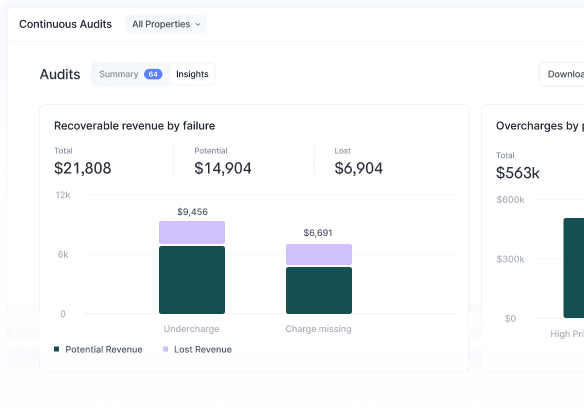
Continuous lease auditing shifts from event-based review to ongoing verification. By cross-checking executed lease documents, rent rolls, and financial ledgers in real time, operators can identify discrepancies as they occur. This approach delivers three measurable benefits.
- Immediate Revenue Recovery
Instead of waiting for year-end audits to discover missed pet rent, expired concessions, or incorrect renewal rates, continuous systems catch issues in days or weeks. In one midsize portfolio, operators recovered more than $180,000 in lost charges across just 3,000 units within the first quarter of implementation. - Compliance Risk Mitigation
Rent mischarges can lead to legal exposure, especially in jurisdictions with rent control or disclosure requirements. Continuous auditing creates a traceable, real-time log of billing accuracy, which not only reduces the risk of fines but also builds defensible audit trails for regulators and lenders. - Operational Accountability
Frequent error detection shortens feedback loops between corporate teams and on-site staff. When a lease is entered incorrectly, leasing teams receive immediate notice and can fix it before the error impacts reporting or tenant satisfaction. Over time, this leads to fewer mistakes and stronger operational discipline.
How Automated Lease Audit Tools Catch Issues
Continuous auditing works because automated tools do the checking that manual review cannot sustain. Four capabilities make it work.
Rule checks. The tool applies a defined set of rules to every lease. It checks whether a charge matches the lease, whether a concession has expired, and whether an escalation went through. It runs these checks on every unit, not a sample.
Document comparison. Rather than trusting the rent roll, the tool reads the executed lease and compares its terms against the ledger. This is where it catches the errors a system-only report misses.
Real-time alerts. When a check fails, the tool flags the specific unit and the specific discrepancy. The alert reaches the team in days, not at the next quarterly review.
Exception routing. Each flagged issue goes to the right owner, whether leasing, operations, or finance, with a clear record of what needs fixing. Nothing sits in a report waiting for someone to notice it.
The Impact on Investor Confidence
Investors evaluate multifamily performance based on the reliability of financial forecasts and the predictability of cash flows. Rent roll accuracy directly informs both. Operators who maintain clean, real-time records project credibility and control, two qualities that resonate with institutional capital.
In some recent CMBS transactions, underwriters have begun requesting automated audit histories as part of the diligence process. These audit trails provide independent verification that rent collections match lease agreements. As real estate financing continues to institutionalize, continuous auditing is likely to become an underwriting requirement, not just a best practice.
Why Manual Lease Auditing Breaks Down
Manual auditing works on a small property. At portfolio scale, it breaks down for four reasons.
Sampling. A manual review checks a slice of leases and hopes it represents the whole. Systematic errors hide in the units no one opened.
Delay. By the time a manual audit finds an error, months of mischarges may have passed. The review is backward-looking by design.
Inconsistency. Different reviewers apply different standards, so the result depends on who did the checking.
Staffing. There are never enough hours to check every lease by hand, so teams cut the review short under deadline pressure.
Implementing Continuous Lease Oversight
For operators looking to transition to continuous auditing, follow four steps.
- Sync your data sources. Most discrepancies stem from misalignment between lease systems, rent rolls, and ledgers. Make sure these sources are clean, synchronized, and labeled consistently before you start.
- Define the audit rules. Manual reviews are impractical at scale. Define common error types, such as missed escalations or uncollected amenity fees, and build audit logic to flag them automatically.
- Route the alerts. Send each flagged discrepancy to the right owner in leasing, operations, or finance, so nothing waits in a report.
- Track resolution. Continuous auditing only creates value if discrepancies get resolved quickly. Assign clear ownership and set response-time expectations.
What Operators Should Do Next
Multifamily executives focused on long-term asset performance should reframe lease auditing from a back-office task to a strategic control function. Instead of asking whether lease audits are up to date, ask whether your system is capable of identifying today’s errors as they occur. Investors, regulators, and stakeholders increasingly expect real-time financial accountability. Continuous auditing is no longer a luxury, it is the next operating standard.