
The Complete Guide to Lease to Ledger Errors

A lease says one thing. The ledger says another. On a single unit, that gap is easy to miss. Across a portfolio, it quietly drains revenue and creates compliance risk month after month.
These lease to ledger errors are one of the most persistent problems in multifamily operations. What makes them frustrating is that they survive the systems meant to catch them. Property management software runs its reports, the numbers reconcile internally, and the report comes back clean. Meanwhile the lease and the ledger still disagree.
This guide explains what lease to ledger errors are and why they persist despite property management software reports. It also shows how continuous lease to ledger reconciliation closes the revenue and compliance gaps they create.
What Are Lease to Ledger Errors?
A lease to ledger error is any mismatch between the lease and the ledger. The lease says what a resident owes.
The ledger records what the system actually bills. The lease is the contract; the ledger is the record of charges. When they disagree, the ledger is usually wrong, and the portfolio usually loses the revenue.
Common lease to ledger errors include:
- a recurring charge in the lease that never reached the ledger
- a rent amount that does not match the signed lease
- a concession still applied after its end date
- a fee or reimbursement the lease requires but the ledger omits
- an amendment that changed terms without updating the ledger
Each of these is small on its own. But a single missed charge repeated across hundreds of units becomes real money.
Small discrepancies in property data can have a meaningful effect on rental income and asset value. The Appraisal Institute of Canada provides an example where inaccurate rentable-area information translated into roughly $600,000 in lost rental revenue over five years and nearly $1.4 million in lost property value, illustrating how seemingly minor operational data errors can compound financially. See the Appraisal Institute of Canada’s analysis of rental data accuracy and property value.
That is why lease to ledger errors matter to portfolio managers, even when each individual error looks trivial.
Why These Errors Persist Despite PMS Reports
Here is the part that frustrates operators most. Property management software produces reports, teams review them, and the errors still survive. Why?
The answer is what the reports actually check. A PMS report validates the ledger against itself. It confirms the recorded charges are internally consistent, that the math adds up, that the report reconciles. What it does not do is compare the ledger against the source lease.
So if no one entered a charge, the report shows no problem. There is nothing in the ledger to flag, because the error is an absence, not a mistake.
- The lease says the charge exists.
- The ledger does not know it should.
- The report only sees the ledger, so it sees nothing wrong.
This is the blind spot. Lease report accuracy is not the same as lease to ledger accuracy. A report can be perfectly accurate about the ledger and still miss the real errors.
Those are the ones where the ledger disagrees with the lease. For a fuller look at this gap, see our guide to why lease audits miss revenue leaks →
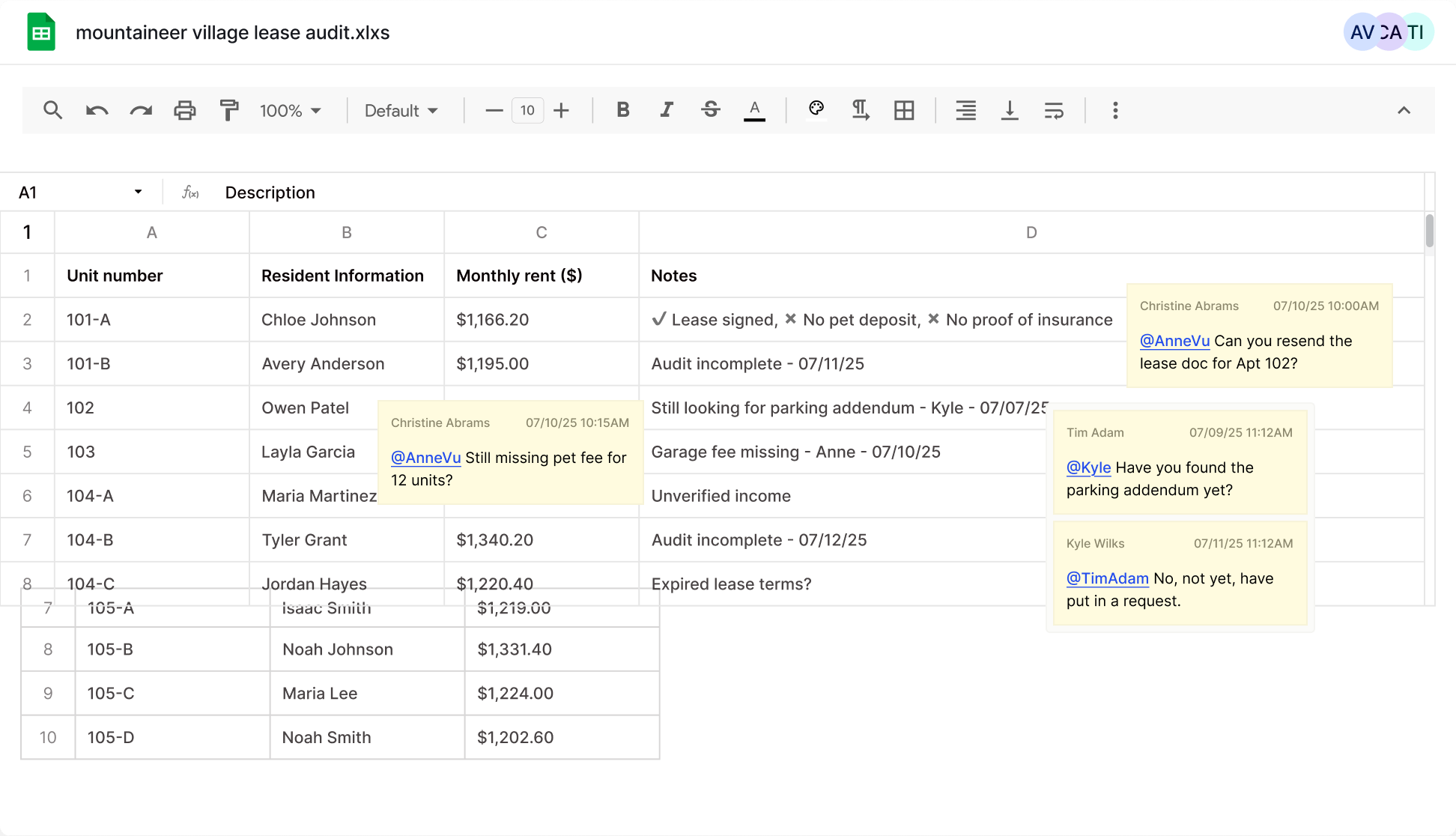
Why Manual Auditing Does Not Close the Gap
The obvious fix is to compare leases against the ledger by hand. And that works, until it meets scale.
Manual lease auditing means a person opening each lease, reading the terms, and checking them against the ledger line by line.
On a small property, a team can do this. Across thousands of units, it breaks down. There are not enough hours, so teams sample. They check a slice and hope it represents the whole.
But lease to ledger errors do not spread evenly. One process or one system migration can introduce a billing error.
That error can affect hundreds of units while never appearing in a small sample. So manual auditing catches the errors it happens to look at and misses the rest. The gap stays open.
Manual review also drifts. Different reviewers apply different standards. One flags a small rent discrepancy, another lets it pass.
The result depends on who did the reviewing, which means rent and lease compliance becomes inconsistent across the portfolio. Our breakdown of why manual lease audits miss compliance risks covers this in detail.
How Continuous Lease to Ledger Reconciliation Works
The fix is not a better report or more manual review. It is continuous lease to ledger reconciliation. This means comparing every lease against the ledger, automatically, and doing it continuously rather than once a quarter.
Continuous reconciliation works in a few steps.
- It reads the executed lease. The system extracts the terms that matter, including rent, recurring charges, concessions, fees, and dates.
- It compares them against the ledger. The system checks every lease term against what the ledger actually bills, across the full portfolio, not a sample.
- It flags the exceptions. Where the lease and ledger disagree, the system surfaces the mismatch. The team sees the specific units and the specific gaps.
- It runs continuously. The check runs constantly instead of quarterly. A new error surfaces days after it appears, not months later.
This is revenue leakage detection done right. It compares the lease to the ledger directly and never assumes the ledger is correct. So it catches the charge no one entered, the concession that outlived its term, and the rent that does not match.
What Continuous Reconciliation Protects
Closing the lease to ledger gap protects two things that matter to every portfolio manager.
Revenue. Every uncollected charge is revenue the portfolio earned but never received. Continuous reconciliation recovers it by catching the gap early, before months of billing pass. Across a large portfolio, that recovery is significant.
Compliance. Lease to ledger errors are not just financial. A ledger that does not match the lease creates exposure in an audit or a resident dispute. When the records agree, the portfolio stays audit-ready. When they drift, every gap is a potential problem. Strong rent and lease compliance depends on the lease and the ledger telling the same story.
Together, revenue protection and compliance are why lease to ledger reconciliation is worth doing continuously rather than occasionally.
Where This Fits in Multifamily Operations
Lease to ledger reconciliation is one part of a broader validation discipline in multifamily property management. During acquisitions, teams run a similar check comparing the rent roll to the leases before they buy. Our guide to rent roll to lease reconciliation covers that acquisition-stage version.
The difference is timing. Rent roll reconciliation is a point-in-time check at a transaction. Lease to ledger reconciliation is ongoing, protecting revenue and compliance through daily operations. A strong operation does both: validate at acquisition, then keep validating continuously after close.
The tools that support this are worth comparing. Our guide to lease audit software vs lease management software explains the difference. One kind of system administers leases; the other validates them.

How SurfaceAI Closes the Lease to Ledger Gap
AI-driven monitoring allows audit and control processes to move beyond periodic sampling toward continuous, full-population validation. ISACA explains that AI can analyze entire datasets in near real time, flag anomalies and control failures, and support continuous assurance rather than relying solely on retrospective sample-based reviews. See ISACA’s analysis of AI-driven continuous auditing and controls testing.
SurfaceAI is built to close exactly this gap. It does not replace the property management system. It validates the data the system holds against the source leases.
SurfaceAI reads every lease and compares the terms against the ledger and rent roll. It surfaces the discrepancies that represent lost revenue or compliance risk. It runs continuously, not quarterly, so a lease to ledger error surfaces as soon as it appears. And it applies the same rules to every unit, so the check stays consistent across the whole portfolio.
For portfolio managers, that means the lease and the ledger finally agree, and stay in agreement. No more errors surviving a clean PMS report. No more relying on a sample. Just accurate records, protected revenue, and a portfolio that stays audit-ready.
Conclusion
Lease to ledger errors persist because the systems meant to catch them are looking in the wrong place. A PMS report checks the ledger against itself, not against the lease. Manual auditing cannot keep pace at scale. So the gap between the lease and the ledger stays open, quietly draining revenue and building compliance risk.
Continuous lease to ledger reconciliation closes it. It compares every lease against the ledger, continuously and automatically. So it catches the errors a report misses and a sample overlooks. For multifamily portfolio managers, that is the difference between records that look clean and records that actually are.
If your team wants the lease and the ledger to finally agree, book a demo to see how SurfaceAI closes the gap.
Frequently Asked Questions About Lease to Ledger Errors