
Multifamily Takeover Documents Guide for 2026

Multifamily property acquisitions do not fail because teams missed one folder. Risk appears when lease documents, resident records, addenda, rent rolls, and compliance files are not organized early enough. Teams cannot trust the handoff without that foundation.
Takeover documents are the bridge between diligence and operations.
If the documents are incomplete, mislabeled, or disconnected from the rent roll, the risk does not disappear after closing. It moves into operations.
That can create delayed onboarding, lease audit backlogs, rent roll inaccuracies, compliance gaps, and revenue leakage.
This guide explains how multifamily acquisitions and operations teams should approach takeover document collection and organization. It covers how to identify missing records earlier. It also explains how to reduce multifamily lease due diligence risk through structured workflows.
For broader diligence context, see how to scale multifamily lease due diligence in 2026 →
Why Takeover Documents Matter
Takeover documents are the source material that validates the asset.
During investment due diligence, teams rely on documents to confirm accuracy. They validate the rent roll, operating assumptions, lease terms, and resident records.
Key takeover documents include lease agreements, addenda, renewals, resident applications, concession agreements, fee schedules, compliance documents, rent rolls, ledgers, and utility billing records.
If these records are incomplete, the acquisition team lacks a reliable view of asset-level risk. That makes real estate risk assessment harder and post-close operations less predictable.
Acquisition activity is strong across multifamily. Marcus & Millichap closed 8,818 transactions with $50.9 billion in sales volume in 2025. Multiple tailwinds are aiding CRE operations. Many investors are capitalizing on positive leverage by acquiring high-quality assets at below replacement cost.
Buyers are filling portfolios with well-priced properties that carry upside potential. That makes thorough document handover and lease-level diligence critical for protecting value after close.

The Main Problem With Property Handovers
Property handovers run on compressed timelines. The buyer, seller, prior manager, new operator, legal team, and onsite staff may all be exchanging information at once.
Common issues include files in inconsistent formats and duplicated documents. Addenda often separate from master leases. Documents may not match to units. Rent roll data may not match lease documents.
When teams rely on manual sorting, these issues surface too late.
Step 1: Build a Takeover Document Inventory
The first step in takeover document collection is knowing what documents exist.
A takeover document inventory should show property name, unit number, and resident name. It should also show document type, lease start and end dates, and addenda included. Missing documents and review status complete the inventory.
Without an inventory, teams waste time searching folders instead of identifying risk. For a deeper look at where records disappear, see our guide to the 9 causes of missing takeover documents →
Step 2: Standardize Document Categories
Multifamily teams should classify takeover documents into clear categories.
Lease documents. Original leases, renewals, amendments, addenda.
Resident records. Applications, IDs, move-in documents, correspondence.
Financial records. Rent rolls, ledgers, concession schedules, charge schedules, delinquency records.
Compliance records. Required notices, affordable housing documents, policy acknowledgements.
Operational records. Parking, storage, pet agreements, utility billing records.
This structure improves lease document management after the handover.
Step 3: Match Documents to the Rent Roll
A takeover document is only useful if it can be tied to the correct unit, resident, and lease record.
The rent roll should act as the operating spine of the review. Each unit should match against its lease file and renewal file. Teams should also verify active addenda, current rent, concessions, recurring charges, and occupancy status.
This is where many hidden issues appear. A resident may be on the rent roll with no complete lease file. A lease may include a fee that is not on the rent roll.
For a deeper reconciliation workflow, see rent roll to lease reconciliation for multifamily M&A →
Step 4: Separate Missing Records From Lease Exceptions
A common mistake is combining all document issues into one review queue. That slows everyone down.
Missing records. Documents that should exist but are not available.
Lease exceptions. Discrepancies between available documents and operating records. Examples: lease rent does not match rent roll rent, PMS charge does not match the lease, concession date conflicts with billing.
The missing document queue can be assigned to the handover team. The exception queue routes to acquisitions, asset management, operations, legal, or accounting depending on the issue.
Step 5: Prioritize Findings by Deal Impact
A missing administrative form is different from a recurring lease term discrepancy that affects revenue assumptions.
Evaluate each issue by underwriting impact, compliance risk, probability, fix effort, and portfolio pattern.
High-priority findings usually include missing active leases, rent discrepancies, undocumented concessions, recurring fee issues, and incomplete compliance records.
For prioritization methodology, see how to prioritize lease due diligence findings fast →
Step 6: Create a Handoff-Ready Document Workflow
The goal of takeover document review is operational readiness.
A handoff-ready workflow should include a document inventory, missing records log, and lease exception log. Risk prioritization, issue owner, resolution status, and post-close action items round it out.
Risk management increasingly relies on secure, accessible digital record-keeping. Cloud-based systems let managers store leases, compliance certificates, maintenance logs, and inspection reports in a central repository.
According to MRI Software, centralizing operational data improves accuracy and enables real-time insights across the portfolio. It also ensures readiness for audits and post-close transitions. That reduces the operational and reputational risks of falling short during property handovers.
Step 7: Connect Document Review to Investment Due Diligence
Takeover documents should feed directly into investment due diligence and real estate risk assessment.
Rent discrepancies should update revenue assumptions. Concession issues should affect cash flow analysis. Missing lease files should affect confidence in rent roll quality. Compliance gaps should be reviewed for operational exposure.
If document findings do not flow into underwriting, the deal team may identify issues without adjusting the decision. That creates false confidence. Teams using a structured hidden lease risk checklist get even more value from this connection.
Step 8: Use Automation to Reduce Manual Document Risk
Automation helps reduce that burden.
In multifamily takeover workflows, automation can help:
- classify documents
- match files to residents and units
- identify missing records
- compare lease terms to rent roll data
- flag discrepancies
- route exceptions
- support large-scale due diligence review
This is especially important for portfolios with thousands of documents across multiple properties.
The value of automation is not just speed. It is completeness. Manual review often relies on sampling. Automated workflows help teams review the full document set consistently.
For related guidance, see how to automate multifamily property operations →
Where SurfaceAI Fits in Takeover Document Workflows
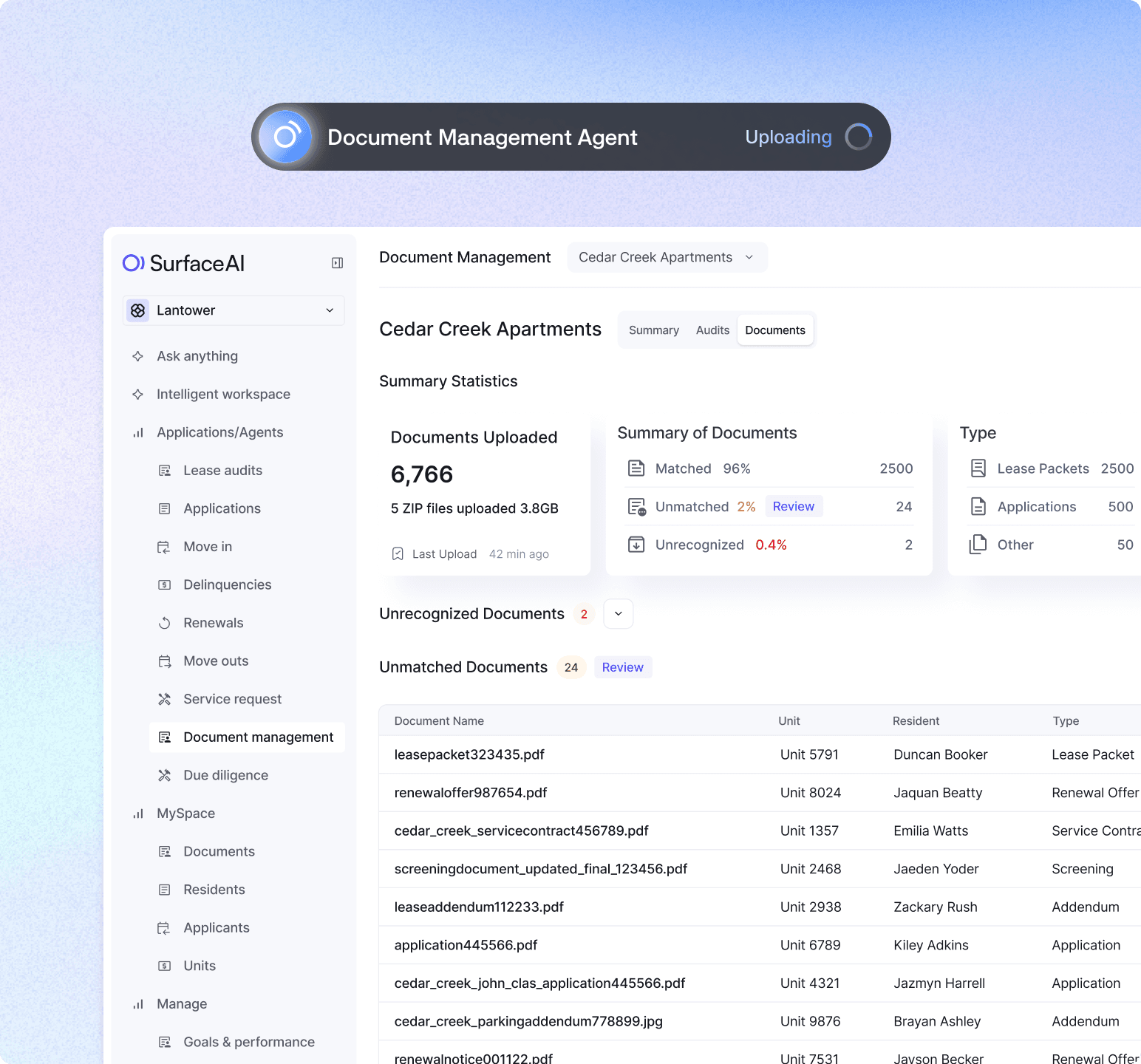
SurfaceAI helps multifamily acquisitions and operations teams manage takeover documents with more structure and visibility.
SurfaceAI works alongside existing property management systems to help teams:
- classify lease and resident documents
- match records to residents and units
- identify missing takeover documents
- compare lease terms against rent roll and PMS data
- surface discrepancies tied to underwriting risk
- support multifamily lease due diligence
- improve post-close operational readiness
This is especially valuable during multifamily property acquisition workflows. Teams need to move quickly. They cannot afford incomplete review.
For product context, see the SurfaceAI Due Diligence Agent and Document Management Agent →
Common Mistakes During Property Handovers
Waiting too long to organize documents. Diligence teams lose valuable review time.
Treating all missing documents equally. Some missing records materially affect risk. Others are administrative cleanup.
Failing to match documents to units. Files without unit-level matching are hard to validate.
Keeping diligence and operations separate. Post-close teams need visibility into diligence findings.
Relying only on manual sampling. Sampling misses portfolio-wide patterns.
Key Takeaway
When documents are incomplete, disorganized, or disconnected from the rent roll, acquisition teams lose visibility into risk and operations teams inherit avoidable problems.
A structured takeover document workflow helps teams organize records and surface missing files. It prioritizes exceptions. It helps teams move from diligence to operations with more confidence.
Conclusion
Multifamily property handovers are too important to manage through scattered folders alone.
Acquisitions and operations teams need a structured process for organizing takeover documents, identifying missing records, validating lease terms, and connecting findings back to underwriting.
Book a demo to see how SurfaceAI helps teams organize takeover documents and surface exceptions with greater confidence. See how it reduces document risk during multifamily lease due diligence.
Frequently Asked Questions About Multifamily Takeover Documents