
Best Takeover Document Platforms for Multifamily

When a multifamily property changes hands, the documents move with it. Leases, amendments, resident files, rental application records, compliance records.
Getting them collected, organized, and into your systems is one of the least glamorous parts of a takeover. It is also one of the most important. Miss a document now, and it becomes a compliance gap or a revenue leak later.
That is why more operators are looking at document platforms built for takeovers. But the options vary widely, and the differences are not obvious from a feature list. This guide covers how to evaluate takeover document collection platforms for multifamily. It walks through the criteria that matter, and how to pick the best fit for your acquisitions and handoffs.
What a Takeover Document Platform Does
Property management document collection platforms help operators collect, organize, and load documents. They matter most when a team acquires or takes over a property.
These document management systems, and the broader category of management platforms, matter most during a transition. A takeover document platform gives the transition a structured process. Instead of a manual scramble of emails and shared drives, it brings order to the intake.
The strongest platforms handle four stages.
- Collect documents from the seller and prior manager.
- Classify each file by document type and match it to the right unit.
- Load the documents into the property management system.
- Check that the set is complete and accurate against what the transition requires.
The weakest platforms only do the first stage. They gather files into one place and stop. The hard work of classification, loading, and verification falls to your team. The difference between the two is what separates a real platform from a shared folder.
Multifamily transaction activity remains substantial even as financing conditions shape how quickly deals move. Freddie Mac notes that multifamily transaction volume began recovering after slowing in 2023 and 2024, with higher interest rates and changing cap rates affecting which acquisitions could close. Its outlook projected multifamily volume of roughly $370 billion to $380 billion as sidelined transactions returned to the market. See Freddie Mac’s 2025 Multifamily Outlook →

The Criteria That Actually Matter
Feature lists all look similar. What separates platforms is how they perform on the criteria that decide whether a takeover goes smoothly. Here are the ones to weigh.
PMS Integration Depth
This is the criterion that matters most, and the one where platforms differ the widest. A platform that collects documents but cannot load them into your property management system fails you. Your team ends up doing manual data entry at the worst possible time.
Ask how deep the integration goes.
- Does the platform push documents into the PMS automatically, or export a file for someone to upload?
- Does it match documents to the right unit in the system, or dump them in a general folder?
Deep property management software integration separates a platform that finishes the job from one that hands it back to you. Our guide to document automation tools for real estate operations covers how this integration works.
Document Intake Workflow
The second criterion is how the platform handles the intake itself. During a takeover, documents arrive from many sources in no particular order. Leases, addenda, and tenant documentation all land at once. A strong platform ingests them from wherever they live, then classifies and organizes them without manual sorting.
Look at how much human work the intake requires.
- Does the platform read and classify documents on its own, or does someone have to tag each file?
- Can it handle unstructured formats like scanned PDFs, or only clean digital files?
The less manual sorting the intake demands, the faster the transition moves. Automated workflows save time and reduce errors, and a platform that streamlines workflows keeps the whole team moving. Our guide to organizing takeover documents covers what good intake looks like.
Transition Readiness
The third criterion is whether the platform actually prepares you for a clean cutover. Collecting documents is not the goal. Being ready to operate on day one is.
A transition-ready platform checks the document set against a defined standard. It flags what is missing before close, not after. It flags the gaps early.
Which units lack a complete lease, which files need a signature, and which records did not transfer. That verification is what prevents the post-close surprises that come from incomplete records. Our guide to the causes of missing takeover documents covers where these gaps come from.
Accuracy and Validation
The fourth criterion is whether the platform checks that the documents are correct, not just present. A lease in the system that does not match the signed document is worse than a missing one. It looks complete while being wrong.
Strong platforms also store documents securely, with version control so the current file is always clear. Beyond document storage, the strongest platforms validate the documents against the data. They compare lease terms to the rent roll and flag discrepancies. This is where a document platform crosses from filing tool to operational safeguard.
Matching the Platform to Your Needs
The best-fit platform depends on how your team operates, how often you take over properties, and how you manage properties day to day.
- For operators who acquire frequently, PMS integration depth and onboarding automation matter most. The volume makes manual work unsustainable.
- For operators with complex compliance requirements, validation and transition readiness matter most. The cost of an incomplete record is highest there.
- For smaller operators, a platform that reduces the manual scramble may be enough on its own.
The mistake is choosing on features alone. A long feature list means little if the platform stops at collection and hands the rest back to your team. Evaluate on the four criteria, weighted by how your operation actually works.
Why Document Platforms Fail Multifamily Operators
Many document platforms disappoint for the same reason. They treat a takeover as a filing problem when it is really a data problem.
Collecting documents is the easy part. The hard part comes next. Someone has to classify each document, match it to the right unit, load it into the PMS, and check it against the records.
A platform that only collects leaves the hardest, most error-prone work to your team. It happens under a deadline, exactly when mistakes are most likely.
That is why collection-only tools create a false sense of progress. The documents sit in one place and takeover looks handled. Then months later, the gaps surface.
- A missing addendum.
- A misfiled lease.
- A charge with no supporting document.
When records are wrong, residents may pay rent that does not match their lease. The platform did its narrow job and left the real risk in place.
How SurfaceAI Handles Takeover Documents
AI-powered document processing can automate the capture, classification, extraction, and validation of unstructured files before sending that information into downstream systems and workflows. Hyland explains that intelligent document processing can validate extracted data against systems of record and integrate with existing enterprise systems, reducing manual entry while supporting end-to-end document automation. Hyland’s analysis of AI-powered document processing and data extraction →
SurfaceAI approaches takeover documents as an operational problem, not a filing one. It does not just collect documents. It processes them end to end.
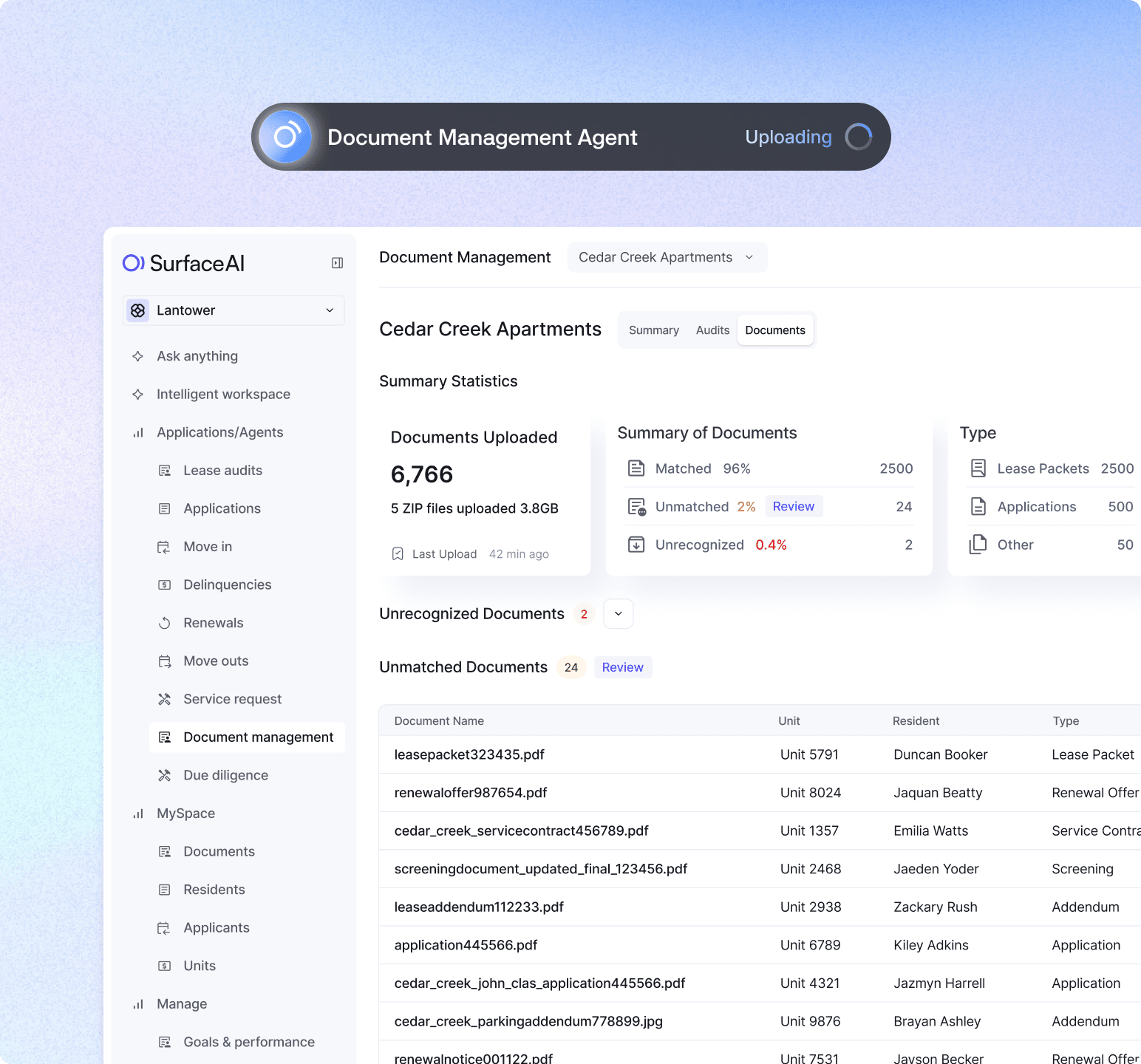
The Document Management Agent ingests documents from the seller and prior manager. It classifies each file by type, matches it to the right unit, and loads it into the property management system.
From abstraction and classification to resident matching, it does the manual work so your team does not have to. Then the Lease Audit Agent validates the loaded data. It compares lease terms against the rent roll and flags discrepancies before they become problems.
SurfaceAI is also designed to support the full transition. The Transitions Agent aims to reach out to prior owners and managers and collect the required files. It is designed to check them against a defined standard before cutover, so the property is ready on day one. For more on the broader process, see our guide to real estate document management software →
The difference is scope. A collection tool gathers files. SurfaceAI collects, classifies, loads, and validates, so the documents are not just present but correct and in the system.
Conclusion
The best takeover document platform for multifamily is not the one with the longest feature list. It is the one that finishes the job. Collection is the easy part. PMS integration, intake automation, transition readiness, and validation are what separate a real platform from a shared folder.
Evaluate platforms on those four criteria, weighted by how your team operates and how often you take over properties. The right platform turns a takeover from a document scramble into a controlled process. It prevents the gaps that would otherwise surface long after close.
Do you want a platform that collects, classifies, loads, and validates takeover documents? Book a demo to see how SurfaceAI handles the full process.
Frequently Asked Questions About Best Takeover Document Platforms for Multifamily