
9 Causes of Missing Takeover Documents in Multifamily

Takeover documents are the backbone of every multifamily acquisition.
They shape due diligence, financial validation, compliance verification, and post-close operations. Yet even experienced acquisition teams routinely discover that critical documents are missing during the handover process.
The consequences are real. Delayed closings. Incomplete records. Hidden compliance issues. And revenue leakage that surfaces only after the transaction closes.
Understanding why documents go missing is the first step toward fixing the problem. Below are nine of the most common causes.
1. Inconsistent Documentation Practices Across Communities
Multifamily portfolios often include properties acquired at different times, managed by different teams, or operated using different processes.
Over the years, each community develops its own habits:
- different folder structures
- different naming conventions
- different file storage locations
- different levels of documentation discipline
When ownership changes or a portfolio is sold, these inconsistencies collide with the buyer’s expectations. Documents that seemed organized to one team become impossible to locate for another.
2. Documents Are Stored Across Multiple Systems
Most multifamily operators do not maintain a single source of truth for their documentation.
Records may exist across:
- property management systems
- accounting platforms
- email attachments
- shared drives
- local desktops
- legal folders
- cloud storage services
- physical file cabinets
The acquisition team eventually has to assemble a complete document package. At that point, information may be scattered across systems that no single employee fully controls. That fragmentation almost guarantees that some records will not make it into the transfer.
3. Staff Turnover Erases Institutional Knowledge
Multifamily operations experience high staff turnover.
When onsite managers, leasing agents, or regional supervisors leave the company, they take institutional knowledge with them.
Documents may technically exist. But the person who knew where they were stored may no longer be with the organization.
This creates blind spots that only become visible during ownership transitions or acquisitions. For more on how to structure documents so knowledge stays with the organization, see our guide to organizing takeover documents →
4. Move-in Documentation Is Frequently Incomplete
Lease execution generates significant paperwork, including:
- signed leases
- pet agreements
- parking addenda
- concession documents
- utility addenda
- guarantor forms
- resident acknowledgements
During busy leasing periods, teams may complete lease execution quickly but fail to properly file every supporting document. Over time, small documentation gaps accumulate across the resident base.
5. Renewals and Amendments Get Lost
Lease renewals and mid-term amendments introduce another layer of documentation complexity.
Renewals may involve new lease terms, updated rents, revised concessions, and updated policy acknowledgements. Amendments may include modifications to fees, occupants, terms, or unit assignments.
Each of these needs to be properly documented, filed, and connected to the original lease record. Missing renewal or amendment paperwork is one of the most common issues encountered during acquisition diligence.
6. Buyers and Sellers Use Different Terminology
Missing documents are not always missing.
Sometimes they exist under different names. Or in different folders. Or classified differently by the seller’s team than the buyer expects.
For example:
- the seller may store amendments as “modifications”
- concessions may be labeled as “incentives”
- addenda may be filed separately from master leases
- renewal packages may be labeled differently across communities
Acquisition teams often request documents using their own terminology. Sellers may then believe documents are missing when they simply exist under different labels.
7. Manual Workflows Cannot Scale Across Large Portfolios
Manual document management may work for small portfolios. It rarely works well at scale.
A single mid-sized multifamily portfolio can include hundreds of thousands of documents. Manual sorting, matching, filing, and verification quickly become impractical.
Without automation, teams simply cannot maintain the level of documentation control needed during large-scale transactions. At scale, structured intake and version control matter more than headcount. For a deeper look at this approach, see our guide to preventing takeover document errors →
Multifamily acquisition activity remains significant, increasing the need for efficient diligence and document management at scale. MSCI reported that global real estate investment volumes stabilized in early 2025 after a sharp rebound in late 2024, with improving capital markets supporting transaction activity across property sectors. See MSCI’s analysis of global real estate investment activity →
8. Compliance and Regulatory Documents Are Often Overlooked
Financial and lease documents typically receive the most attention during acquisitions. But compliance documentation is equally critical, including:
- fair housing acknowledgements
- affordable housing certifications
- income verification records
- required disclosures
- inspection reports
- insurance documents
These records may exist somewhere in the organization but not be included in the takeover process. When compliance documents go missing, the buyer inherits regulatory risk they may not fully understand until an audit occurs.
9. Buyers Underestimate the Complexity of Multifamily Property Handover Processes
Acquisition teams often expect documentation to be more complete than it actually is.
Because a property appears operationally stable, buyers may assume documentation is equally well-maintained. In reality, high-performing communities may still have significant documentation gaps beneath the surface.
Underestimating this complexity leads acquisition teams to spend far more time reconstructing documentation than they anticipated. For a broader framework, see the guide to multifamily takeover documents →
Why Missing Documents Create Real Business Risk
Missing takeover documents affect more than record-keeping. They can create:
- delayed closings
- inaccurate rent rolls
- incomplete compliance records
- increased legal exposure
- operational disruptions after handover
- difficulty enforcing lease terms
- revenue leakage from undocumented fees
For real estate investors, these issues directly impact deal value and post-close operations. That is why real estate deal risk mitigation increasingly depends on structured, automated document management.
How Automated Document Management Reduces Handoff Errors
Modern acquisition workflows are moving beyond manual document reviews.
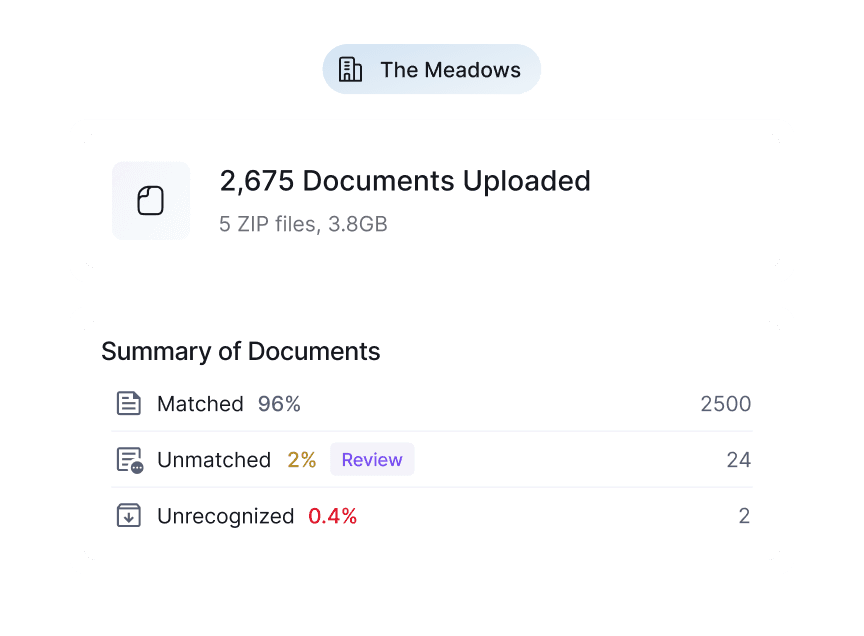
AI-powered document management systems can:
- classify documents automatically
- identify missing records
- match documents to units and residents
- detect duplicates and outdated versions
- highlight inconsistencies
- validate compliance documentation
- organize records for buyer review
These systems reduce handoff errors, accelerate diligence, and improve documentation consistency across communities.
Real estate acquisition automation transforms takeover workflows from labor-intensive investigations into structured, repeatable processes.
Where Property Management Software Integration Matters
Property management software integration plays a critical role in reducing document loss.
Synchronization matters. When lease documents, financial records, and resident information stay aligned across the property management system and the document repository, both buyers and sellers gain a more accurate picture of the property’s operational state.
Poor integration is one of the leading causes of documentation drift during transitions. Improving document control in real estate acquisitions often starts with strengthening these system connections.
Where SurfaceAI Fits
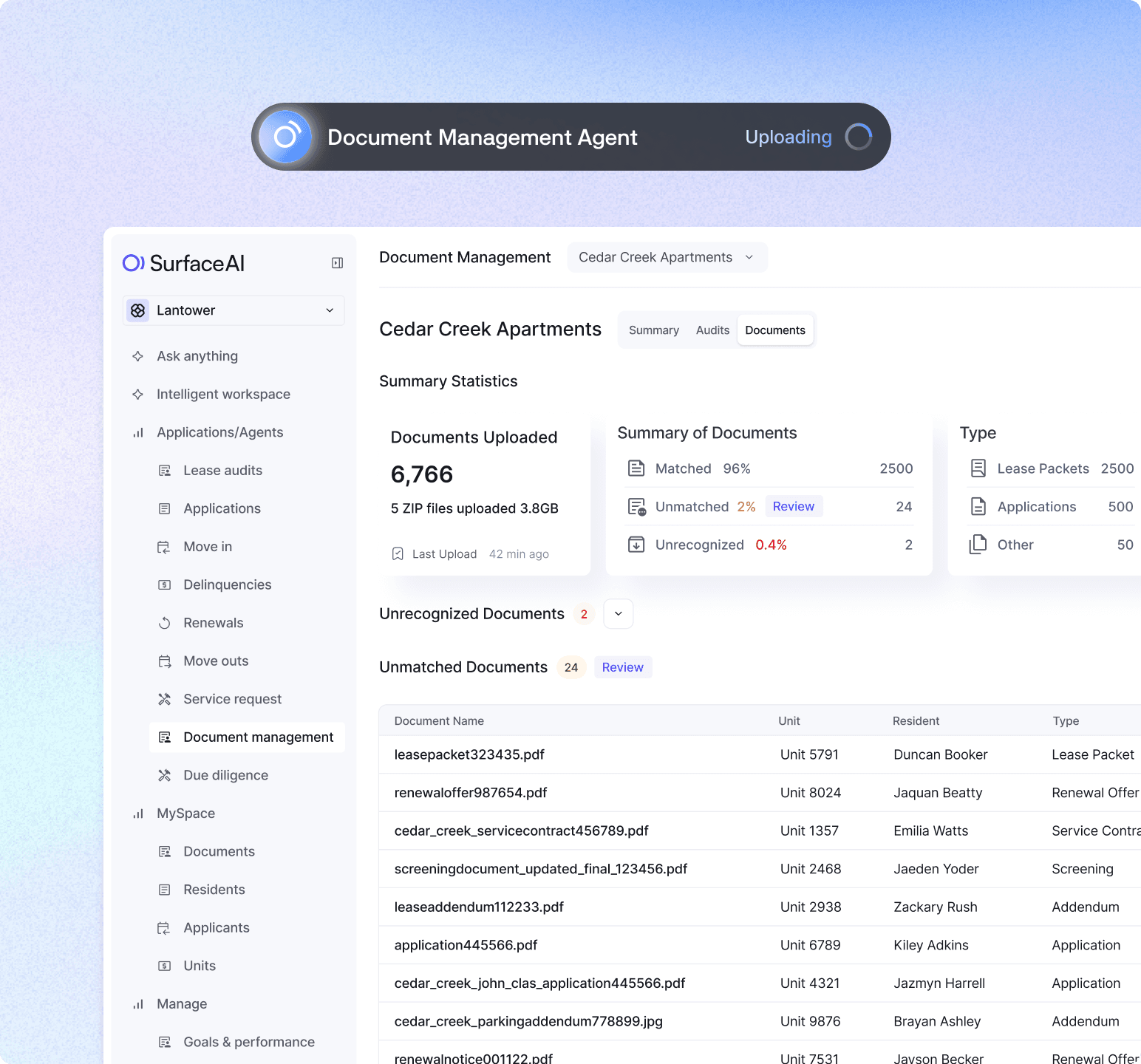
SurfaceAI helps multifamily operators maintain documentation integrity across the property lifecycle, including before, during, and after acquisitions.
Rather than replacing the property management system, SurfaceAI works alongside it to continuously organize, validate, and reconcile lease and operational data.
For acquisitions, SurfaceAI helps teams:
- classify takeover documents automatically
- identify missing records early
- match documents to units and residents
- validate lease details against operational data
- surface compliance exceptions
- streamline the handover process
By automating multifamily takeover document management, SurfaceAI reduces manual effort, uncovers hidden risks, and improves the quality of documentation available at closing.
For product context, see the SurfaceAI Document Management Agent and Due Diligence Agent →
Key Takeaways
Missing takeover documents remain one of the most common sources of friction in multifamily acquisitions.
The causes vary. Inconsistent documentation practices. Fragmented storage systems. Staff turnover. Manual workflows. Integration gaps between platforms.
Addressing these issues requires more than better spreadsheets. It requires standardized processes, automated document classification, integrated systems, and AI-powered validation.
Conclusion
Missing takeover documents are not just administrative problems. They influence deal value, compliance, operations, and long-term investment outcomes.
Multifamily transactions keep growing more complex. Structured takeover document management, real estate acquisition automation, and stronger property management software integration will become essential tools. They reduce risk and improve handover quality.
If your team wants to reduce missing documents during acquisitions and streamline multifamily property handover processes, book a demo. SurfaceAI helps modernize the takeover process
Frequently Asked Questions About Causes of Missing Takeover Documents