
How to Organize Takeover Documents in 2026

Acquiring a multifamily property involves more than reviewing financial statements and negotiating purchase terms.
Every acquisition depends on accurate, complete, and well-organized documentation.
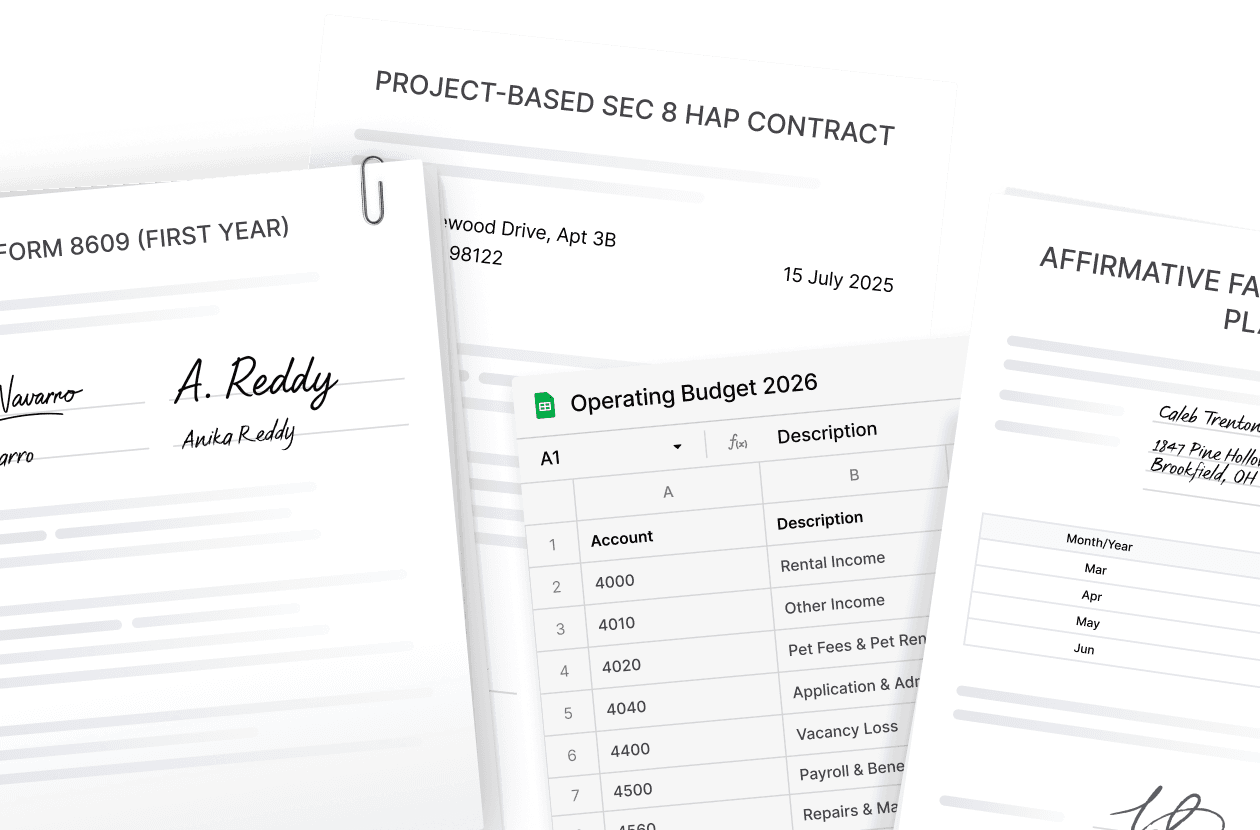
Many document types influence the outcome of a deal. Lease agreements, resident files, vendor contracts, inspection reports, compliance records, financial documents, and legal agreements all shape due diligence findings, deal valuation, and post-close operations.
These documents often scatter across emails, shared drives, spreadsheets, and legacy property management systems. That forces acquisition teams to spend valuable time searching for information instead of evaluating risk.
The result is predictable. Due diligence slows down, closings get delayed, and hidden operational issues emerge only after the acquisition closes.
This guide covers the tactical side of real estate investment documentation. This guide focuses on four things. How to structure files, standardize naming, build checklists, and cross-reference records. Together, they help acquisition teams complete the due diligence process faster.
For the broader “what and why” of takeover documents, see our guide to multifamily takeover documents. For a companion focused on error prevention, see preventing takeover document errors →
Why Takeover Documentation Matters More Than Ever
Today’s multifamily transactions involve significantly more operational data than they did just a few years ago.
Acquisition teams may review:
- thousands of lease documents
- resident files
- lease amendments
- financial documentation
- maintenance histories
- vendor agreements
- compliance documentation
- insurance certificates
- inspection reports
- legal documents
Every missing or disorganized document introduces uncertainty into the property acquisition process. The more efficiently these records are organized, the faster teams can identify risks and move toward closing.
Real estate transaction activity can shift quickly with market conditions, increasing the importance of efficient and reliable acquisition reviews. According to MSCI, global real estate investment volume was flat year over year in the first quarter of 2025. That followed a nearly 50% increase in the final quarter of 2024.
1. Build a Standardized Document Checklist Before Due Diligence Begins
One of the biggest causes of acquisition delays is inconsistent documentation requests.
Rather than requesting documents as questions arise, establish a standardized due diligence checklist before diligence starts.
Typical categories include:
- executed leases
- lease amendments
- resident ledgers
- rent rolls
- security deposit records
- service contracts
- maintenance logs
- insurance policies
- capital improvement records
- financial statements
- inspection reports
- compliance certifications
- utility contracts
- warranties
- litigation records
Standardization reduces confusion for both buyers and sellers. It also helps team members work from the same information from day one of the real estate transaction.
2. Organize Documents by Property, Building, and Unit
Folders based solely on document type quickly become difficult to navigate.
Instead, structure takeover documentation so teams can easily locate records.
A common hierarchy looks like:
Portfolio → Property → Building → Unit → Document Type
This structure simplifies lease validation, resident verification, and post-close migration into the buyer’s document management system.
3. Standardize File Naming Conventions
Inconsistent naming creates unnecessary delays.
Compare:
Lease_Final2.pdf
versus
BuildingA_Unit305_Lease_Executed_2025-04-12.pdf
Consistent naming makes documents searchable and significantly reduces manual effort.
Include:
- property name
- building
- unit
- document type
- execution date
- version if applicable
A clear naming convention pays off across the entire property acquisition process. A clear naming system makes real time document retrieval possible. It creates clean audit trails. It also helps every downstream team – legal, operations, asset management – find what they need without asking someone else.
4. Verify That Every Lease Has Supporting Documentation
A signed lease rarely tells the complete story.
Supporting documents often include:
- addenda
- pet agreements
- parking agreements
- concessions
- guarantor forms
- utility disclosures
- income certifications
- resident acknowledgements
Missing documentation may affect both compliance and future revenue collection. It can also affect cash flow projections in the underwriting model.
5. Cross-Reference Documents Against Operational Data
Organizing documents is not enough. Teams should also verify that documentation matches operational records.
Compare:
- lease terms versus rent rolls
- recurring charges versus billing records
- resident names versus lease agreements
- lease expiration dates versus PMS records
- deposits versus accounting records
Discrepancies may indicate revenue leakage, data migration errors, lease administration issues, or incomplete documentation. These inconsistencies can directly affect deal valuation.
For a deeper look at this process, see our guide to rent roll to lease reconciliation →
6. Identify Deal Valuation Risks Early
Well-organized documentation helps acquisition teams uncover deal valuation risks before closing.
Examples include:
- undocumented concessions
- lease discrepancies
- expired agreements
- missing renewals
- incomplete resident files
- inconsistent recurring charges
- unresolved compliance issues
Finding these issues during diligence lets buyers adjust underwriting assumptions or renegotiate purchase terms. Waiting until after closing often results in unexpected operational costs. It can also affect long term returns depending on interest rates and financing structure.
7. Prepare for Real Estate Legal Compliance
Documentation also supports regulatory compliance.
Acquisition teams should verify:
- fair housing documentation
- affordable housing requirements
- resident notices
- required disclosures
- inspection records
- insurance documentation
- licensing records
Strong document organization makes legal reviews significantly more efficient. It also reduces the likelihood of missing compliance obligations during ownership transitions, which supports ensuring compliance across the transaction. For more on this angle, see our guide to the best multifamily compliance system →
Thorough document review is a critical part of real estate due diligence. According to PREA, acquisition teams should confirm transaction documents are complete, fully executed, and free from significant errors. Teams should also gather supporting property, financial, title, and condition information early in the process.
8. Use AI to Manage Large-Scale Takeover Documentation
Modern acquisitions often involve tens of thousands of documents.
Manual organization is no longer practical.
An ai powered document management solution can help:
- classify documents automatically
- identify missing files
- match leases to units
- detect duplicate records
- surface inconsistencies
- prioritize exceptions for review
AI does not replace acquisition teams. It lets them spend more time evaluating risks and less time searching through folders.
Common Mistakes That Slow the Property Acquisition Process
Even experienced teams encounter avoidable documentation issues.
Common mistakes include:
- inconsistent folder structures
- duplicate files
- outdated document versions
- incomplete lease packages
- missing amendments
- inconsistent naming conventions
- relying on spreadsheets to track document status
- failing to validate documents against operational systems
Each of these problems increases diligence time and reduces confidence in the transaction.
How Organized Documentation Improves Due Diligence
A structured documentation process delivers measurable benefits.
Faster reviews. Teams spend less time locating information.
Better collaboration. Legal, acquisitions, operations, and asset management teams work from the same organized records. Buyers and sellers can exchange information without friction.
Earlier risk identification. Issues surface before they impact negotiations.
Stronger underwriting. More reliable documentation improves confidence in financial assumptions.
Smoother property transitions. Organized records reduce post-close operational disruption. Real estate investors get cleaner onboarding into ownership.
Where SurfaceAI Fits
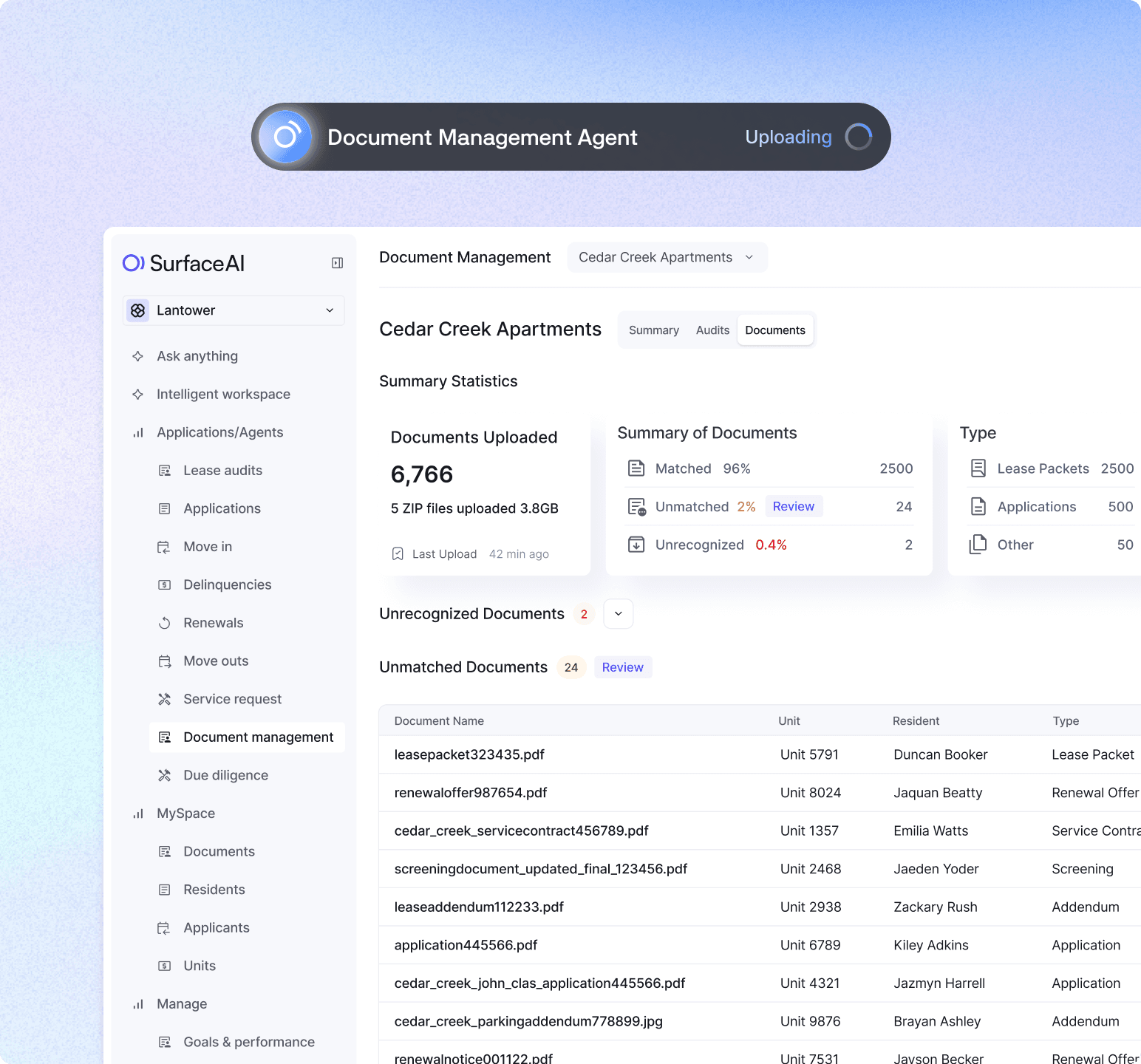
SurfaceAI helps multifamily acquisition teams automate one of the most time-consuming parts of the takeover process.
Rather than manually organizing and reviewing thousands of documents, SurfaceAI uses AI to classify, match, and validate lease documentation across the portfolio.
SurfaceAI helps teams:
- organize lease documents automatically
- match files to the correct property and unit
- identify missing documentation
- compare lease data with rent rolls and PMS records
- surface discrepancies that may affect valuation
- strengthen due diligence reviews
- improve takeover documentation management
By turning fragmented records into structured, searchable information, SurfaceAI helps acquisition teams complete due diligence more efficiently while reducing the risk of overlooked issues.
For product context, see the SurfaceAI Due Diligence Agent and Document Management Agent →
Real Estate Investment Documentation Checklist
Before closing a multifamily acquisition, verify that you have:
- executed lease agreements
- lease amendments
- resident ledgers
- rent rolls
- security deposit records
- compliance documents
- resident notices
- vendor contracts
- insurance policies
- maintenance histories
- inspection reports
- financial statements
- capital expenditure records
- utility agreements
- warranties
- litigation documentation
- property condition reports
- required legal disclosures
A standardized checklist helps ensure documentation is complete before ownership transfers.
Conclusion
Well-organized real estate investment documentation is one of the most overlooked advantages during multifamily acquisitions.
Good documentation changes what teams can do. When records are complete, searchable, and validated against operational data, acquisition teams complete due diligence faster, identify deal valuation risks earlier, and transition properties with greater confidence.
As multifamily transactions continue to grow in complexity, manual document management becomes increasingly difficult to scale. AI-powered takeover documentation management gives acquisition teams better visibility into lease records, compliance documentation, and operational data while reducing manual effort. That supports informed decisions across every stage of real estate investing.
If your team wants to accelerate the property acquisition process and reduce valuation risk, book a demo. SurfaceAI helps organize and validate takeover documentation at scale
Frequently Asked Questions About Organizing Takeover Documents