
How to Prevent Takeover Document Errors in 2026

Takeover document errors are one of the most common sources of friction during multifamily acquisitions.
They rarely start as major issues.
A lease file is missing. Addendum stored separately. Two versions of the same document exist. A rent roll does not match the lease package. A compliance record is incomplete.
But during a multifamily acquisition, small document errors can quickly become operational risk. They can slow the takeover process and weaken real estate due diligence. They also create post-close cleanup work and reduce confidence in the asset handoff.
This is why document management for real estate acquisitions is becoming more important in 2026.
Acquisition and operations teams need a structured way to organize documents. They need to prevent handoff mistakes. They need to surface missing records before those records affect underwriting or post-close execution.
Why Takeover Document Errors Happen
Document errors usually happen because multifamily acquisition workflows involve many systems, teams, and file sources at once.
Documents may come from:
- prior owners
- previous property managers
- onsite teams
- legal teams
- leasing systems
- property management software
- shared drives
- email attachments
- document portals
By the time files reach the buyer or new operator, they may be incomplete, duplicated, mislabeled, or outdated.
Common errors show up in documents including active leases, addenda, renewals, and compliance files. Examples include:
- missing active leases
- missing lease addenda
- duplicate files
- outdated document versions
- files assigned to the wrong unit
- resident names that do not match the rent roll
- incomplete compliance documents
- unsigned agreements
- separated renewal files
- inconsistent naming conventions
These issues create delays because teams cannot trust the document set.
For broader takeover document workflow context, see Multifamily Takeover Documents Guide for 2026 →
Deal activity remains strong across multifamily. Apartment deliveries declined 36.7% year over year through Q1 2026. But the market still absorbed nearly 303,400 net units over the prior four quarters. That volume of transaction and transition activity puts enormous pressure on document handoff quality.
Healthy leasing demand combined with rising lease renewals is keeping acquisition pipelines active. Newmark’s 1Q 2026 Multifamily Capital Markets report notes that multifamily demand remained well above trend, with 93,277 units absorbed in Q1 2026 and 303,377 units absorbed over the prior year. Structured takeover document workflows are critical for teams managing handoffs at scale. See Newmark’s 1Q 2026 U.S. Multifamily Capital Markets Conditions & Trends.
The Cost of Poor Document Management During Acquisitions
Poor document management affects more than file organization.
It can impact:
- real estate due diligence
- rent roll validation
- lease audits
- underwriting confidence
- compliance review
- post-close operations
- property management software setup
- asset transition timelines
When teams cannot confirm whether documents are complete and current, they rely on manual sampling. Or they rush through post-close cleanup. Both create avoidable risk. That creates avoidable risk.
A missing concession addendum may affect revenue assumptions. A mismatched lease file may create billing errors. An outdated version may cause teams to trust the wrong terms. An incomplete compliance file may become an operational issue after takeover.
Document errors are not just administrative problems. They can affect asset performance, cash flow, and long term outcomes for real estate investments. That makes them critical information for buyers and sellers during the due diligence process.
Document Management for Real Estate Acquisitions: What It Should Do
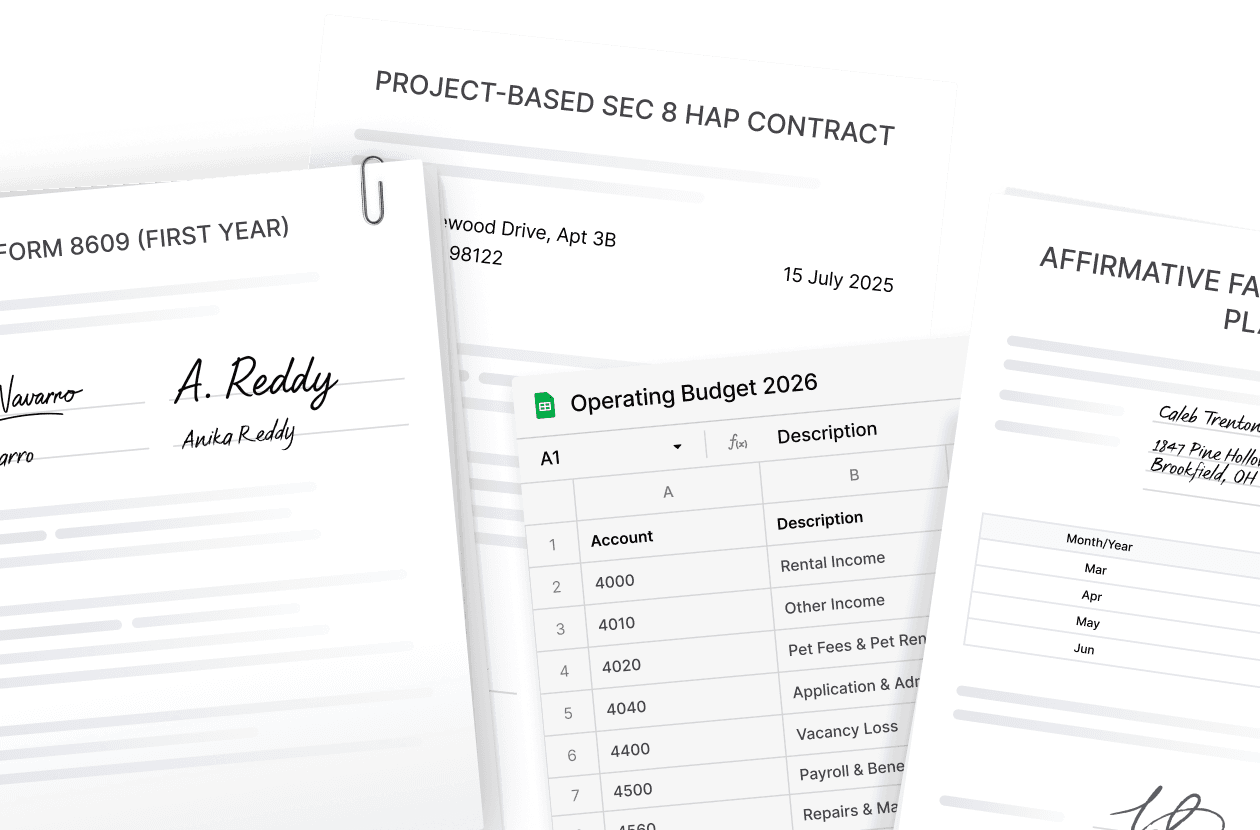
Strong document management for real estate acquisitions should help teams prevent errors before they move downstream.
At minimum, the workflow should support:
- document intake
- classification
- version control
- resident and unit matching
- missing file detection
- duplicate identification
- exception routing
- audit trail visibility
- handoff readiness
The goal is to create a reliable document foundation before lease review, underwriting validation, and operational transition begin. A good document management system gives real estate professionals real time visibility. They can see what the team has received. They can see what still needs attention.
Step 1: Centralize Document Intake Early
The first step in error prevention is centralizing document intake.
Acquisition teams should avoid collecting takeover documents through scattered email threads, individual folders, or ad hoc file sharing. Teams should collect documents into one structured intake process.
This helps teams answer:
- Which files have been received?
- Which files are still missing?
- Which files belong to each property?
- Which units have complete document packages?
- Which files require follow-up?
Centralized document storage reduces confusion before detailed review starts.
Step 2: Standardize File Categories
Document categories should be standardized before review begins.
Recommended categories include:
Lease records. Active leases, renewals, amendments, addenda.
Resident records. Applications, move-in documents, notices, resident acknowledgements.
Financial records. Rent rolls, ledgers, charge schedules, concession schedules, purchase agreements.
Compliance records. Required disclosures, policy acknowledgements, affordable housing records, inspection-related documents.
Operational records. Parking, storage, pet, utility agreements, other resident-specific operational documents.
Without standardized categories, teams spend too much time deciding what a document is. They should be identifying what is missing or incorrect instead.
Step 3: Control Document Versions
Version confusion is one of the most common takeover process errors.
It happens when teams receive:
- multiple versions of the same lease
- outdated rent rolls
- revised addenda
- duplicate document scans
- unsigned and signed copies
- files with similar names but different terms
Version control matters because real estate due diligence depends on reviewing the correct document.
Teams should define which version is current and whether a signed version exists. They should check whether a later amendment supersedes prior terms. They should confirm whether the document matches the rent roll — and whether the team should archive or review the file.
AI document management can help by identifying duplicates, similar documents, and potential version conflicts faster than manual review.
Step 4: Match Documents to Units and Residents
A document is only useful if it is matched correctly.
During a multifamily acquisition, each file should be tied to:
- property
- unit
- resident
- document type
- lease term
- effective date
- review status
Assigning a document to the wrong unit or resident can create false confidence during diligence. A lease may appear complete but belong to another resident. Someone may have stored a renewal under the wrong unit. Someone may have disconnected an addendum from the active lease.
Matching documents correctly helps team members reduce handoff mistakes before they become operational issues.
Step 5: Identify Missing Files Before Lease Review
Missing documents should be surfaced before teams begin detailed lease review. Otherwise, reviewers waste time looking for records that are not available. Our guide to the 9 causes of missing takeover documents covers why these gaps happen in the first place.
Common missing files include:
- active leases
- renewal agreements
- concession addenda
- utility addenda
- pet, parking, storage agreements
- compliance documents
- resident ledgers
A better process separates missing file detection from lease exception review. Teams should route missing files to the takeover or onsite team for follow-up. Teams should route lease exceptions to the appropriate acquisitions, operations, compliance, or accounting team.
This prevents one backlog from slowing every part of the process.
Step 6: Connect Document Review to Transaction Management
Takeover document management should connect directly to transaction management.
During a multifamily acquisition, document findings can affect:
- underwriting assumptions
- closing conditions
- purchase price discussions
- post-close action plans
- operational handoff requirements
For example, missing lease records may reduce confidence in rent roll quality. Recurring document gaps may signal operational weakness. Incomplete compliance files may require remediation. Concession documents may change revenue assumptions.
When document findings stay isolated in folders or spreadsheets, they are easy to miss. A stronger workflow connects document exceptions to the transaction timeline.
It assigns each issue an owner. This is often a transaction coordinator or acquisitions lead. That connection helps leadership make an informed decision at each stage of the deal.
Current data must ground a credible transaction outcome. It also needs operational stability, including documentation quality, record completeness, and workflow alignment between buyer and seller.
According to Inman, the most successful real estate transactions are not defined by the headline purchase price. They are defined by the structured guardrails that govern risk, set expectations, and determine how value transfers cleanly from seller to buyer.
Step 7: Use AI to Reduce Manual Review Errors
Manual document review is vulnerable to fatigue, inconsistency, and time pressure.
AI document management helps reduce error risk by supporting:
- file classification
- duplicate detection
- document matching
- missing file identification
- lease term extraction
- exception flagging
- handoff readiness checks
This does not remove the need for human review. It makes human review more focused.
AI surfaces the files and exceptions that need attention first. Teams do not need to inspect every file equally. That helps reduce manual review work while improving accuracy.
For related automation workflows, see How to Automate Multifamily Property Operations in 2026 →
Step 8: Create a Handoff Error Log
Every acquisition should have a structured handoff error log.
This should include:
- property
- unit
- resident
- document issue
- error type
- risk level
- owner
- status
- resolution date
- post-close action needed
Common error types include missing files, duplicate files, and outdated versions. Incorrect unit matches and unsigned documents are also frequent. Incomplete addenda, rent roll mismatches, and compliance gaps round out the list.
This gives acquisitions and operations teams shared visibility into what still needs to be resolved.
Step 9: Prioritize Errors by Risk
Not every document error deserves the same urgency.
A missing low-risk acknowledgement is different from a missing active lease.
Prioritize errors based on:
- underwriting impact
- compliance risk
- operational impact
- probability
- fix effort
- portfolio pattern
High-priority errors usually include missing active leases, missing renewal files, and missing concession documents. Rent roll conflicts and unsigned agreements tied to revenue also qualify. Compliance-sensitive missing records complete the high-priority category.
Lower-priority errors may move into post-close cleanup if they do not affect deal confidence or operational readiness.
For prioritization methodology, see How to Prioritize Lease Due Diligence Findings Fast →
Where SurfaceAI Fits in Takeover Error Prevention
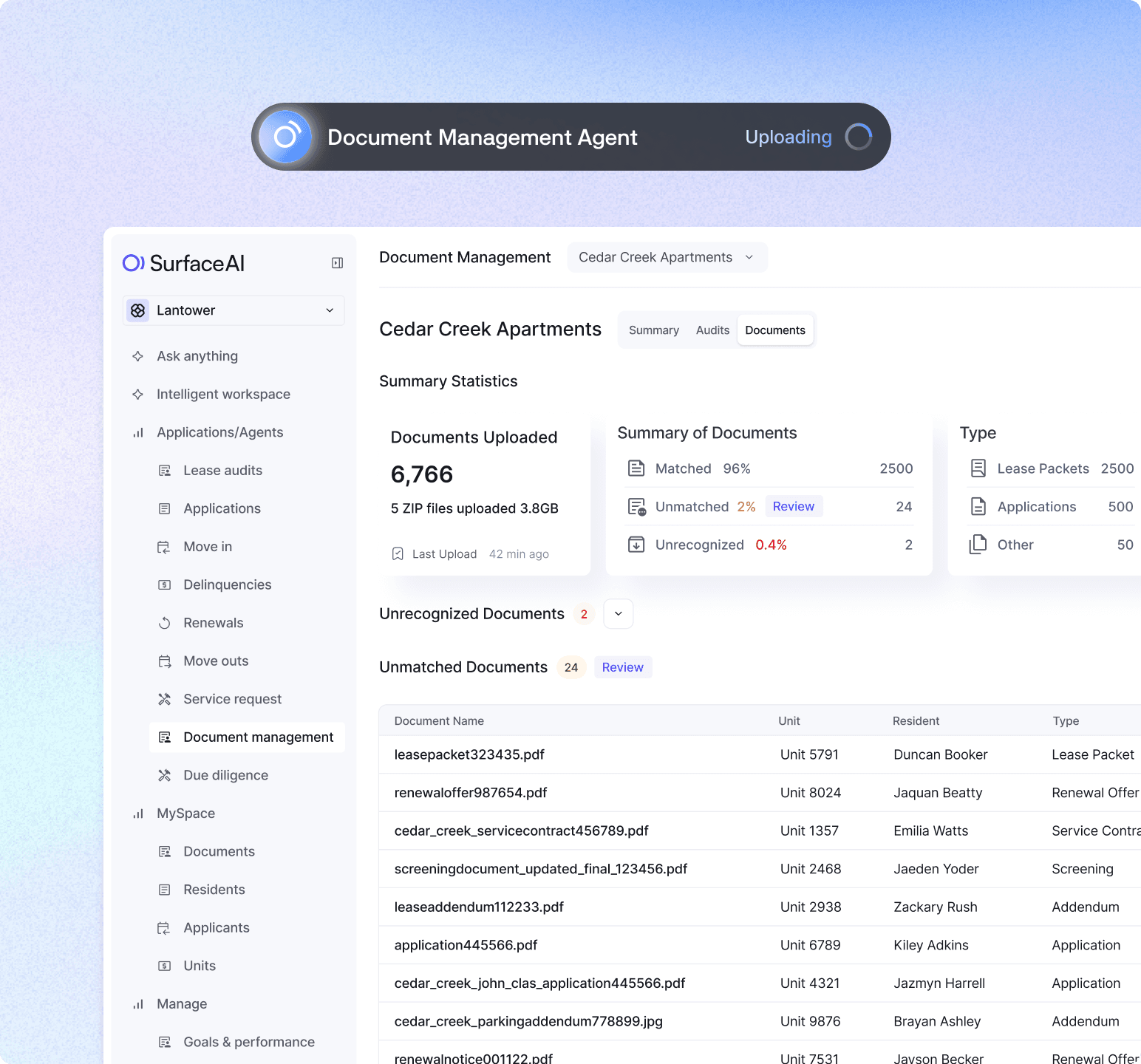
SurfaceAI helps multifamily operators and real estate acquirers reduce takeover document errors by automating document review and validation workflows.
SurfaceAI works alongside existing property management systems as an intelligence layer that supports acquisition business operations. The management platform helps teams:
- classify takeover documents
- match files to properties, units, and residents
- identify missing records
- detect duplicate or inconsistent files
- compare lease terms against rent rolls and PMS data
- surface discrepancies tied to revenue or compliance risk
- support real estate due diligence
- improve post-close handoff readiness
SurfaceAI is especially useful when teams are managing large acquisition timelines, complex property handovers, or high-volume document sets.
The value is not just faster document review. It is fewer missed errors before the asset moves into operations.
For product context, see the SurfaceAI Due Diligence Agent and Document Management Agent →
Common Takeover Document Errors to Watch For
Missing active lease. The resident appears on the rent roll, but no current lease is available.
Missing addendum. The lease file may not document a fee, concession, pet, parking, storage, or utility term.
Duplicate lease versions. Multiple files exist, but it is unclear which is current.
Wrong unit match. The document is attached to the wrong unit or resident.
Outdated rent roll. The rent roll does not reflect the most current lease terms.
Unsigned agreement. A document exists but is not fully executed.
Incomplete compliance file. Required disclosures or compliance-sensitive records are missing.
Takeover Error Prevention Checklist
Use this checklist during acquisition handoffs:
- centralize document intake
- standardize file categories
- identify duplicate files
- confirm current document versions
- match documents to units and residents
- surface missing active leases
- confirm addenda are connected to master leases
- compare lease data against rent roll data
- create a handoff error log
- assign owners to each exception
- prioritize errors by deal and operating impact
- track unresolved issues into post-close operations
This gives teams a structured way to prevent takeover process errors instead of reacting to them later.
Key Takeaway
Document errors during multifamily acquisitions are preventable when teams use structured workflows and AI-assisted document management.
The highest-risk mistakes involve missing files and version confusion. Incorrect unit matching and handoff gaps between acquisitions and operations are also common.
Teams that centralize intake, standardize categories, and control versions reduce document risk. Matching documents and routing exceptions clearly prevents issues from affecting underwriting or post-close execution.
Conclusion
Multifamily acquisition handoffs are too complex to manage through scattered folders and manual review alone.
Teams need document management workflows that reduce version confusion. They need to surface missing files early. They need to prevent handoff mistakes before those mistakes become operational issues.
Book a demo to see how SurfaceAI helps reduce document errors and improve acquisition readiness. See how it strengthens document management, real estate due diligence, and takeover process accuracy.
Frequently asked questions on how to prevent takeover document errors