
Acquisitions and Dispositions in Multifamily: The Data Validation Playbook for Both Sides

Every multifamily transaction has two perspectives.
The buyer wants confidence that the property performs exactly as represented.
The seller wants to demonstrate a clean, well-documented asset that justifies maximum value.
Between those two objectives sits one of the most important, and often overlooked, parts of any transaction: data validation.
The quality of your operational data matters on both sides of the deal. Whether you’re acquiring or disposing of a multifamily property, your lease data, financial records, operational documentation, and resident files directly affect transaction speed, valuation, and post-close performance.
This guide covers three things. How acquisitions and dispositions teams can use structured data validation to reduce risk, improve transparency, and complete transactions with greater confidence.
What Are Acquisitions and Dispositions in Real Estate?
Acquisitions and dispositions refer to the two primary transaction activities within real estate investing.
Acquisitions involve purchasing assets that align with an investment strategy. Dispositions involve selling those assets to maximize returns or reposition a portfolio.
The financial objectives differ. But both processes depend on the same foundation: reliable operational data.
Buyers need accurate information to underwrite the investment. Sellers need complete documentation to support valuation and reduce buyer uncertainty.
For a deeper look at the buy side specifically, see our complete guide to property acquisitions →
Why Data Validation Matters on Both Sides of the Transaction
Property value is built on operational performance.
If the underlying records contain inconsistencies, both buyers and sellers face unnecessary risk.
Examples include:
- missing lease documents
- incorrect rent roll data
- expired lease amendments
- missing recurring charges
- incomplete resident files
- compliance gaps
- duplicate documentation
These issues create additional diligence requests, delay closing, and often lead to purchase price adjustments. Organizations that validate operational data before marketing or acquiring an asset typically complete transactions more efficiently, regardless of market conditions.
Real estate investment activity continues to recover, increasing the importance of efficient acquisition and disposition workflows. According to MSCI, global commercial real estate investment volumes stabilized in early 2025 following a strong rebound in late 2024. That reflects improving transaction conditions across property sectors.

The Acquisition Side: What Buyers Need to Validate
Acquisition teams should verify every assumption supporting the investment.
Lease accuracy. Compare executed leases against rent rolls to confirm rental income, lease terms, and occupancy.
Revenue integrity. Validate recurring charges such as:
- pet rent
- parking
- storage
- utilities
- amenity fees
Small billing discrepancies across hundreds of units can materially affect NOI.
Documentation completeness. Review every resident file for:
- executed leases
- amendments
- required disclosures
- compliance records
- guarantor agreements
Incomplete documentation increases operational risk after closing.
Compliance readiness. Affordable housing documentation, regulatory requirements, and resident records should all be reviewed before ownership transfers.
For a detailed workflow, see our multifamily due diligence review checklist →
The Disposition Side: Preparing a Property for Sale
Many owners begin organizing documentation only after a buyer requests it. By then, valuable time has already been lost.
Preparing for disposition should begin well before the property is listed. Sound disposition in real estate depends on the same operational discipline as acquisitions, just applied in reverse.
Validate lease files. Ensure each occupied unit has a complete lease package.
Clean up rent roll discrepancies. Resolve inconsistencies between lease agreements and operational records before marketing the asset.
Organize supporting documentation. Provide buyers with a structured, searchable document repository rather than scattered files across multiple systems. Our takeover documents guide covers the folder hierarchy and file organization that supports this.
Resolve known operational issues. Address documentation gaps before they become negotiation points.
A clean data room increases buyer confidence and often shortens diligence timelines. For a property owner planning an exit, this preparation directly protects deal value.
Types of Real Estate Dispositions
Multifamily owners execute dispositions for different strategic reasons. Understanding the types of real estate dispositions helps operators match the process to the goal.
Portfolio rebalancing. Selling underperforming assets to reinvest in higher-growth markets or property types.
Full exits. Divesting an entire portfolio or fund, often tied to fund lifecycle timing.
1031 exchange dispositions. Selling one asset to acquire another while deferring capital gains tax.
Distressed sales. Selling assets under time pressure, often due to loan maturities or operational challenges.
Strategic dispositions. Selling assets that no longer fit long term portfolio strategy, even if they perform well.
Each disposition type creates different documentation urgency. But all of them benefit from operational data that’s already been validated before the transaction begins.
Common Challenges During Acquisitions and Dispositions
Even experienced organizations encounter recurring issues.
Fragmented documentation. Files stored across email, shared drives, local folders, and property management systems create unnecessary complexity.
Manual validation. Reviewing thousands of lease documents manually is slow and difficult to scale.
Multiple versions of the same document. Outdated lease amendments and duplicate records increase confusion.
Inconsistent processes. Different communities often organize documentation differently, making portfolio-wide reviews more difficult.
Building an Effective Disposition Strategy
A strong disposition strategy goes beyond pricing and marketing. Operational readiness is equally important.
Leading organizations prepare by:
- standardizing document organization
- validating lease records
- reconciling rent rolls
- reviewing recurring charges
- identifying missing documentation
- completing compliance reviews
That reduces surprises during buyer due diligence and improves transaction efficiency. Disposition readiness is one of the most predictable ways to protect proceeds. That’s true in commercial real estate broadly, and in multifamily specifically.
Well-organized due diligence documentation delivers several benefits. It helps control the scope of reviews, speeds document analysis, reduces risk, and improves decision-making throughout the transaction. According to EthosData, structured data rooms with controlled access and organized documentation become the single source of truth for buyers and sellers during diligence.
How AI Is Transforming Acquisition and Disposition Workflows
Artificial intelligence is reducing the manual effort required to prepare properties for acquisition or sale.
Instead of reviewing every document individually, AI can:
- classify lease documents
- match files to units
- compare leases against rent rolls
- detect missing records
- surface inconsistencies
- prioritize high-risk exceptions
That lets both buyers and sellers focus on decision-making rather than document administration. The same real estate acquisition disposition workflow benefits either side of the transaction. That’s why AI adoption is accelerating across both.
Where SurfaceAI Fits
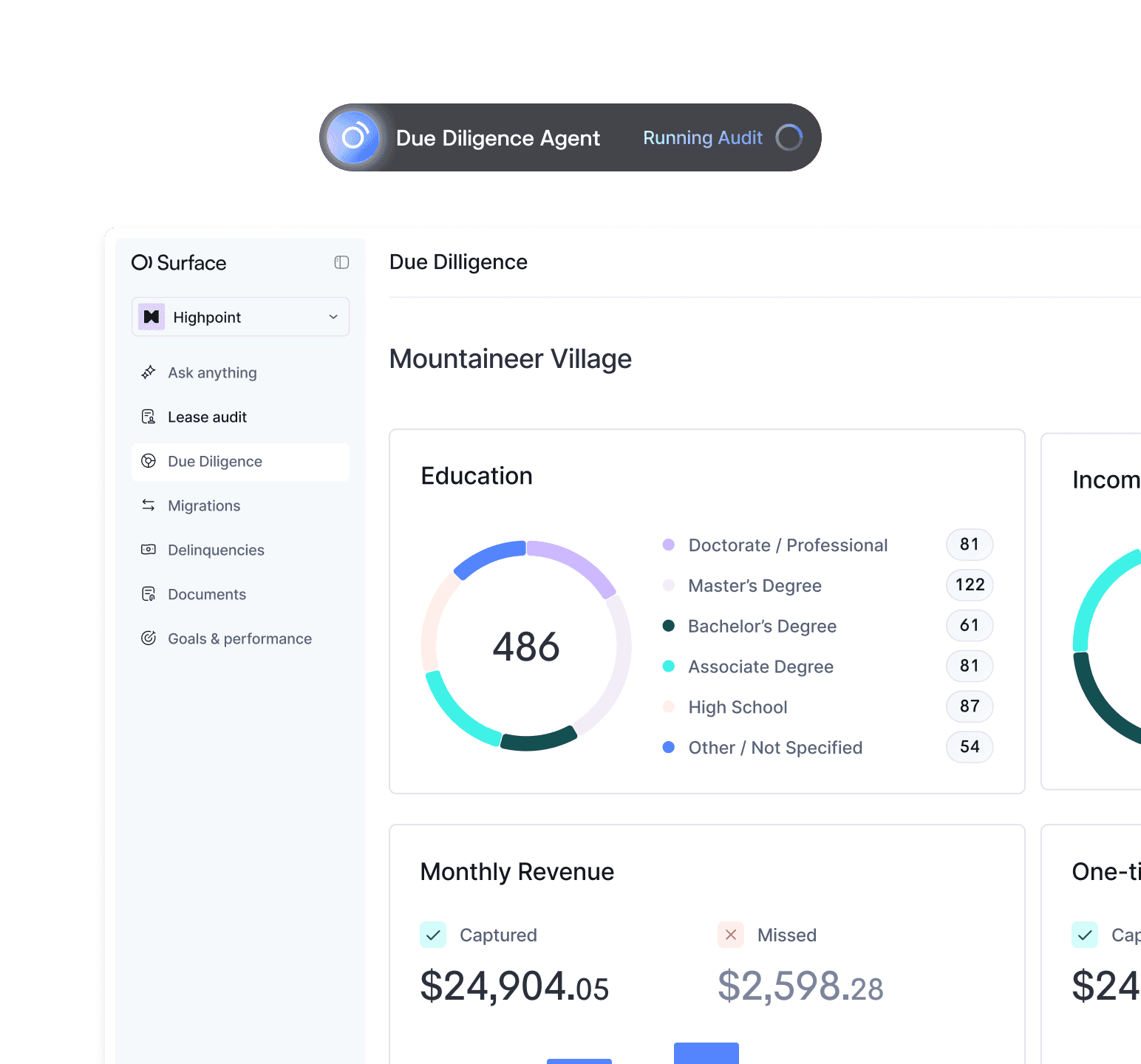
SurfaceAI helps multifamily organizations improve both acquisitions and dispositions by validating the operational data behind every real estate transaction.
SurfaceAI does not replace existing property management systems. It analyzes lease documents, rent rolls, resident records, and supporting documentation to identify issues before they affect valuation or closing timelines.
SurfaceAI helps teams:
- compare lease data against rent rolls
- detect missing documentation
- identify recurring charge discrepancies
- surface compliance issues
- organize takeover documentation
- prioritize high-risk exceptions
- improve acquisition due diligence
- prepare properties for disposition
You might be evaluating a property for purchase or preparing one for sale. Either way, SurfaceAI helps ensure the underlying data supports confident decision-making across the real estate portfolio.
For product context, see the SurfaceAI Due Diligence Agent and Document Management Agent →
Best Practices for Acquisition and Disposition Teams
Successful transactions begin long before the purchase agreement is signed.
Before entering the real estate market, ensure your team has:
- validated lease agreements
- reconciled rent rolls
- reviewed recurring charges
- confirmed document completeness
- organized resident records
- verified compliance documentation, ensuring compliance across every jurisdiction
- standardized file organization
- established exception-based review workflows
The more complete and accurate the operational data, the smoother the transaction. That principle holds for every property type in a multifamily portfolio. Class A urban assets, workforce housing, student housing, the discipline stays the same.
The Future of Multifamily Transactions
Acquisitions and dispositions are becoming increasingly data-driven.
Investors expect faster diligence, greater transparency, and more confidence in the information supporting each deal. Organizations that rely solely on manual reviews will struggle to meet those expectations.
AI-powered validation enables acquisition and disposition teams to identify risks earlier, improve operational visibility, and complete transactions with greater efficiency.
Portfolios keep growing. Data quality will become just as important as financial performance in shaping the disposition process and the acquisition workflow.
Conclusion
Successful acquisitions and dispositions depend on more than favorable market conditions and strong financial models.
They require accurate lease data, complete documentation, reliable operational records, and confidence that every assumption behind the transaction has been validated.
Investing in structured data validation before a property changes hands lets buyers reduce investment risk. Sellers gain transparency and strengthen their disposition strategy.
If your team wants to streamline acquisitions and dispositions and strengthen transaction readiness, book a demo. SurfaceAI helps multifamily organizations validate operational data before every transaction.
Frequently Asked Questions About Acquisitions and Dispositions in Multifamily