
The Multifamily Due Diligence Review Checklist and Software Guide

Multifamily acquisitions move quickly.
What often determines whether a deal closes on time isn’t the underwriting model or purchase agreement. It’s the due diligence review.
Every acquisition depends on one critical question: can you trust the information behind the investment?
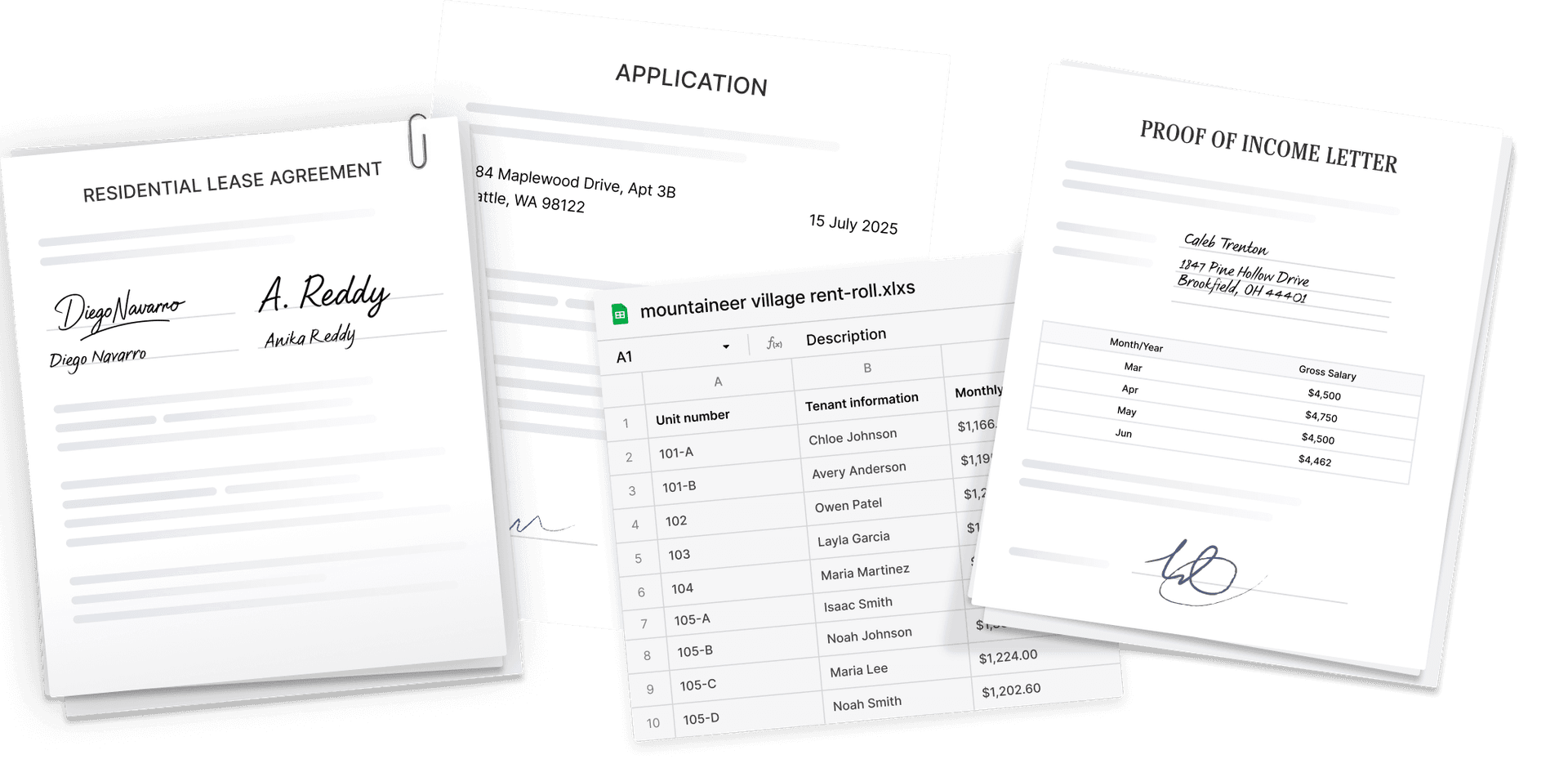
Every acquisition involves a lot of documentation. Lease files, rent rolls, resident ledgers, compliance records, concessions, recurring charges, and property documents all need to be reviewed before capital is committed.
Many acquisition teams still rely on spreadsheets and manual document reviews. Those workflows struggle to keep pace with today’s portfolio transactions.
AI due diligence software is changing that.
Acquisitions teams no longer have to review thousands of lease documents manually. Modern platforms automate document analysis, identify discrepancies, and direct teams to the records that require investigation.
This guide covers three things. It explains what a modern multifamily due diligence review should include, provides a practical checklist, and shows how to evaluate the best due diligence software.
What Is a Multifamily Due Diligence Review?
A due diligence review validates the financial, operational, legal, and lease information supporting a real estate acquisition.
Its purpose is simple: identify risks before closing.
For multifamily properties, this means verifying that:
- lease documents support the rent roll
- recurring charges are correctly billed
- concessions match underwriting assumptions
- resident records are complete
- compliance requirements have been met
- operational information reflects reality
The more units involved, the more difficult this process becomes. A 500-unit acquisition may involve tens of thousands of individual documents. Without structured workflows, important issues can easily be overlooked.
Real estate due diligence typically breaks down into three parallel tracks:
- Financial due diligence (rent rolls, ledgers, financial statements, cash flows)
- Legal due diligence (leases, contracts, disclosures, legal documents)
- Operational due diligence (compliance records, inspection reports, resident data).
Each track produces its own risk profile, and each depends on document accuracy.
Multifamily transaction activity continues to require disciplined due diligence as investment markets recover. According to MSCI, global real estate investment volumes stabilized in early 2025 following a strong rebound in late 2024. That stability highlights the continued need for efficient transaction execution and scalable acquisition workflows.
Why Manual Due Diligence Reviews Are Becoming Unsustainable
Historically, acquisition teams reviewed lease files one document at a time.
While this approach worked for smaller transactions, today’s portfolios create significantly more complexity.
Common challenges include:
- thousands of lease documents
- inconsistent file naming
- missing amendments
- multiple document versions
- fragmented storage systems
- compressed diligence timelines
The result is often one of two outcomes. Either teams miss important issues, or they spend weeks reviewing low-risk records while higher-risk discrepancies remain hidden.
Neither is ideal. Manual document review is time consuming. It is inconsistent across reviewers. And it produces uneven quality once portfolios cross a certain size threshold.
The Multifamily Due Diligence Review Checklist
Every acquisition should follow a standardized review process. Use this due diligence review checklist as a starting point.
1. Validate the Rent Roll
The rent roll forms the foundation of underwriting.
Verify:
- monthly rent
- lease start dates
- lease expiration dates
- occupancy status
- recurring charges
- concessions
- security deposits
Every line item should match supporting documentation.
2. Review Executed Lease Agreements
Confirm that every occupied unit has:
- an executed lease
- the latest renewal
- required signatures
- complete pages
- correct resident information
Missing or outdated leases create unnecessary uncertainty.
3. Verify Lease Amendments
Lease amendments often contain critical financial information.
Review:
- rent increases
- concessions
- parking agreements
- pet agreements
- utility responsibilities
- renewal terms
Missing amendments frequently explain discrepancies between leases and rent rolls.
4. Review Resident Ledgers
Resident ledgers help validate:
- rent collections
- recurring charges
- payment history
- concessions
- credits
- balances
They provide another layer of verification during due diligence and support both risk assessment and post-close operations.
5. Identify Missing Documents
Review every resident file for required documentation.
Examples include:
- guarantor agreements
- addenda
- disclosures
- compliance forms
- inspection records
Incomplete files increase both compliance and operational risk. For a broader risk taxonomy, see our hidden lease risk checklist →
6. Compare Lease Data Across Systems
Important information often exists in multiple locations.
Compare:
- lease documents
- property management software
- rent rolls
- resident ledgers
- document repositories
Discrepancies should be investigated before closing.
7. Review Compliance Documentation
Verify that required compliance records exist.
Examples include:
- affordable housing documentation
- resident notices
- required disclosures
- certifications
- inspection records
Missing compliance documents may affect future operations.
8. Prioritize High-Risk Exceptions
Not every issue deserves equal attention.
Focus first on:
- revenue-impacting discrepancies
- missing leases
- missing amendments
- incorrect recurring charges
- incomplete compliance records
Exception-based reviews let teams spend more time evaluating risk instead of searching for it. For a deeper look at how to structure this workflow, see our guide to exception-based lease due diligence. For how to rank findings once they surface, see our guide to prioritizing lease due diligence findings →
What the Best Due Diligence Software Should Do
Technology should make due diligence more reliable, not simply faster.
When evaluating due diligence software tools, look for platforms that support the entire review process.
Automated Document Classification
The software should automatically identify:
- leases
- amendments
- resident documents
- disclosures
- supporting records
That eliminates manual document sorting and document review overhead. Some platforms integrate with virtual data rooms used during the due diligence period. That helps consolidate source materials before validation begins.
Lease Validation
The platform should compare lease terms against operational records to identify inconsistencies.
Examples include:
- rent mismatches
- incorrect dates
- missing charges
- incomplete records
Exception-Based Review
Rather than reviewing every document, acquisition teams should receive prioritized exceptions. That significantly improves review efficiency.
Portfolio-Level Visibility
Large acquisitions require centralized reporting.
Leadership should understand:
- outstanding issues
- document completion
- compliance status
- review progress
- high-risk findings
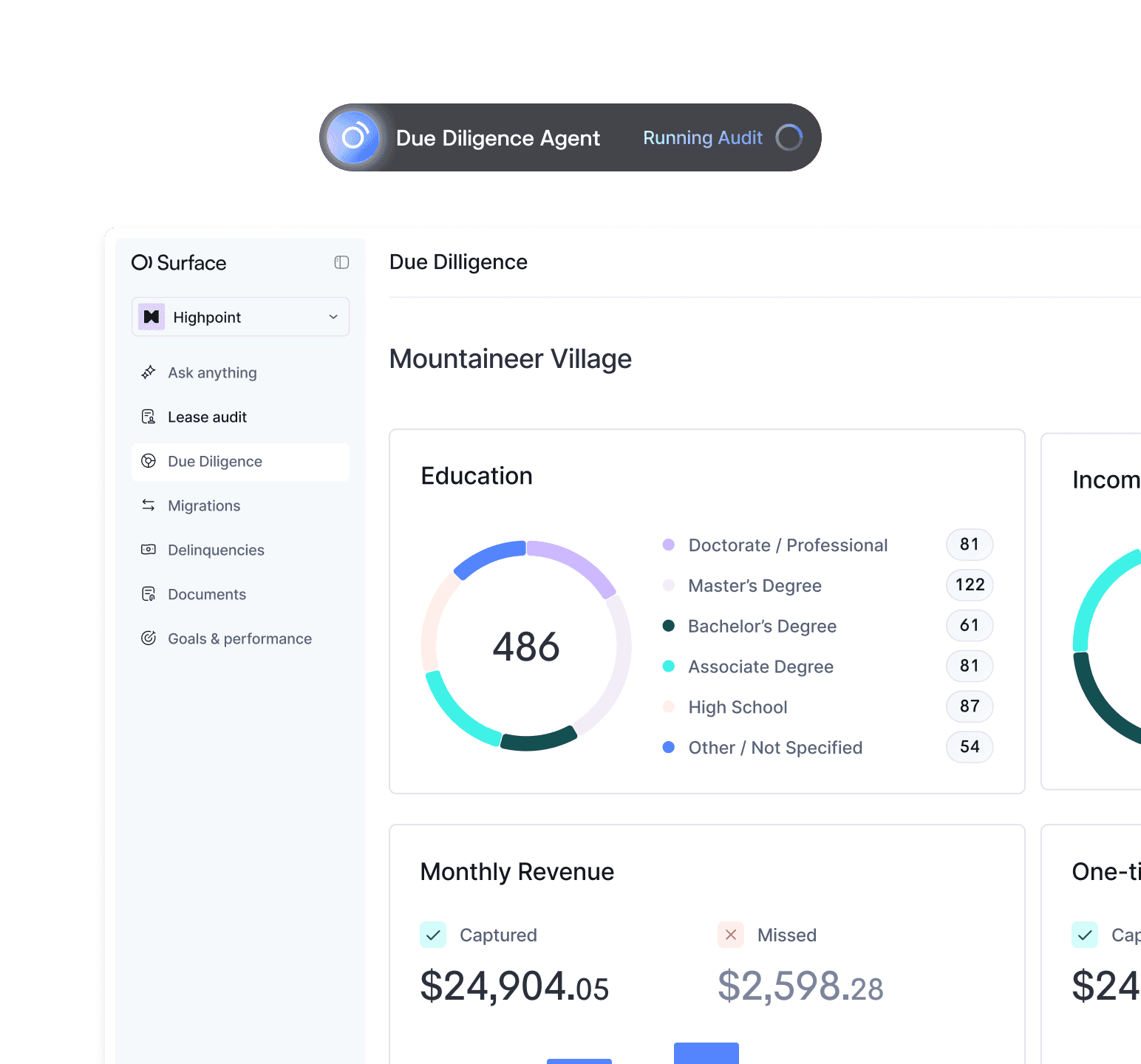
Real time dashboards make this possible without relying on dozens of spreadsheets.
Audit Trail
Every finding should be traceable. Review decisions, supporting documentation, and validation history should remain accessible throughout the acquisition process.
Data Protection
Lease documents contain sensitive resident information. Look for platforms with strong data protection, role-based access controls, and enterprise-grade security certifications. These matter as much as functionality when evaluating vendors.
AI Lease Due Diligence Platforms: What to Look For
The capabilities above describe what strong due diligence software does. The next question is how to choose among the AI lease due diligence platforms now available to multifamily acquisition teams.
Not every platform labeled “AI” delivers the same value for lease-heavy transactions. When evaluating AI lease due diligence platforms, focus on a few distinctions that separate genuine acquisition tools from general document software.
Depth of lease understanding. The strongest platforms understand lease structure specifically. They recognize base rent, escalations, concessions, renewal options, and addenda, rather than treating a lease as generic text. That depth is what makes lease review automation reliable across thousands of documents.
Validation against operational data. A platform that only reads documents is incomplete. AI lease due diligence platforms should compare lease terms against the rent roll, ledgers, and PMS records to surface discrepancies that affect underwriting.
Multifamily specificity. General AI contract analysis tools are built for corporate contracts and commercial leases. Multifamily acquisitions involve high volumes of residential leases with recurring charges and compliance requirements that general tools often miss.
Exception prioritization. The platform should return a prioritized list of findings, not a flat report. Acquisition teams working under compressed timelines need to know what matters most first.
Integration and security. Look for property management software integration, clean audit trails, and enterprise-grade data protection. These determine whether a platform fits into an existing acquisition workflow.
The right platform reduces transaction risk by catching lease-level issues before closing rather than after. For a broader look at how AI applies across the acquisition lifecycle, see our guide to due diligence in mergers and acquisitions →
AI Due Diligence Software Is Changing Multifamily Acquisitions
Artificial intelligence is transforming how acquisitions teams perform due diligence.
Instead of manually opening every lease, AI can:
- classify documents
- compare lease data
- identify inconsistencies
- detect missing files
- highlight revenue-impacting discrepancies
- prioritize exceptions
That lets acquisitions professionals focus on informed decisions instead of document administration. The target company might be a single-property acquisition or a large portfolio transaction. Either way, AI due diligence software supports the same core workflow: validate documents, reconcile data, surface risk.
The result is a faster, more consistent diligence review.
Where SurfaceAI Fits
SurfaceAI was built specifically to help multifamily acquisitions teams manage lease due diligence at scale.
SurfaceAI does not replace your existing property management software. It analyzes lease documents, rent rolls, resident records, and operational data to identify issues that may affect underwriting and post-close performance.
SurfaceAI helps teams:
- automate lease document classification
- compare lease data with rent rolls
- identify missing documentation
- detect recurring charge discrepancies
- surface compliance issues
- prioritize exceptions for review
- reduce manual due diligence effort
Acquisitions teams no longer spend weeks reviewing thousands of leases manually. They receive a prioritized list of findings that require attention. That improves review consistency while accelerating transaction timelines.
For product context, see the SurfaceAI Due Diligence Agent and Document Management Agent →

Manual vs AI Due Diligence Reviews
Manual Review |
AI Due Diligence Software |
|---|---|
| Reviews every lease individually | Automatically classifies documents |
| Heavy spreadsheet usage | Centralized workflow |
| Time-intensive | Exception-based review |
| Difficult to scale | Supports large portfolios |
| Findings depend on reviewer consistency | Standardized validation rules |
| Higher risk of overlooked issues | AI highlights discrepancies automatically |
What Makes a Real Estate Due Diligence Report Review Effective
The real estate due diligence report review comes next. That is where acquisitions leadership makes the go/no-go decision on the compiled findings.
An effective report review evaluates whether identified risks materially affect valuation, underwriting assumptions, or post-close operations. It asks three questions:
Does this finding change the deal economics? A recurring charge missing from the ledger may indicate ongoing revenue leakage that reduces effective NOI.
Does this finding change the risk profile? Missing compliance documentation may create regulatory exposure that changes the deal’s risk assessment.
Does this finding change closing conditions? Some issues can be resolved through purchase price adjustments or escrow holdbacks. Others may require walking away.
Strong software supports this evaluation by categorizing findings by financial impact, compliance risk, and resolution difficulty. That lets acquisition leadership move through the report review efficiently without losing context on what each finding actually means.
Final Thoughts
A strong due diligence review isn’t about reading every document.
It’s about identifying the information that changes investment decisions.
As multifamily portfolios continue to grow, acquisitions teams need workflows that prioritize high-risk findings, validate operational data, and eliminate unnecessary manual review.
AI due diligence software helps teams move faster while improving confidence in the information behind every acquisition. The best platforms don’t replace experienced acquisitions professionals. They give them better information, sooner.
If your team wants to automate lease reviews and identify hidden operational risks before closing, book a demo. SurfaceAI helps multifamily acquisitions teams complete due diligence with greater speed and confidence.
Frequently Asked Questions About Multifamily Due Diligence Review