
Real Estate Acquisition: The Complete Guide to Property Acquisitions

Every successful real estate acquisition starts long before the purchase agreement is signed.
The best investors don’t simply buy properties. They evaluate risk, validate operational data, analyze financial performance, review documentation, and ensure the asset they’re purchasing matches the assumptions behind the investment.
As multifamily portfolios become larger and transactions involve thousands of leases, resident records, and operational documents, the acquisition process has become significantly more complex.
This guide walks through the complete property acquisition lifecycle. From identifying investment opportunities to due diligence, closing, and post-acquisition transition. It highlights where technology and artificial intelligence are transforming modern acquisitions.
What Is a Real Estate Acquisition?
A real estate acquisition is the process of purchasing real property for investment or operational purposes.
For multifamily owners, institutional investors, REITs, and private equity funds, acquisitions typically involve much more than negotiating a purchase price. A successful acquisition requires validating every assumption supporting the investment.
That includes reviewing:
- property performance
- lease agreements
- rent rolls
- financial statements
- resident documentation
- operational processes
- compliance records
- capital expenditure requirements
The objective is simple: understand exactly what you’re buying before ownership changes hands.
Real estate acquisition activity continues to recover as capital returns to the market. According to MSCI, global commercial real estate investment volumes stabilized in early 2025 following a strong rebound in late 2024. That trend underscores the continued importance of efficient acquisition and due diligence processes.

Why Property Acquisitions Require More Than Financial Analysis
Financial models are only as accurate as the information behind them.
A property’s reported Net Operating Income (NOI) may look attractive, but hidden operational issues can significantly affect future performance.
Examples include:
- undocumented concessions
- incorrect recurring charges
- missing lease amendments
- incomplete resident files
- inaccurate rent rolls
- compliance gaps
These issues may not appear in underwriting models but can materially affect investment returns and cash flow projections. That is why operational due diligence has become just as important as financial analysis.
The Real Estate Acquisition Process
Every transaction differs, but most acquisitions follow the same high-level process.
1. Identify Investment Opportunities
Acquisitions begin by identifying properties that align with investment objectives.
Evaluation criteria often include:
- target markets
- asset class
- occupancy
- rental growth
- demographics
- portfolio strategy
- investment horizon
At this stage, investors focus on identifying opportunities worth investigating further. Strong market research on the local market often separates good acquisitions from bad ones.
2. Perform Property Analysis
Before making an offer, investors evaluate the property’s financial and operational performance.
Typical analysis includes:
- rent rolls
- occupancy
- operating expenses
- historical NOI
- market comparables
- capital expenditure requirements
- debt assumptions
That provides an initial estimate of value. For a deeper framework, see our guide to real estate investment analysis →
3. Underwrite the Investment
Underwriting converts operational information into investment assumptions.
Teams estimate:
- projected income
- operating expenses
- future NOI
- cash flow
- real estate financing scenarios
- return metrics
- exit assumptions
Underwriting should never rely solely on reported information. Every assumption must be validated during due diligence.
4. Conduct Due Diligence
Due diligence is where acquisition teams verify that reported information reflects operational reality.
That often involves reviewing:
- lease agreements
- rent rolls
- resident ledgers
- lease amendments
- recurring charges
- maintenance history
- vendor contracts
- insurance policies
- compliance records
For multifamily properties, this stage often requires reviewing thousands of individual documents. For a detailed workflow, see our multifamily lease due diligence guide.
5. Review Operational Risk
Many acquisition risks originate within day-to-day operations rather than financial statements.
Examples include:
- missing lease documents
- inconsistent resident records
- lease discrepancies
- incomplete compliance documentation
- billing inconsistencies
- property management process gaps
Identifying these risks before closing protects both valuation and future operations.
6. Complete Legal Review
Legal review verifies ownership, contracts, and regulatory compliance.
Common review areas include:
- title documentation
- purchase and sale agreements
- easements
- litigation
- zoning
- service contracts
- insurance
- compliance obligations
Legal due diligence ensures there are no hidden obligations that could affect ownership.
7. Close the Transaction
Once financing, legal review, and due diligence are complete, ownership transfers.
Operational work is just beginning. Closing marks the transition from evaluation to execution.
8. Complete the Property Transition
Property transitions involve transferring operational responsibility between organizations.
Critical activities include:
- document migration
- resident records
- lease files
- vendor contracts
- property management system data
- compliance documentation
Poorly managed transitions often create operational disruption immediately after closing. Our multifamily takeover documents guide explores this process in detail.
Common Risks During Property Acquisitions
Even experienced investors encounter recurring challenges.
Incomplete lease documentation. Missing leases and amendments create uncertainty around revenue assumptions.
Rent roll discrepancies. Rent rolls should always match executed lease agreements. Differences often indicate billing issues or outdated information.
Revenue leakage. Incorrect recurring charges, concessions, or billing errors can materially affect projected NOI.
Compliance issues. Incomplete documentation may expose buyers to future legal or operational risks.
Operational blind spots. Many issues remain hidden until teams compare information across multiple systems.
Why Manual Acquisition Reviews No Longer Scale
A 500-unit acquisition can involve:
- thousands of lease documents
- hundreds of amendments
- thousands of resident records
- financial reports
- compliance files
- maintenance documentation
Reviewing everything manually takes weeks.
As transaction timelines become shorter, acquisition teams increasingly rely on technology to improve speed without sacrificing accuracy.
How AI Is Changing Real Estate Acquisitions
Artificial intelligence is transforming acquisition workflows by automating repetitive document-intensive tasks.
AI can now help teams:
- classify documents
- compare lease data
- identify missing files
- reconcile rent rolls
- detect discrepancies
- prioritize exceptions
- surface operational risks
Instead of reviewing every document, acquisition professionals focus on records that actually require investigation. That significantly improves review efficiency across real estate transactions of every size.
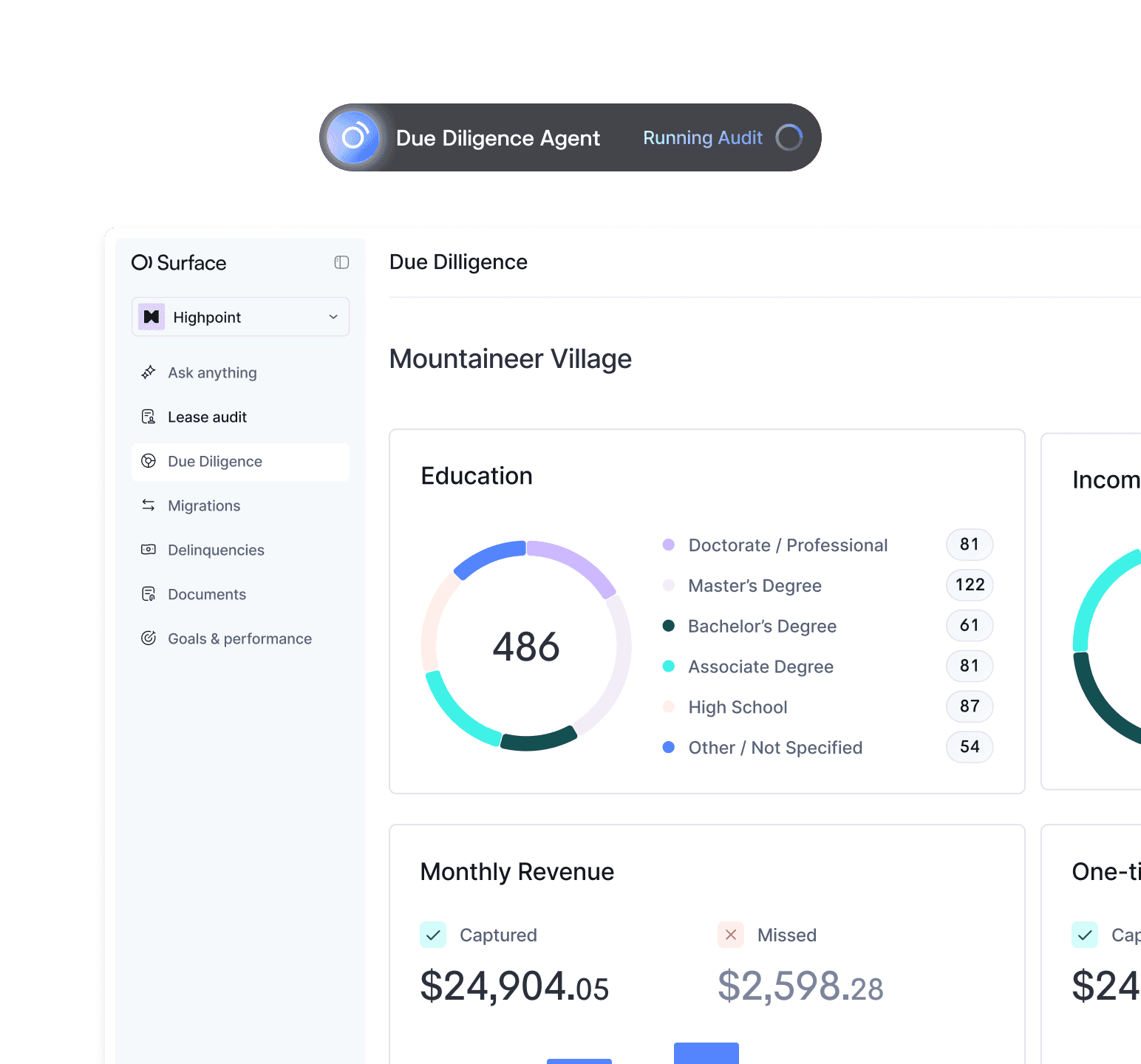
Where SurfaceAI Fits
SurfaceAI helps multifamily acquisitions teams validate the operational data behind investment decisions.
SurfaceAI does not replace your property management software or underwriting models. It works alongside existing systems to analyze lease documents, rent rolls, resident records, and property data.
SurfaceAI helps teams:
- compare lease documents against rent rolls
- identify revenue-impacting discrepancies
- detect missing documentation
- surface compliance issues
- prioritize high-risk exceptions
- support acquisition due diligence
- improve property transitions
- strengthen portfolio visibility after closing
Acquisition teams no longer spend weeks manually reviewing thousands of leases. They receive prioritized findings that help them focus on the issues most likely to affect valuation and future performance.
For product context, see the SurfaceAI Due Diligence Agent and Transitions Agent →
Technology Is Becoming a Competitive Advantage
The most successful acquisition teams aren’t simply faster. They’re better informed.
Modern acquisition technology helps organizations:
- reduce manual review
- improve due diligence accuracy
- strengthen operational visibility
- identify hidden risks
- accelerate closing timelines
- improve post-acquisition integration
Technology lets teams spend less time searching for information and more time making investment decisions. A property owner or investment firm may be active in both acquisitions and dispositions. That operational discipline compounds across every deal.
Best Practices for Successful Property Acquisitions
Before completing any acquisition, ensure your team:
- validates the rent roll against executed leases
- reviews recurring charges and concessions
- confirms resident documentation is complete
- identifies missing lease amendments
- reviews compliance records
- evaluates operational workflows
- standardizes takeover documentation
- uses technology to prioritize high-risk findings
These practices reduce uncertainty while improving confidence in underwriting assumptions. Sound property guidance during acquisition prevents most of the surprises that surface after closing.
The Future of Real Estate Acquisitions
Acquisitions are becoming increasingly data-driven.
Artificial intelligence will keep reducing manual document review while improving the speed and consistency of operational due diligence.
The winning combination is experienced acquisition professionals paired with AI-powered operational intelligence. Those organizations identify risks earlier, complete transactions more efficiently, and integrate new properties with fewer disruptions. The best acquisition teams share one advantage. They have a stronger understanding of real estate data across property management, financial performance, and compliance.
The future of property acquisitions isn’t about replacing people. It’s about giving them better information before capital is committed.
Conclusion
Successful real estate acquisitions depend on more than financial models and purchase agreements.
They require complete operational visibility, accurate documentation, disciplined due diligence, and confidence that the property’s underlying data supports the investment thesis.
As multifamily portfolios continue to grow in complexity, manual acquisition workflows become increasingly difficult to scale. AI-powered operational intelligence helps acquisitions teams validate lease data, uncover hidden risks, reduce revenue leakage, and accelerate due diligence without sacrificing accuracy.
If your team wants to improve real estate acquisition workflows and gain greater confidence in every investment decision, book a demo. SurfaceAI helps multifamily acquisitions teams make faster, more informed decisions.
Frequently Asked Questions About Real Estate Acquisition