
AI Due Diligence for Real Estate: From Manual Review to Automated Intelligence

Real estate due diligence is one of the most time-sensitive, high-risk phases of any deal. Teams check leases, documents, financials, and operational data, often under heavy time pressure. A missed detail does not just slow the deal, missed detail changes what the asset is worth.
AI due diligence introduces automation and intelligence into this process, letting teams analyze more data, more consistently, in less time. This guide explains what AI due diligence is, how it works, and where it applies. You will also learn how to evaluate the tools, so your team moves faster without sacrificing accuracy.
Why Real Estate Due Diligence Needs AI
Traditional diligence leans on manual lease review, spreadsheet tracking, sampling instead of full coverage, and scattered document folders. These approaches break down as portfolios grow and deals get more complex.
The core problem is coverage. A manual team reviews a sample of leases and hopes it represents the whole. But the error that breaks a deal often hides in the units no one opened. Due diligence automation closes that gap by reviewing the full population, not a slice.
The second problem is time. Deal clock does not wait. Manual review of thousands of lease files does not fit inside a diligence window, so teams cut the review short. That is where risk slips through.
What Is AI Due Diligence?
AI due diligence uses artificial intelligence to automate, analyze, and validate data during the diligence phase of a real estate transaction or portfolio review. People also call it diligence AI, due diligence AI, automated due diligence, or AI-powered diligence.
Diligence AI does not replace human expertise. It does the following:
- Supports the team.
- Reads and analyzes large volumes of documents.
- Extracts structured data from leases and contracts.
- Identifies inconsistencies, gaps, and outliers.
- It prioritizes issues for human review.
This lets diligence teams focus on judgment and decision-making instead of manual data collection.
The shift is from AI for due diligence documents as a filing aid to AI as an analytical engine. A modern due diligence tool does not just store files. It reads them, compares them against the data, and surfaces what matters.
How AI Due Diligence Works
An AI due diligence software platform works in a few clear stages.
First, it ingests the documents. Leases, amendments, addenda, rent rolls, and financials come in from many sources, often as scanned PDFs. The system reads them, including the unstructured ones older tools cannot handle.
Second, it extracts the terms. The platform pulls the data that matters, including rent, escalations, concessions, fees, dates, and clauses, turning a stack of documents into structured, comparable data.
Third, it validates against the source. The system compares the extracted lease terms against the rent roll and the ledger, flagging every place they disagree. This is where AI for due diligence documents becomes real risk detection.
Fourth, it prioritizes. Instead of a flat list, the platform surfaces the highest-risk exceptions first, so team spends its time where it matters.

Core Use Cases of Diligence AI in Real Estate
Lease and Contract Analysis
AI reviews executed lease agreements at scale. It identifies rent and escalation discrepancies, missing fees or clauses, non-standard terms, and gaps between documents and summaries. This capability is foundational for both acquisitions and ongoing audits. Our guide to how AI transforms lease review covers it in depth.
Automated Document Review
Real estate diligence involves thousands of documents. Diligence AI organizes them automatically, validates completeness, reduces manual document chasing, and improves traceability during review. This accelerates diligence timelines while reducing operational friction. Our guide to what slows lease review before acquisitions covers where the bottlenecks form.
Risk Identification and Prioritization
AI due diligence systems surface risk in three ways. They compare lease terms against expected rules, highlight outliers across portfolios, and flag issues that may affect valuation or compliance. Instead of static checklists, teams gain dynamic, data-driven insight. Our guide to the multifamily due diligence checklist shows how this fits a structured review.
Automated Due Diligence vs. Traditional Diligence
| Traditional Diligence | AI Due Diligence |
|---|---|
| Manual review | Automated analysis |
| Sampling-based | Full-population coverage |
| Spreadsheet tracking | Centralized intelligence |
| Reactive issue discovery | Proactive risk detection |
| Time-intensive | Scalable and fast |
AI does not eliminate diligence. It raises the floor and ceiling of what diligence teams can accomplish.
What to Look For in a Due Diligence Tool
Not every due diligence tool delivers the same value. When you evaluate due diligence software tools, weigh four things.
Document handling. Can the platform read unstructured files like scanned lease PDFs, or only clean digital data? Real diligence runs on messy documents.
Validation depth. Does the tool compare documents against the rent roll and ledger, or just extract and display? Validation against the source is where risk detection happens.
Coverage. Does it review every lease, or a sample? Full-population coverage is the point of automated due diligence software.
Integration. Does it connect to your existing systems, or require a parallel one? The best tools work alongside your PMS and data stack.
AI Due Diligence Beyond Real Estate
The same principles driving artificial intelligence for M&A due diligence now apply to real estate. In corporate deals, AI-powered tools for M&A legal due diligence read contracts at scale and flag risk. They compress timelines that used to take weeks.
Real estate deal diligence follows the same logic. The documents differ, leases and rent rolls instead of corporate contracts. But the pattern is identical. Read everything, compare against the data, and surface the risk. Due diligence automation is reshaping both.
How SurfaceAI Powers Real Estate Due Diligence
SurfaceAI applies AI to real diligence workflows through specialized agents designed for real estate operations.
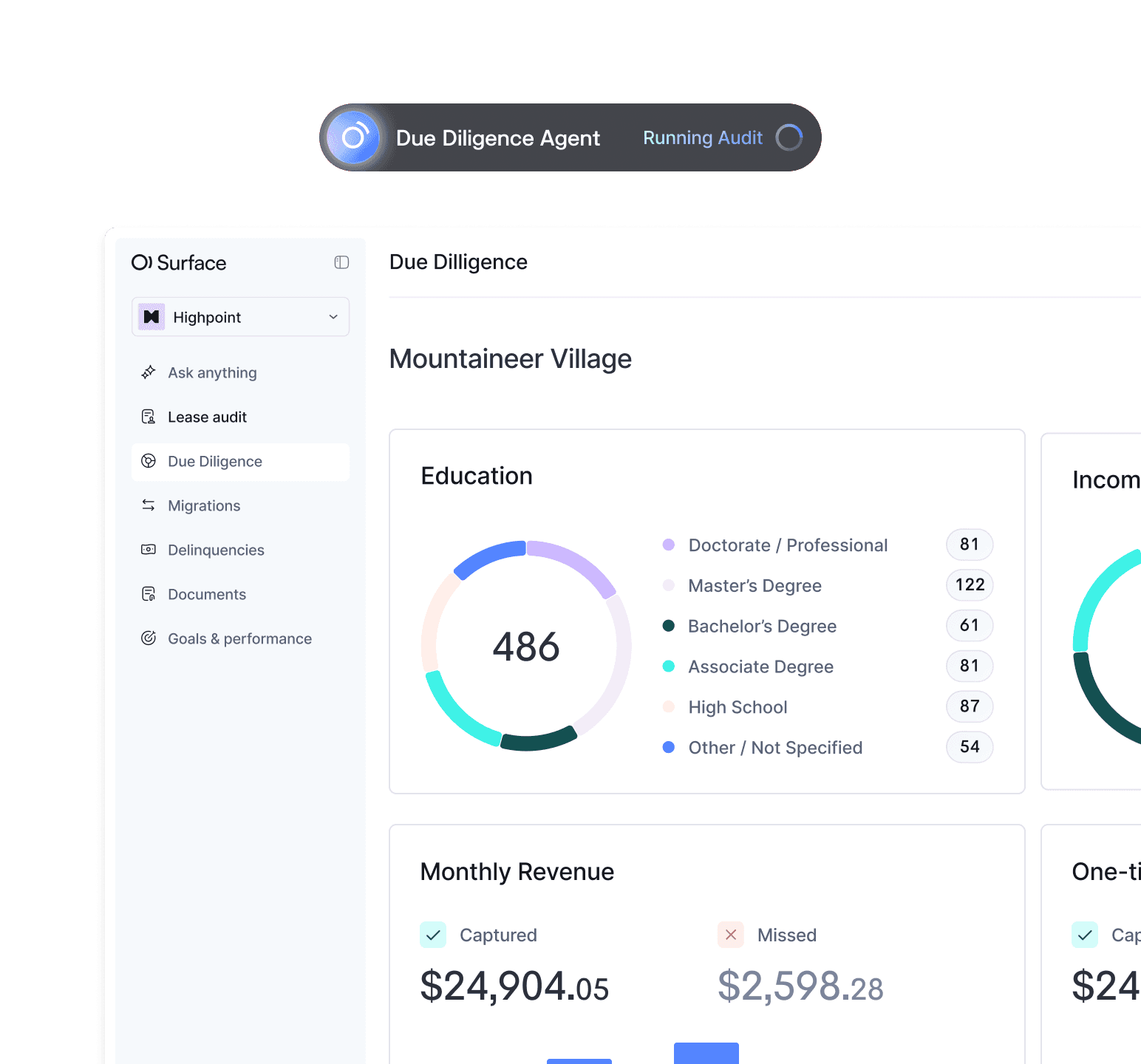
- Due Diligence Agent analyzes leases and documents during acquisitions, surfacing risks and inconsistencies before close.
- Lease Audit Agent continuously reviews leases post-acquisition to identify discrepancies affecting revenue or compliance.
- Document Management Agent organizes and validates lease documents across systems, so teams always have access to source files.
SurfaceAI Workspace delivers all outputs in one place, giving centralized visibility across portfolios. It operates alongside existing PMS and data systems. It does not replace them.
Accuracy, Governance, and Trust in Diligence AI
Diligence outcomes drive financial decisions, so AI must be used responsibly. AI delivers the greatest value when applied to structured review and risk identification, while preserving human oversight.
AI used in high-stakes diligence should operate within clear governance and human oversight. NIST recommends defining responsibility for AI oversight, establishing data-quality and model-validation standards, and maintaining ongoing monitoring, auditing, and review processes based on the potential financial and operational impact of the system. See NIST’s AI Risk Management Framework Playbook on AI governance.
This approach aligns with how SurfaceAI is deployed. AI augments diligence teams rather than acting on its own. Every flagged issue goes to a person to judge, with a clear record of what the system found and why.
AI Due Diligence Beyond Acquisitions
Diligence does not end at close. Leading teams now apply diligence AI to ongoing portfolio reviews, lease compliance monitoring, asset-level risk analysis, and reporting. This links acquisition diligence to asset management oversight. Our guide to AI use cases in asset management covers the broader picture.
The Future of Real Estate Due Diligence
As transaction volumes rise and timelines compress, AI due diligence keeps evolving. The shift is toward continuous validation instead of point-in-time review, portfolio-wide intelligence, and faster deal execution without lost accuracy. Diligence AI becomes a strategic capability, not just a transactional tool.
AI is moving deeper into institutional pre-investment diligence. MSCI’s 2026 acquisition of Vantager expanded its AI-powered diligence capabilities, including extracting and analyzing unstructured data-room documents and producing standardized outputs to support investment decisions. See MSCI’s announcement on AI-powered pre-investment diligence.
Conclusion
AI due diligence is redefining how real estate teams evaluate risk, validate assumptions, and execute transactions. By automating document review and lease analysis, diligence AI improves speed, accuracy, and confidence, without replacing professional judgment.
The teams that adopt it stop choosing between fast and thorough. They get both. SurfaceAI brings this intelligence directly into real estate diligence workflows, so teams move faster while seeing more.
Do you want to run due diligence on validated data instead of a sample? Book a demo to see how SurfaceAI powers real estate due diligence.
Frequently Asked Questions AI Due Diligence for Real Estate