What Slows Lease Review Before Multifamily Acquisitions

Most acquisition delays do not start with the deal. They start with the leases.
A team can have the model built, the financing lined up, and the timeline agreed. Then lease review begins, and the process stalls. This is the bottleneck at the heart of multifamily lease due diligence. The leases sit scattered across systems.
The volume runs high. The clock keeps ticking. By the time the team finishes, the diligence window has closed on a fraction of the portfolio.
Lease review for property acquisitions is where deal risk hides. This guide names the operational bottlenecks that slow it down, so teams can spot them before they cost time or money.
Why Lease Review Matters Before an Acquisition
A lease is the proof behind the rent roll. Lease agreements define what a resident owes, when they owe it, and under what lease terms.
Those terms drive cash flow and net operating income noi. When a buyer underwrites a multifamily deal, they trust the rent roll. Lease review is how they confirm the rent roll is real.
Skip that step, and the deal rests on assumptions. Hidden lease risks stay buried until after close, when they become the buyer’s problem. Rents, operating costs, and operating expenses all feed the cap rate and the debt service the buyer underwrote.
A rent that does not match the lease changes the numbers. So does a concession that never expired, or a charge that no one billed. Strong lease review turns those assumptions into verified facts before the buyer commits capital. That supports informed decisions and protects long term returns.
The problem is not that operators skip lease review. The problem is that they cannot finish it. The bottlenecks below are why. For the workflow that solves them, see our guide to exception-based lease due diligence →
Bottleneck 1: The Sheer Volume of Leases
Scale is the first wall teams hit. A single investment property has a few dozen leases. A portfolio of real estate assets can have thousands.
Reading every lease by hand does not scale. A reviewer can work through a handful carefully. Across thousands of units, the math breaks down. There are not enough hours in the diligence window to read them all.
So teams sample. They review a slice and hope it represents the whole. Our breakdown of why manual lease audits miss risks shows where this goes wrong. But problems do not spread evenly.
A billing error in the unreviewed majority stays hidden until after close. Volume forces a choice between speed and coverage, and coverage usually loses.
Transaction activity remains substantial even as direct property investment has cooled. Preqin’s Q2 2026 real estate update reports that deal count fell to its lowest level since the pandemic, underscoring how acquisition teams are operating in a more selective environment where diligence quality matters. See Preqin’s Q2 2026 real estate market update →
Bottleneck 2: Scattered and Disorganized Files
Even when the leases exist, finding them is its own problem. Lease files rarely sit in one clean place.
Some live in the seller’s property management system. Others sit in email threads, shared drives, or physical files at the property. A single unit’s full history might span three locations. Before a reviewer can analyze a lease, they have to assemble it.
That assembly work eats the diligence timeline. Teams spend days locating and organizing files that should have been ready on day one. Every hour spent hunting for a document is an hour not spent reviewing it. Scattered files turn lease portfolio review into a scavenger hunt.
Bottleneck 3: Compressed Diligence Timelines
Acquisitions move fast. The diligence window often runs just weeks, sometimes days. That deadline does not flex to match the size of the portfolio.
A larger portfolio does not come with a longer timeline. It comes with the same window and more work. The pressure forces teams to cut the review short, sample more aggressively, or push findings to after close. None of those protect the deal or the purchase price the buyer agreed to.
The deal clock is real, and it does not wait. Property acquisition analysis has to keep pace with the transaction timeline. The volume of leases does not change that deadline.
Bottleneck 4: Manual, Inconsistent Review
When teams divide lease review across several people, standards drift.
- One reviewer flags a small rent discrepancy.
- Another lets it pass.
- One checks every amendment against the ledger.
- Another skips it.
The result depends on who did the reviewing. Two properties with the same problems can produce different findings, because different people reviewed them. Manual review does not just move slowly. It moves inconsistently, and inconsistency lets real issues slip through.
This is the hidden cost of manual diligence. It is not only that people are slow. It is that people vary, and variation creates blind spots no one planned for.
Bottleneck 5: No Standardized Process
Many teams treat each acquisition as a fresh start.
- Rebuild the review process every time.
- Define what to check on the fly.
- Lean on individual judgment rather than a repeatable standard.
Without a standard, the review quality swings from deal to deal. What one team checks, another misses. The lessons from the last acquisition do not carry into the next. A repeatable process would catch more and cost less, but few teams build one, so each deal reinvents the work.
Standardization is what separates a controlled review from an improvised one. It is also what most pre-acquisition lease review lacks.

How These Bottlenecks Compound
Each bottleneck is manageable alone. Together, they multiply.
High volume meets a compressed timeline, and the team samples. Scattered files eat the timeline further, so the sample shrinks.
Manual review adds inconsistency, so even the sample is unreliable. No standard means the next deal repeats every mistake. The bottlenecks do not add up. They stack, and the review that results covers less than anyone intended.
Property managers, acquisition teams, and real estate operators all feel this in any real estate market. It is common across commercial lease review and multifamily alike.
This is why so many multifamily deals close with lease review only partly done. It is not one failure. It is five, working together, inside a window too short to absorb them. Weak coverage means weak risk assessment, because a review that misses most of the portfolio cannot accurately price the risk.
Where Better Process Changes the Outcome
The fix is not to work harder inside a broken process. It is to remove the bottlenecks step by step. The common types of friction below each have a clear answer.
Centralize First
Pull every lease into one place before review starts. When files live in a single repository, reviewers stop hunting and start reviewing. Centralization also reveals what is missing, because a gap is obvious when everything else is in one place.
Screen the Full Portfolio
Instead of sampling and hoping, screen every lease against the rent roll on key fields. Full-population screening catches the systematic errors a sample misses.
- It confirms rental rates and the income generation behind them across every unit.
- It replaces “we checked 15%” with “we screened everything and flagged the exceptions.”
These lease-level exceptions sharpen acquisition risk assessment. Instead of a broad sample, the team sees the exact leases that carry risk, which makes the assessment both faster and more accurate.
Apply One Standard
Define what counts as an issue before review begins. Our due diligence review checklist and software guide lays out one standard to start from. A single standard, applied to every lease, removes the reviewer-to-reviewer drift that manual review introduces. Consistency is a process choice, not a personality trait.
Automate the Repetitive Work
Technology can read every lease, compare it against the rent roll, and surface the exceptions. That removes the volume bottleneck and the consistency bottleneck at once.
AI is increasingly compressing transaction workflows that historically required large teams and weeks of manual effort. MetaProp specifically identifies underwriting, appraisal, lease abstraction, and due diligence as areas where AI is reducing timelines from weeks to hours. See MetaProp’s analysis of AI in real estate transactions and capital markets
Reviewers stop hunting for problems and start evaluating the ones the system found.
How SurfaceAI Fits
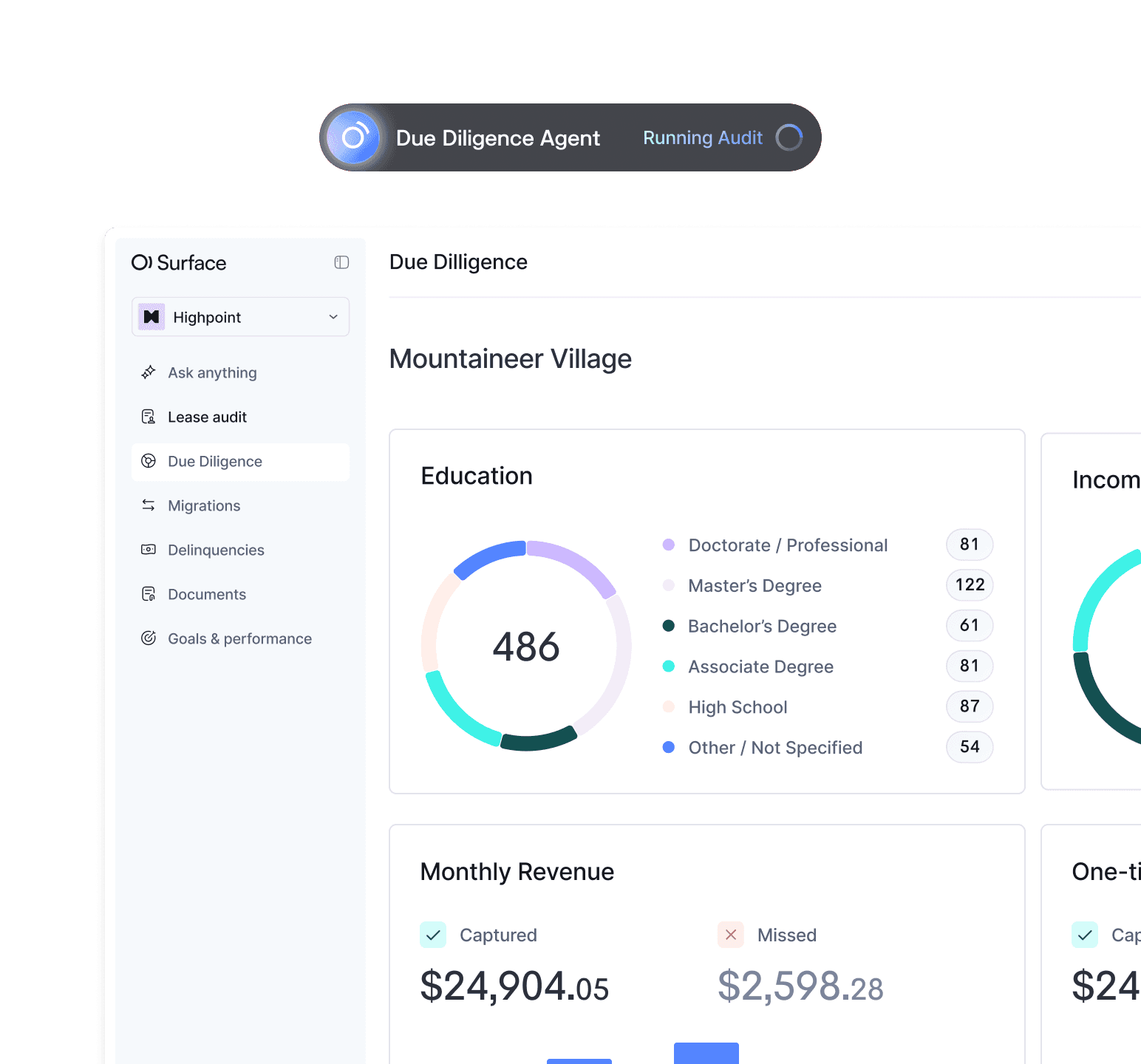
SurfaceAI helps multifamily operators run lease review for property acquisitions as a controlled process. It reads leases, compares their terms against the rent roll and ledger, and surfaces the discrepancies that affect the deal.
Instead of:
- Sampling, SurfaceAI screens the full portfolio.
- Manual inconsistency, it applies the same rules to every lease.
- A scavenger hunt, it works from centralized data.
That removes the bottlenecks that slow diligence. Teams review more of the portfolio in less time.
SurfaceAI does not replace the judgment of an experienced acquisitions team. It gives them a complete, consistent view of the leases, so they spend their time on decisions rather than document hunting.
Conclusion
Lease review for property acquisitions slows down for reasons that are structural, not careless.
- Volume outpaces the timeline.
- Files scatter across systems.
- Deadlines compress.
- Manual review drifts.
- And no standard carries from one deal to the next.
Each bottleneck costs coverage. Together, they leave most acquisitions reviewing a fraction of the leases they should. The teams that move fastest do not just work harder. They centralize, screen the full portfolio, apply one standard, and automate the repetitive work.
Do you want to review more of the portfolio before you close? Book a demo to see how SurfaceAI removes the bottlenecks that slow lease review.
Frequently Asked Questions About What Slows Lease Review Before Multifamily Acquisitions