
Revenue Leakage: What It Is and How to Stop It
Every business loses some revenue it already earned. Money slips through gaps in billing, contracts, and systems, never reaching the bottom line. This quiet loss has a name: revenue leakage. In multifamily real estate, income flows from thousands of lease terms across a portfolio, so the leak can run wider than most operators realize.
Revenue leakage rarely announces itself. No alarm sounds when a charge goes unbilled or a concession outlives its term. The money simply never arrives, and the reports look clean.
That invisibility is what makes leakage so costly, and so worth understanding. This guide explains what revenue leakage is, how to spot it, and how to shut it down.
Operational gaps can translate into meaningful financial losses for multifamily operators. Multifamily Dive reported that 77% of surveyed operators said rental fraud reduced income or increased costs by 10% to 20%. Gaps in fraud prevention, inconsistent application standards, and delayed detection were among the contributing issues. See Multifamily Dive’s report on the financial impact of rental fraud.
What Is Revenue Leakage?
The revenue leakage definition is simple. Revenue leakage is the loss of earned income from process gaps, billing errors, or system failures, rather than from weak sales. To define revenue leakage in one line: money you earned but never collected.
That distinction matters. A company with strong sales can still lose real money to leakage, because the problem lives in execution, not demand. The earned revenue exists on paper. Getting it from the contract to the bank account is where it disappears.
Some people use the term financial leakage to describe the same phenomenon across a broader set of costs and losses. Revenue leakage focuses specifically on the income side: money a business earned but failed to capture.
Common Causes and Sources of Revenue Leakage
Leakage comes from the seams between systems and processes, not from a single failure. The common causes of revenue loss show up again and again. Knowing the sources of revenue leakage is the first step to closing them.
Manual data entry creates gaps. When people key in charges by hand, some charges never make it into the system. Human error at scale becomes systematic loss.
Disconnected systems lose data in transit. When contract terms live in one system and billing in another, they fall out of sync. What the agreement says and what the system bills drift apart.
Operational inefficiencies erode accuracy over time. Concessions expire, rates escalate, and terms change. Each change is a chance for inaccurate billing to fall behind the contract.
Financial reporting hides the gap. Standard reports check a system against itself, confirming the math adds up internally. They rarely check the system against the source agreement, so a missing charge produces no flag.
Weak accounts receivable follow-up lets billed income go uncollected. A charge can reach the ledger yet still never reach the account if no one chases it.

Revenue Leakage in Multifamily Real Estate
Multifamily operators face revenue leakage in a particularly acute form, because income comes from so many individual lease terms. Each lease is a contract with its own rent, fees, concessions, and escalations. Multiply that across thousands of units, and the surface area for leakage grows enormous.
In multifamily, revenue leakage occurs most often as a charge written into a lease but never added to the ledger. Other examples include a concession that expired yet still reduces rent, or a rent escalation that never took effect. An amenity or pet fee the lease requires but the system omits counts too. Our guide to why lease audits miss revenue leaks covers how these slip through.
None of these looks dramatic on a single unit. A missed fifty-dollar fee barely registers. Across a large portfolio, though, thousands of small gaps compound into a meaningful share of income. The property earned all of it and collected none.
How to Identify Revenue Leakage
Finding leakage means looking where standard reporting does not. The gap sits between what agreements say and what systems actually bill.
Compare the source against the system. The core method is simple to state and hard to do by hand. Take each contract, read its terms, and check them against what the ledger charges. Every disagreement is potential leakage.
Look at the full population, not a sample. Leakage does not spread evenly. A systematic billing error can affect hundreds of units while never appearing in a small sample. A real revenue leakage analysis checks everything, because the gap often hides in the records no one reviewed.
Focus on the revenue-impacting fields first. Rent, recurring charges, and concessions move the most money. Checking these first surfaces the largest leaks fastest.
Watch the billing cycles and points of change. Renewals, amendments, move-ins, and transfers are where contract terms change and billing falls behind. These moments deserve the closest attention.
Revenue Leakage Control and Analysis
Identifying leakage once is useful. Controlling it continuously is what protects income over time, and this is where strong revenue management pays off.
Revenue leakage control means building the checks into operations so gaps get caught as they appear, not months later. A one-time cleanup recovers past losses. Ongoing control prevents new ones from forming.
Strong revenue leakage analysis goes beyond counting errors. Good analysis traces each leak to its cause, whether a broken process, a system handoff, or a point of change.
That way, the team fixes the underlying gap. Correcting the specific charge recovers that dollar. Fixing the process that caused it recovers every future dollar it would have cost.
The most effective approach treats leakage as a systemic issue rather than a series of one-off mistakes. When the same error appears across many units, that pattern points to a process gap worth fixing at the root.
The Role of a Revenue Leakage Audit
A revenue leakage audit reviews contracted terms against actual billing to quantify and recover lost income. Think of it as a targeted examination of where earned revenue is escaping.
A good audit does three things. First, it measures the leak, showing how much income the gaps represent. Second, it locates the leak, identifying the specific units, charges, and processes involved. Third, it supports recovery, giving teams the detail they need to correct charges and reclaim income.
Done once, an audit recovers back revenue. Regular auditing turns that one-time recovery into a control system that keeps leakage from returning. Moving from periodic audit to continuous validation separates operators who plug leaks once from those who keep them sealed.
Revenue Leakage Prevention
Prevention is cheaper than recovery, and far less disruptive. Stopping a leak before it forms avoids the lost income entirely.
Effective revenue leakage prevention rests on a few principles. Validate continuously, so the system and the source agreement stay aligned in real time. Standardize processes, so the same steps run the same way every time and drift has fewer places to start.
Automate the checks, because manual review cannot keep pace at scale. Act at the points of change, catching discrepancies the moment a term changes rather than at the next reconciliation.
Together these turn leakage from an accepted cost of doing business into a managed, shrinking problem. Our guide to preventing lease revenue leakage covers the multifamily playbook in depth.
How SurfaceAI Stops Revenue Leakage
Continuous auditing uses technology to move financial controls beyond periodic reviews and toward ongoing validation. The Institute of Internal Auditors explains that continuous auditing and monitoring provide ongoing assessments of risks and controls, helping organizations identify issues sooner and improve control effectiveness.
SurfaceAI is built to close the exact gap where revenue leaks: the space between what a lease says and what the ledger bills.
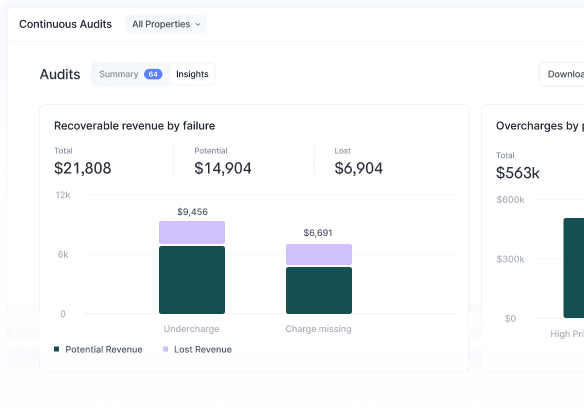
The platform reads every lease and compares the terms against the rent roll and ledger. The system flags each discrepancy that represents lost income. A missed charge, an expired concession, a rent that does not match the lease, each becomes a specific, correctable exception. Running continuously across the whole portfolio, the system catches gaps as they form rather than months later.
This covers the full cycle of leakage work. SurfaceAI identifies the leaks and traces them to their source for analysis. The platform serves as a continuous audit and prevents new leakage by validating data in real time.
For operators, that means earned income actually reaches the bottom line. Our guide to lease analysis software shows how the validation works.

“I’ve been thoroughly impressed with the Surface AI lease audit product. It’s exceptionally user-friendly, and the audit results are clear, concise, and easy to interpret. The impact on our student teams has been tremendous—what once took several days can now be completed in just a few hours. The tool also makes it simple to identify and address issues efficiently. I can’t speak highly enough about the value this product brings.”
Amanda Pour, Operations Compliance Manager
Conclusion
Revenue leakage is the income a business earned but never collected, lost to process gaps rather than weak demand. In multifamily real estate, leakage hides between thousands of lease terms and the systems meant to bill them. Reports that only check a system against itself never see it.
The fix is to look where those reports do not. Compare every agreement against what the system actually bills, across the full portfolio, continuously. Identify the leaks, control them at the source, and prevent new ones from forming. Earned revenue is only real when it reaches the account, and stopping leakage is how an operator makes sure it does.
Ready to find the revenue your portfolio is already losing? Book a demo to see how SurfaceAI stops the leak.
Frequently Asked Questions About Revenue Leakage