8 Reasons Manual Lease Audits Miss Compliance Risks

Lease audits have always been an important part of multifamily operations.
They help property management teams verify lease accuracy, ensure compliance, identify billing errors, and protect rental revenue. But portfolios keep growing and lease data keeps fragmenting. It now sits across property management systems, document repositories, and spreadsheets. Traditional manual audits are getting harder to sustain at that scale.
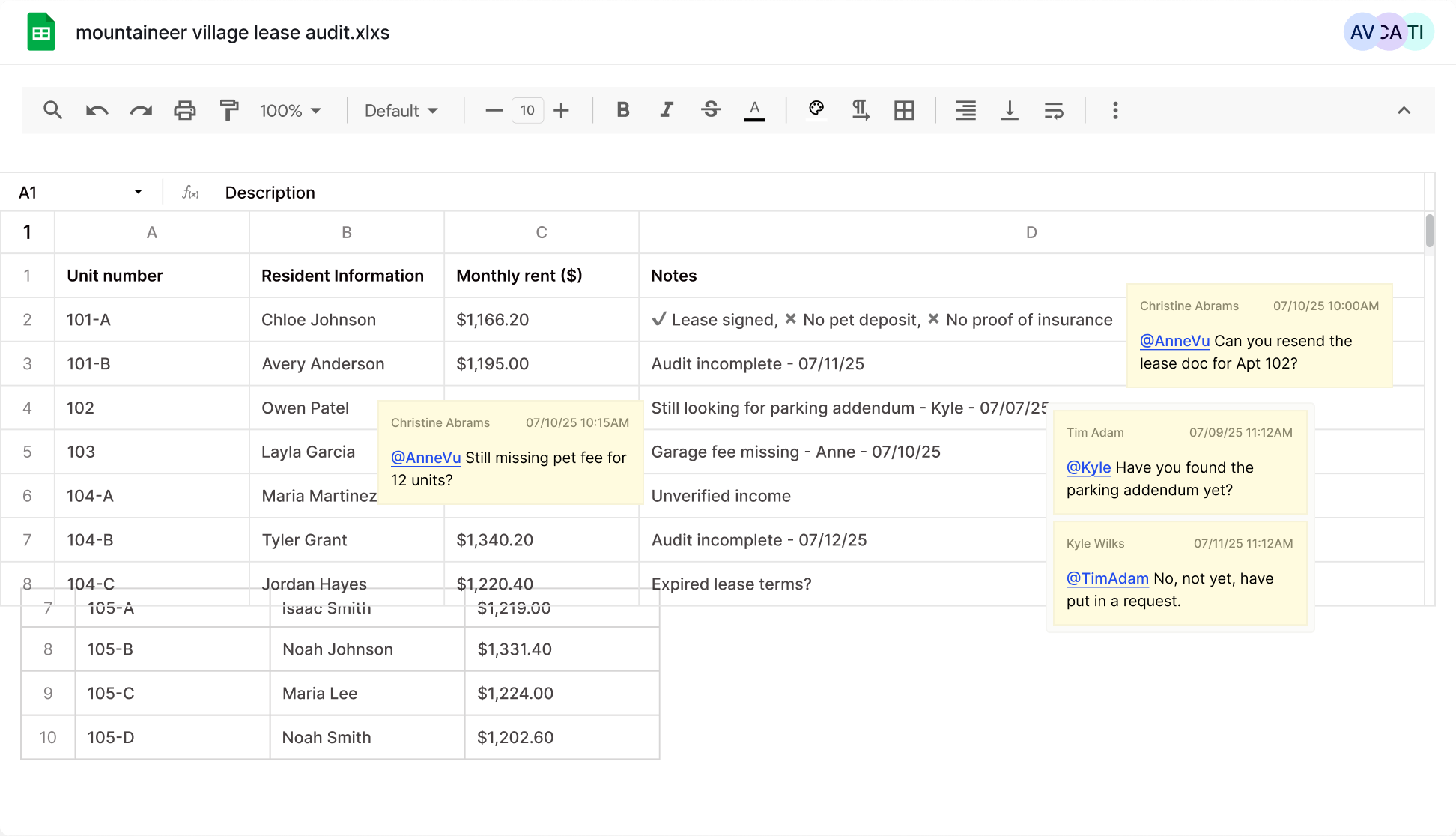
Many operators still conduct lease audits periodically using spreadsheets and manual document reviews. That approach may have worked for smaller portfolios. But it often leaves compliance issues and revenue-impacting discrepancies undiscovered for months.
Modern lease compliance software is changing that. Automated systems take a different approach. Instead of reviewing every lease one by one, they continuously analyze portfolio data, identify exceptions, and direct teams to the records that actually require attention.
Here are eight reasons manual lease audits frequently miss compliance risks.
1. Manual Audits Only Capture a Snapshot in Time
Most multifamily operators conduct lease audits quarterly, semi-annually, or before major events like acquisitions or ownership transitions.
The problem is that lease data changes every day.
Residents sign new leases. Teams process renewals. Staff upload addenda. Accounting modifies charges. Onsite teams update resident information continuously.
A lease that was accurate during last month’s audit may contain discrepancies today.
Continuous monitoring catches these changes as they happen. That lets operators identify issues in real time rather than months later. For more on the continuous-vs-periodic argument, see our take on why lease audits shouldn’t be occasional →
2. Reviewing Every Lease Doesn’t Scale
A 300-unit property may contain thousands of individual lease-related documents.
A portfolio with 20 or 30 communities can quickly grow into hundreds of thousands of documents.
Reviewing every lease manually becomes nearly impossible without significant staffing.
As portfolios grow, audit quality often declines. Teams simply cannot review everything consistently. Automated audit workflows scale with portfolio size while maintaining consistent review standards, reducing manual review work.
3. Hidden Revenue Leakage Often Goes Undetected
Many revenue losses do not come from major accounting errors.
They come from small discrepancies such as:
- missing pet fees
- incorrect parking charges
- outdated utility billing
- lease concessions that remain active after expiration
- recurring fees that never entered the property management system
These issues are difficult to identify manually. They require comparing information across multiple records, systems, and billing systems.
Automation compares lease documents, rent rolls, and PMS data to identify discrepancies that may indicate revenue loss. For more on this topic, see our guide to preventing multifamily lease leakage →
Billing and calculation errors can create substantial financial losses across rental housing operations. According to the U.S. Government Accountability Office, inaccurate tenant subsidy calculations and incomplete supporting documents contributed to $35 million in improper rental assistance payments in fiscal 2007. Fiscal 2010 still reported $15 million in similar issues.
4. Compliance Issues Are Buried in Large Volumes of Documents
Lease compliance depends on complete and accurate documentation.
Missing or outdated documents may include:
- lease addenda
- income certifications
- renewal agreements
- resident acknowledgements
- required disclosures
When teams rely on manual reviews, missing documents often stay undiscovered until an audit, acquisition, or legal issue arises.
Exception-based auditing automatically identifies incomplete records. Teams can then resolve issues earlier and stay compliant with fewer surprises.
5. Human Error Is Unavoidable
Even experienced leasing professionals make mistakes.
Manual audits involve repetitive tasks:
- reviewing leases
- comparing dates
- verifying charges
- confirming resident information
- checking documentation
- tracking critical dates like renewals and lease expirations
Fatigue and inconsistent review practices increase the likelihood of missed issues. Manual processes are time consuming and vulnerable to human oversight.
Automation provides a consistent auditing process that applies the same validation rules across every lease.
6. Manual Audits Focus on Reviewing Everything Instead of Reviewing Exceptions
Traditional audits require teams to inspect every record regardless of whether it contains a problem.
This approach consumes significant time while producing relatively few findings.
Modern audit automation tools take the opposite approach. Instead of reviewing every lease, the system identifies exceptions such as:
- lease term mismatches
- missing lease documents
- inconsistent charges
- conflicting lease terms
- incomplete records
Property teams spend their time resolving actual issues rather than searching for them. This exception-based workflow dramatically improves audit efficiency.
7. Data Lives Across Multiple Systems
Multifamily operators rarely store all lease information in a single location.
Critical data may exist across:
- property management systems
- the accounting system
- document repositories
- shared drives
- email attachments
- resident portals
Manual audits require teams to switch between systems repeatedly. That slows reviews and increases the chance of overlooking inconsistencies.
Automation connects information across systems. That makes hidden discrepancies easier to find. It also produces a cleaner audit trail across finance teams and operations.
8. Manual Audits Make It Difficult to Prioritize Risk
Not every discrepancy has the same impact.
Some issues represent minor administrative errors. Others expose the organization to significant compliance or financial risk. Those show up in the financial data or the next financial report.
Manual processes often produce long lists of findings. They rarely help teams decide what to address first.
Modern lease compliance software prioritizes exceptions based on severity. Teams focus on the highest-risk issues before they affect cash flow or portfolio performance.
Continuous auditing uses technology to provide ongoing assessments of risks and controls rather than relying solely on periodic reviews. The Institute of Internal Auditors notes that combining continuous auditing with continuous monitoring can improve efficiency, risk management, and control effectiveness. See The IIA’s Continuous Auditing and Monitoring guidance →
What Automated Lease Auditing Looks Like
Unlike traditional audit processes, automated systems continuously review operational data and surface only the records that require attention.
Instead of manually comparing documents one by one, automated systems analyze:
- lease agreements
- rent rolls
- resident records
- recurring charges
- amendments
- compliance documentation
When inconsistencies are detected, the system flags the exception for review. That lets property teams spend less time searching for problems and more time resolving them.
Benefits of Exception-Based Lease Auditing
Exception-based auditing offers several advantages over traditional manual reviews.
Faster audits. Teams focus only on records that contain discrepancies.
Better compliance. The system catches missing documents and incomplete records earlier. That improves audit readiness.
Stronger revenue protection. Teams can fix billing errors and lease mismatches before they turn into ongoing revenue loss.
Consistent review standards. The system evaluates every lease against the same validation criteria. That reduces the risk of missed issues.
Improved portfolio visibility. Leadership gains a centralized view of audit findings across multiple properties rather than relying on isolated property-level reviews.
Where SurfaceAI Fits
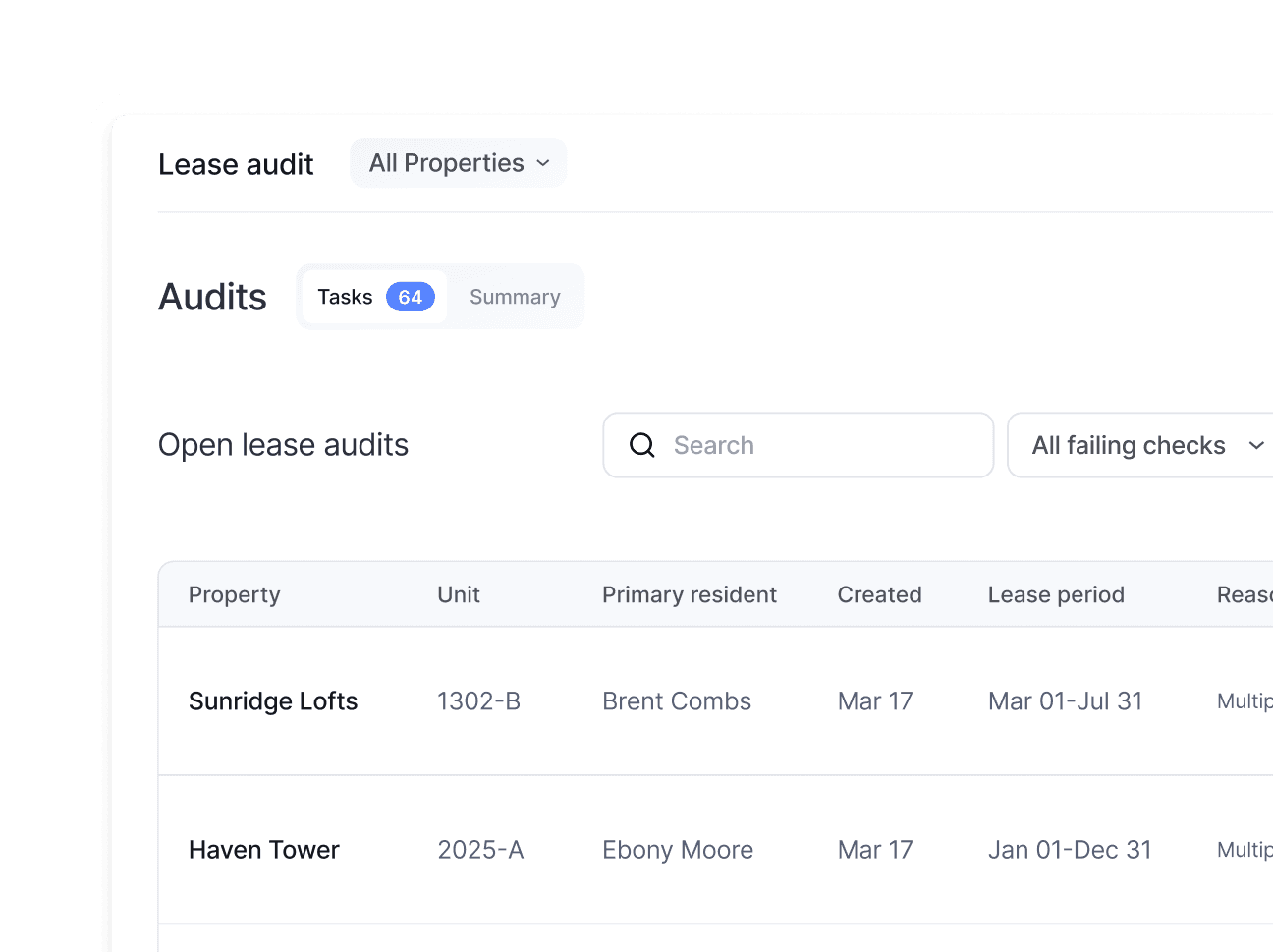
SurfaceAI helps multifamily operators move beyond manual lease reviews by automating exception-based lease auditing across their portfolio.
Rather than replacing your property management system, SurfaceAI works alongside existing technology to continuously compare lease documents, rent rolls, and operational records.
SurfaceAI helps teams:
- identify lease discrepancies
- detect missing lease documents
- surface compliance exceptions
- uncover revenue leakage
- validate recurring charges
- improve audit readiness
- prioritize high-risk issues
Instead of requiring staff to manually review every lease, SurfaceAI directs attention to the records that need investigation. That helps teams improve both efficiency and accuracy.
For product context, see the SurfaceAI Lease Audit Agent and Document Management Agent →

“I’ve been thoroughly impressed with the Surface AI lease audit product. It’s exceptionally user-friendly, and the audit results are clear, concise, and easy to interpret. The impact on our student teams has been tremendous—what once took several days can now be completed in just a few hours. The tool also makes it simple to identify and address issues efficiently. I can’t speak highly enough about the value this product brings.”
Amanda Pour, Operations Compliance Manager
Manual Audits vs Automated Auditing
Manual Lease Audits |
Automated Lease Auditing |
|---|---|
| Performed periodically | Continuous monitoring |
| Reviews every lease | Reviews exceptions automatically |
| Time-intensive | Scales across large portfolios |
| High reliance on manual effort | AI-assisted validation |
| Issues often found months later | Issues identified closer to real time |
| Difficult to prioritize risk | High-risk exceptions prioritized |
| Inconsistent review quality | Consistent validation across every lease |
Key Takeaways
Manual lease audits remain an important operational practice. But they never handled the speed, scale, and complexity of today’s multifamily portfolios.
Lease data keeps growing across multiple systems. Relying solely on periodic manual reviews increases the likelihood of missed compliance issues, documentation gaps, and revenue leakage.
Exception-based auditing helps operators continuously monitor lease data, identify discrepancies sooner, and focus resources where they have the greatest impact.
Conclusion
If your team wants to strengthen property management compliance, improve audit readiness, and gain better visibility into lease accuracy, book a demo. SurfaceAI helps uncover issues before they become costly problems
Frequently Asked Questions About How Manual Lease Audits Miss Compliance Risks