
Lease Audit: What It Is, and How the Process Works

A signed lease may say one thing while the rent roll or property management system says another.
A lease audit identifies those differences.
For multifamily operators, a lease audit compares executed lease documents with operational records. The goal is to verify that rent, charges, dates, concessions, deposits, renewals, and documentation were recorded correctly.
The objective is straightforward: ensure the information used for billing, reporting, compliance, and property operations reflects the agreements actually in force.
This guide explains what a lease audit is, what to review, how the lease audit process works, and when automation becomes useful.
What Is a Lease Audit?
A lease audit is a structured review of lease agreements and the corresponding operational records.
In multifamily, auditors commonly compare leases and supporting documents with:
- Rent rolls
- Property management system records
- Resident ledgers
- Renewal records
- Charge schedules
- Concessions
- Deposits
The review determines whether the contractual terms and operating data agree.
If they do not, the difference becomes an exception for investigation.
Why Lease Audits Matter
Small lease discrepancies can create larger problems when repeated across a portfolio.
Lease audits can help identify issues affecting:
- Rental revenue
- Financial reporting
- Compliance
- Resident accounts
- Due diligence
- Property transitions
- Portfolio data quality
The value is not simply finding mistakes. The real payoff is greater confidence in the information operators use to run the property. Accurate lease data also supports better tracking of operational expenses tied to each unit.
Audit quality depends on verifying the accuracy and completeness of the information being reviewed rather than accepting system-produced data at face value. The PCAOB’s Audit Evidence standard requires auditors to test the accuracy and completeness of company-produced information and evaluate whether the evidence is sufficiently reliable and detailed for the audit’s purpose. See PCAOB AS 1105: Audit Evidence →
Lease Audit vs. Rent Roll Audit
A rent roll audit primarily verifies information contained in the rent roll.
A lease audit is broader. The audit uses lease documentation to validate the rent roll and other operating records.
For example, a rent roll may contain:
- Resident name
- Unit
- Monthly rent
- Lease dates
- Occupancy status
The lease and its supporting documents provide the contractual evidence behind those fields.
Rent roll verification is therefore an important component of the broader lease audit process.
What Does a Lease Audit Check?
The scope varies by operator, but most multifamily lease audits review the following areas.
1. Base Rent
Confirm that contractual rent agrees with the rent roll, PMS, and applicable resident records.
2. Lease Dates
Verify relevant start, expiration, renewal, and amendment dates.
Incorrect dates can affect renewals, billing, occupancy reporting, and other workflows.
3. Recurring Charges
Review contractual charges such as:
- Pet rent
- Parking
- Storage
- Utility reimbursements
- Amenity fees
A documented charge that is absent from billing may represent revenue leakage.
4. Concessions
Confirm the amount, duration, effective period, and supporting documentation for concessions.
5. Deposits
Compare deposit obligations with the corresponding ledger or transfer records.
6. Addenda
Verify required supporting agreements and confirm that the operating system reflects the applicable terms.
7. Renewals and Amendments
Identify the document containing the current terms and confirm that property records incorporate the changes.
8. Document Completeness
Check for missing or incomplete leases, renewals, addenda, signatures, and other required documents.
The Lease Audit Process: Step by Step
A repeatable lease audit process generally follows eight stages.
Step 1: Define the Scope
Determine why the audit is being conducted and what needs to be reviewed.
Common use cases include:
- Routine operational reviews
- Revenue verification
- Compliance reviews
- Acquisitions
- Management transitions
- Pre-disposition preparation
The purpose of the audit should determine the fields and properties included.
Step 2: Establish the Current Source Documents
Identify the documents that define the resident’s current obligations, such as:
- Executed lease
- Latest renewal
- Amendments
- Addenda
- Concession agreements
This keeps outdated documents from standing in as current terms.
Step 3: Gather the Operating Records
Collect the records being validated, including the rent roll, PMS data, resident ledger, and relevant charge records.
Step 4: Compare Key Fields
Validate the contractual information against the operating records.
Typical fields include:
- Rent
- Charges
- Dates
- Deposits
- Concessions
- Resident information
Apply the same validation rules consistently across the audit population.
Step 5: Identify Exceptions
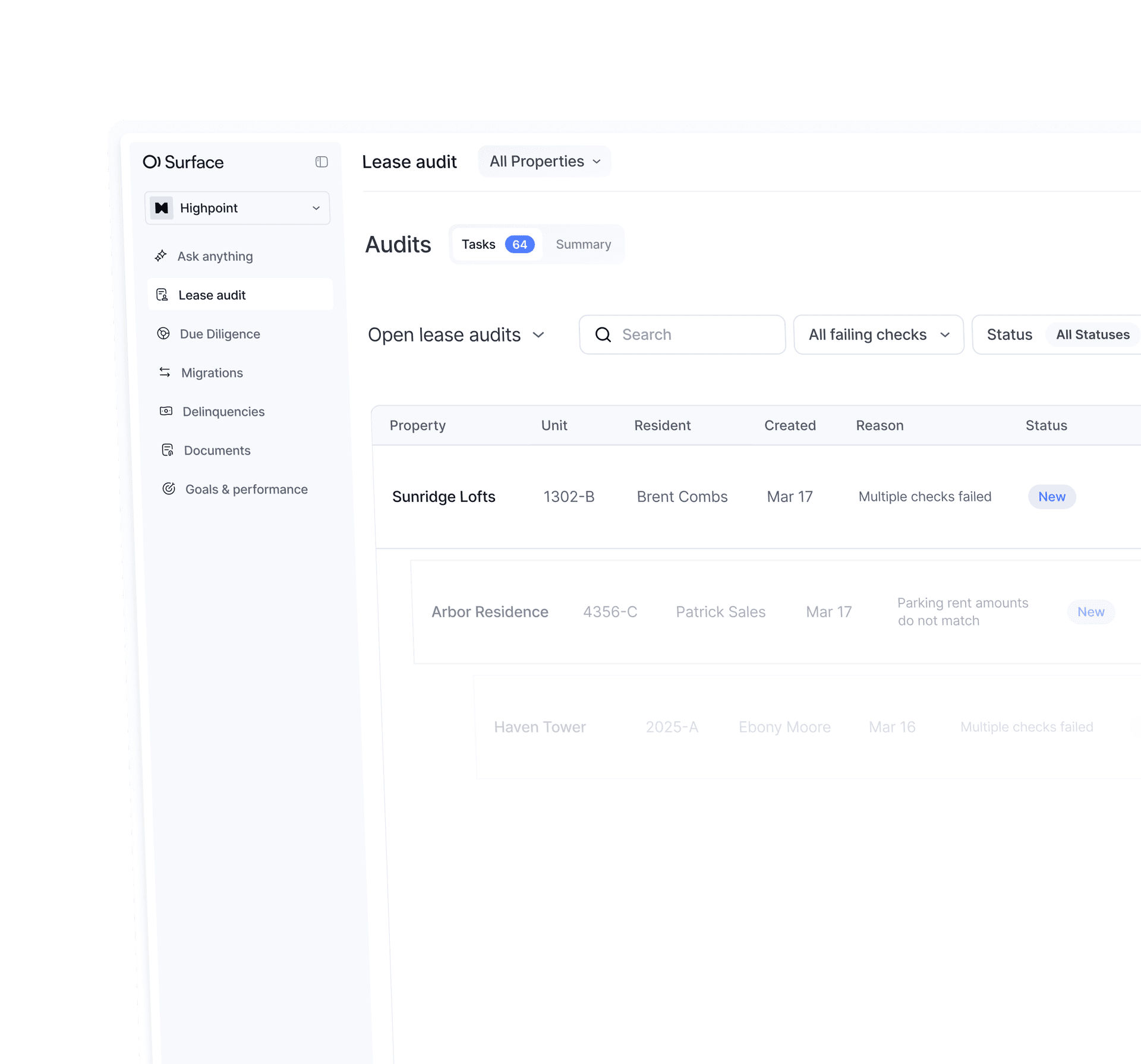
Flag records where the information does not align or the required documentation is unavailable.
Common exceptions include:
- Rent mismatches
- Missing charges
- Incorrect dates
- Missing documents
- Unsupported fees
- Incorrect concessions
An exception requires review. An exception does not automatically mean an error occurred.
Step 6: Determine the Cause
Investigate why the discrepancy exists.
Possible causes include data entry mistakes, missing documentation, incorrect document classification, migration problems, or inconsistent operating procedures.
This step separates one-off errors from broader process failures.
Step 7: Remediate Verified Issues
Correct the appropriate documentation or system record according to the organization’s approval and compliance procedures.
Step 8: Review Patterns
Aggregate findings by property and exception type.
Repeated findings can reveal workflow problems worth fixing at the process level rather than one unit at a time.
Manual Lease Audits
A manual lease audit puts the work on staff. They locate the relevant documents, find the required terms, compare them against operating records, document the differences, and investigate findings.
This approach can work for limited review volumes.
The challenge is scale.
A large lease portfolio can require teams to compare thousands of documents and data points, making the process time-consuming and difficult to perform frequently.
Manual reviews can also vary depending on the reviewer.
For a deeper examination of these limitations, see 8 Reasons Manual Lease Audits Miss Compliance Risks →
Automated Lease Audits
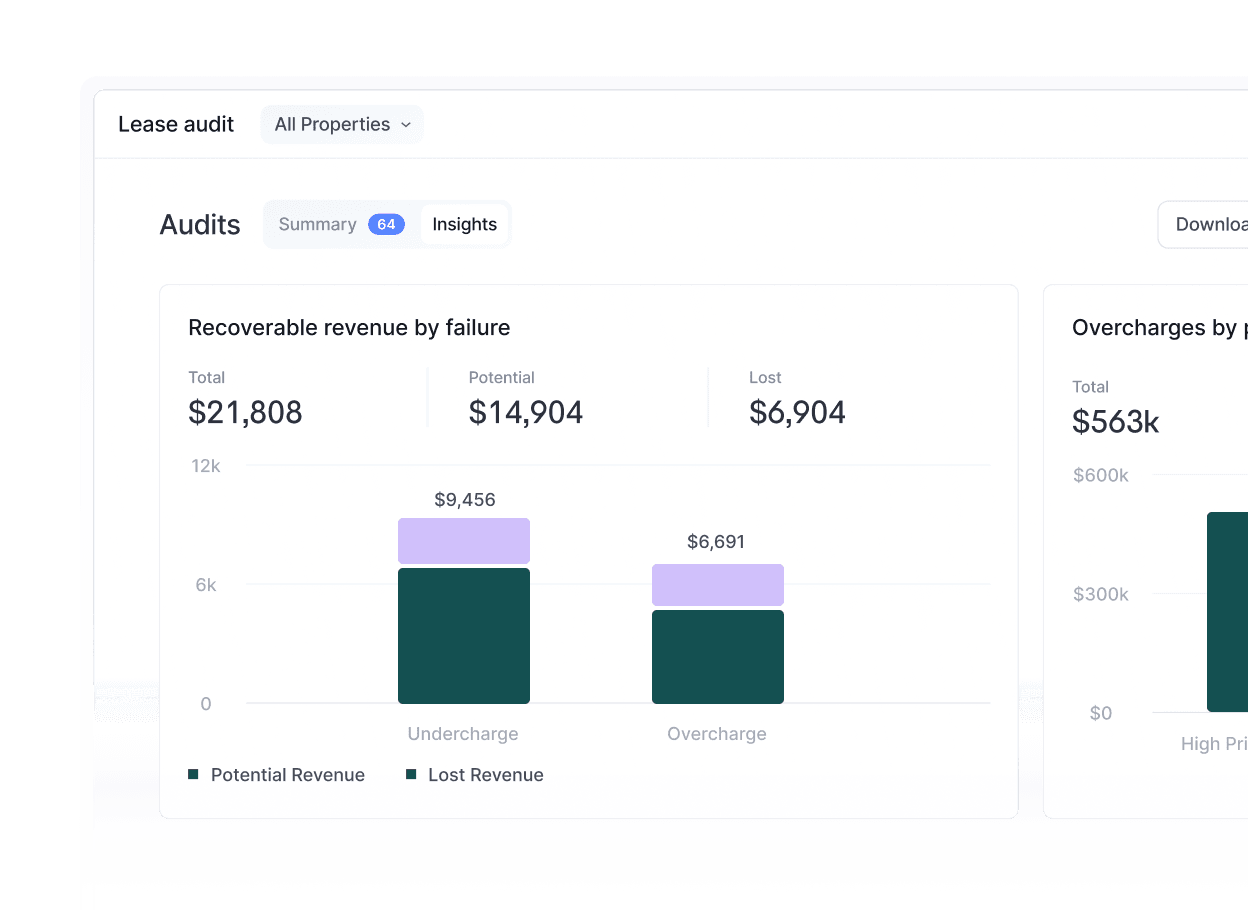
Automated lease auditing reduces the manual work required to locate and compare information.
Depending on the system, software can assist with:
- Document classification
- Lease data extraction
- PMS and rent roll comparison
- Missing-document detection
- Exception identification
- Portfolio-level reporting
The cost saving comes from catching discrepancies early and reducing repetitive manual review.
For a deeper look at this technology, see Automated Lease Auditing Software and Lease Audit Software vs. Lease Management Software →
Manual vs. Automated Lease Audits
| Manual Lease Audit | Automated Lease Audit |
|---|---|
| Documents reviewed individually | Documents can be analyzed systematically |
| Fields compared manually | Fields can be compared automatically |
| Review frequency limited by staff capacity | Larger populations can be reviewed more frequently |
| Findings tracked manually | Exceptions can be centralized |
| Reviewer consistency may vary | Validation rules can be standardized |
| Staff spends significant time finding issues | Staff can focus more time on investigating issues |
Automation does not remove human judgment. It reduces the manual effort required to determine where that judgment is needed.
What Is an Exception-Based Lease Audit?
Exception-based auditing directs operators toward leases that fail defined validation checks rather than requiring the same manual review of every record.
Exceptions can be organized by:
- Issue type
- Property
- Financial impact
- Compliance significance
- Frequency
This is particularly useful for large portfolios because repeated exceptions can expose systemic operating problems.
How Often Should Lease Audits Be Performed?
No universal schedule exists. Performing lease audits on a regular schedule keeps lease data accurate as terms change.
Frequency depends on factors such as:
- Portfolio size
- Risk tolerance
- Data quality
- Acquisition activity
- Compliance requirements
- Staff capacity
Operators may conduct audits quarterly, annually, during transactions, or when a specific concern arises.
Automated systems can support more frequent validation by reducing the manual effort required for each review.
Continuous auditing moves assurance beyond periodic reviews by using technology to test controls and data on an ongoing basis. ISACA explains that continuous auditing can automate error checking and data verification in real time, allowing emerging risks and control issues to surface more frequently than with traditional retrospective audits. See ISACA’s audit of continuous auditing and digital transformation →
Lease Audits During Acquisitions
During a multifamily acquisition, a lease audit helps verify whether the underlying documents support the information used during underwriting.
Buyers may validate:
- Contractual rent
- Lease dates
- Concessions
- Recurring charges
- Deposits
- Document completeness
Material discrepancies can influence revenue assumptions, post-close planning, and confidence in the acquisition data.
Lease Audits During Ongoing Operations
Lease audits are also useful as an operational control.
Regular validation can help identify:
- Revenue discrepancies
- Documentation gaps
- PMS errors
- Compliance exceptions
- Recurring workflow failures
This makes lease auditing relevant throughout the property’s lifecycle, not only during transactions.
Lease Audit vs. Lease Management
While they sound similar, lease management and lease auditing serve different purposes.
Lease management supports activities such as:
- Lease creation
- Document storage
- Renewals
- Critical-date tracking
- Resident administration
Lease auditing checks whether the resulting documentation and operational records remain aligned.
For a deeper comparison, see Lease Audit Software vs. Lease Management Software →
What Lease Audit Software Should Help Operators Do
Useful lease audit software should help operators:
- Identify the current lease documents
- Extract relevant lease terms
- Verify rent roll and PMS information
- Detect missing documentation
- Surface exceptions
- Review findings across properties
The goal is not another report.
The point is to make it easier to find where investigation is actually required.
Where SurfaceAI Fits
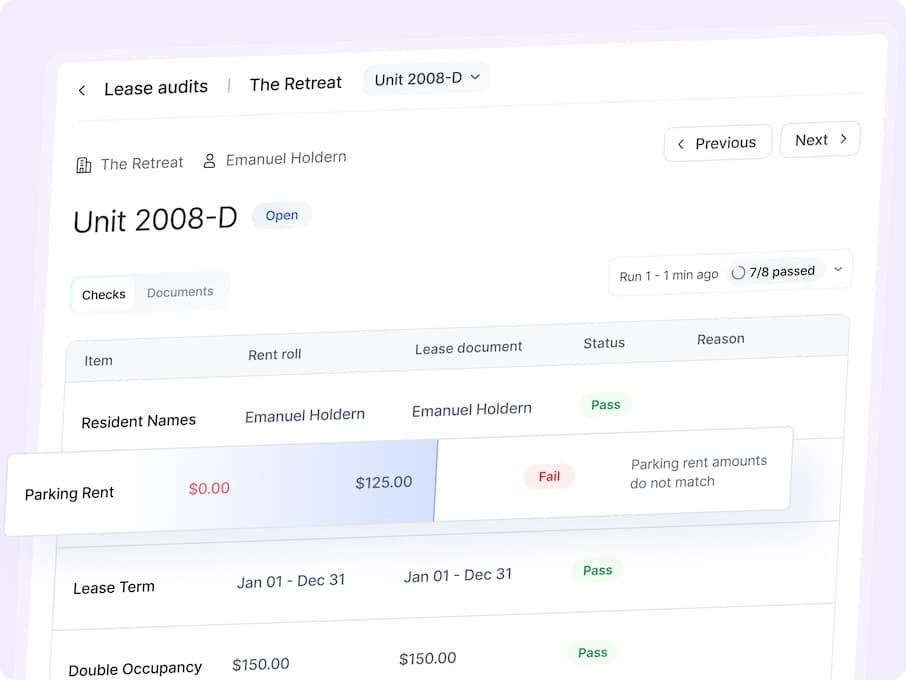
SurfaceAI supports the validation layer of multifamily lease auditing. The platform analyzes lease documentation alongside operational records to surface discrepancies in rent, charges, dates, concessions, renewals, and document completeness.
That enables operations teams to direct attention toward exceptions rather than reviewing every lease manually.
At portfolio scale, repeated findings also help teams spot processes that need standardizing or correcting.

“I’ve been thoroughly impressed with the Surface AI lease audit product. It’s exceptionally user-friendly, and the audit results are clear, concise, and easy to interpret. The impact on our student teams has been tremendous—what once took several days can now be completed in just a few hours. The tool also makes it simple to identify and address issues efficiently. I can’t speak highly enough about the value this product brings.”
Amanda Pour, Operations Compliance Manager
What Happens After a Lease Audit?
The audit should lead to both record-level corrections and operational improvement.
Operators should determine:
- What needs to be corrected?
- Why did the issue occur?
- Does the underlying process need to change?
Repeated findings may indicate the need for clearer document classifications, stronger addendum requirements, improved renewal workflows, or other process changes.
The objective is to prevent the same issue from returning.
Building a Lease Audit Program
A practical program can follow this cycle:
Define
Set the audit scope and validation rules.
Validate
Compare source documents with operating records.
Surface
Identify exceptions.
Investigate
Determine whether the finding represents an error or another documented condition.
Correct
Remediate confirmed issues.
Analyze
Look for recurring patterns.
Improve
Address processes producing repeated exceptions.
Monitor
Continue reviewing priority areas over time.
Common Lease Audit Mistakes
Auditing Only Base Rent
Charges, concessions, dates, deposits, and supporting documentation may also affect revenue and compliance.
Treating the PMS as the Source of Truth
The audit exists to independently validate operational records against the contractual documents.
Correcting Findings Without Addressing Root Causes
Repeated exceptions often indicate a process problem.
Auditing Only During Transactions
Lease data can become inaccurate during everyday operations, making periodic operational review valuable as well.
Lease Audit Checklist
Use this framework as a starting point:
- [ ] Confirm the current executed lease or renewal
- [ ] Verify resident and unit information
- [ ] Compare base rent
- [ ] Verify lease dates
- [ ] Review recurring charges
- [ ] Review concessions
- [ ] Verify deposits
- [ ] Confirm required addenda
- [ ] Check document completeness
- [ ] Compare terms with the rent roll
- [ ] Compare terms with PMS records
- [ ] Record and investigate exceptions
- [ ] Correct confirmed discrepancies
- [ ] Review recurring patterns
- [ ] Improve underlying processes
- [ ] Monitor priority risks
Conclusion
A lease audit verifies that contractual lease terms agree with the operational records used to run a multifamily property.
That validation can uncover revenue discrepancies, documentation gaps, compliance issues, and broken workflows while increasing confidence in rent roll and PMS data.
For smaller portfolios, teams may still handle audits manually. As portfolios grow, automated and exception-based approaches can reduce repetitive review work and allow teams to focus on the records that require investigation.
Want a more scalable way to validate leases, rent rolls, documents, and PMS data? Book a demo to see how SurfaceAI can support your lease audit process.
Frequently Asked Questions About Lease Audit