
Best Lease Audit Tools for Yardi, Entrata and RealPage

Multifamily operators already rely on property management systems to run leasing, billing, resident records, and property operations.
But a PMS answers a different question from a lease audit tool.
The PMS tells you what is recorded.
A lease audit asks whether those records agree with the executed lease documents behind them.
That distinction matters whether your portfolio runs on Yardi, Entrata, RealPage, or a combination of systems.
The best lease audit tool for a multifamily operator is not simply the product with the longest feature list. The best tool works effectively with the operator’s existing PMS. It compares lease documentation with operational data, surfaces meaningful exceptions, and fits into existing compliance and remediation workflows.
This guide explains what to look for when evaluating lease audit tools for Yardi, Entrata, and RealPage environments. It also covers how the requirements differ across each setup. For the fundamentals behind the review itself, see our guide to the lease audit process →
Technology is becoming more deeply embedded in everyday multifamily operations. Multifamily Executive reports that operators are moving AI, analytics, service integration, and property management systems from isolated pilots into portfolio-wide workflows spanning leasing, maintenance, accounting, payments, and resident operations. See Multifamily Executive’s overview of how property-management technology is scaling across multifamily.
What Should a Lease Audit Tool Do With a Property Management System?
A lease audit tool should validate selected PMS records against the underlying lease documentation.
That usually means comparing fields such as:
- Base rent
- Recurring charges
- Lease start and expiration dates
- Concessions
- Deposits
- Renewals
- Addenda
- Resident and unit information
- Document completeness
The goal is not to replace the PMS.
It is to add a validation layer around the information already being used to operate the portfolio.
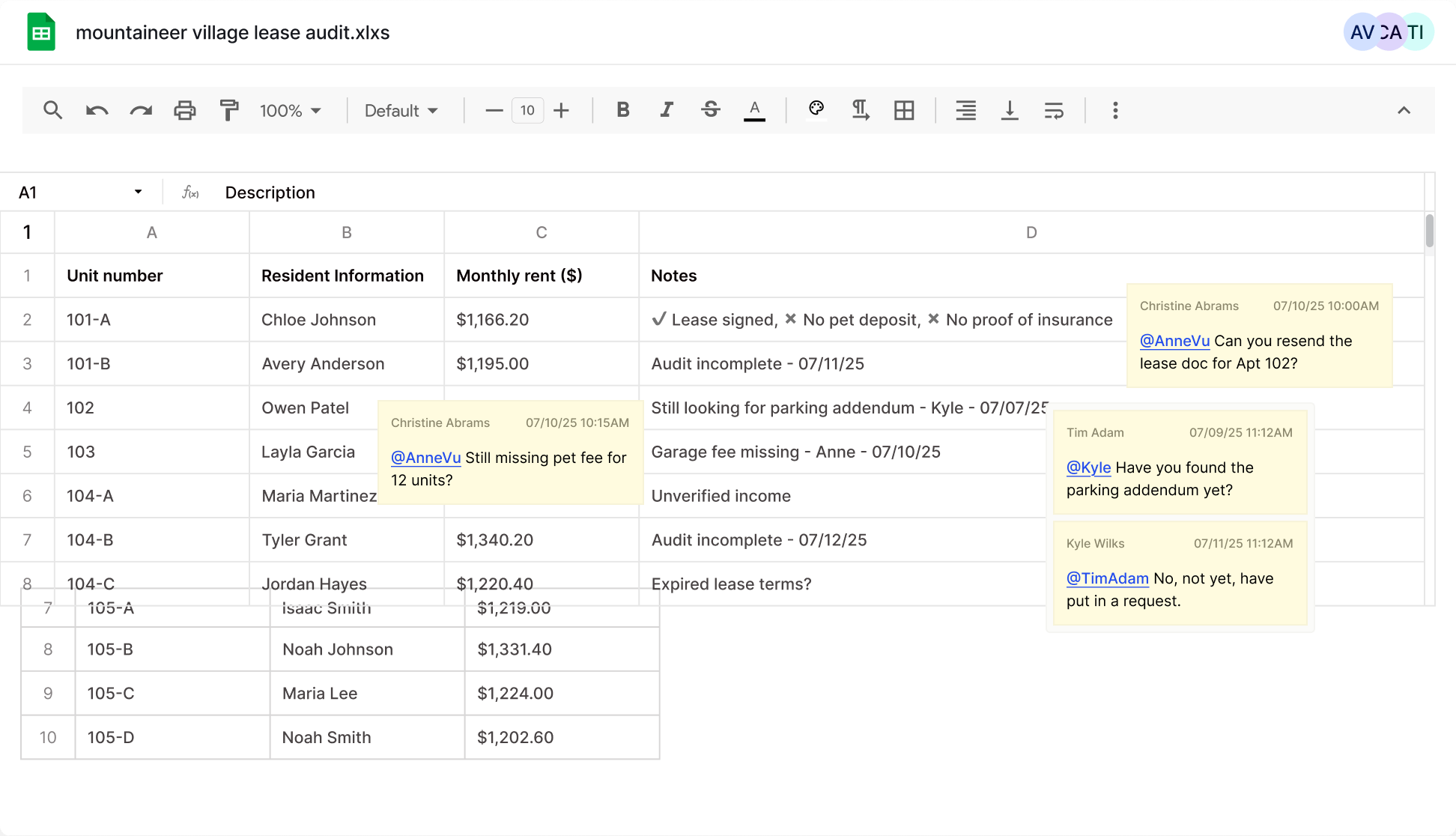
For example, the PMS might show $2,250 in monthly rent while the current executed renewal shows $2,300. The lease audit tool should surface that discrepancy for review.
That is where property management software integration becomes important.
Why Does PMS Integration Matter for Lease Auditing?
Because lease auditing depends on comparing two different sources of information.
On one side is the contractual record:
- Lease
- Renewal
- Addenda
- Concession agreement
- Other supporting documentation
On the other side is the operational record:
- PMS fields
- Rent roll
- Resident ledger
- Charge information
- Occupancy data
If audit software cannot reliably access or ingest the relevant operational data, teams may still be forced to export files and reconcile manually.
Good integration reduces that friction and makes more frequent validation possible.
What Makes a Good Lease Audit Tool for Yardi?
For Yardi operators, the strongest lease auditing setup connects lease documentation with current Yardi data and turns discrepancies into actionable exceptions.
Operators should look for the ability to:
- Compare lease terms against Yardi records
- Validate rent and recurring charges
- Check current lease dates
- Identify missing or incomplete documents
- Distinguish renewals from original leases
- Surface exceptions by property or portfolio
- Route findings into an operational review process
The more automated the data flow, the easier it becomes to move from periodic audit projects toward continuous validation.
SurfaceAI directly integrates with Yardi. That lets multifamily teams analyze lease documentation alongside operational records, without positioning another system as the PMS replacement.
The role is complementary. Yardi continues to run the property, while the audit layer checks whether selected records align with the contractual source documents.
What Makes a Good Lease Audit Tool for Entrata?
The criteria are similar for Entrata environments, but the emphasis should remain on how well the audit platform fits the operator’s existing workflows.
Look for tools that can:
- Access relevant Entrata property and resident data
- Compare current lease terms with operational records
- Detect missing charges or conflicting values
- Identify documentation gaps
- Support portfolio-level exception reporting
- Separate audit findings from day-to-day lease administration
SurfaceAI directly integrates with Entrata as well.
That lets operators keep Entrata as their property management system while adding an independent layer of lease validation around selected operational data.
This distinction is important.
A leasing workflow can be completed correctly from a process standpoint while still leaving a discrepancy between the signed agreement and the operational record. An audit tool is designed to find that gap. Our guide to why lease audits miss revenue leaks covers how these gaps form.
What Should RealPage Operators Look for?
RealPage operators should evaluate lease auditing with particular attention to the data-access workflow.
SurfaceAI does not currently have a direct RealPage integration, so operators should not assume the same connection model available with Yardi or Entrata.
For a RealPage environment, evaluate:
- Which lease and resident data can be made available for audit
- How frequently that data can be refreshed
- Whether exports or another approved workflow are required
- How lease documents are accessed
- Whether exceptions can still be centralized and reviewed efficiently
The underlying audit objective remains the same: compare the contractual record with the operating information and identify where the two do not agree.
The difference is how that information reaches the audit layer.
For RealPage portfolios, the implementation model should be clarified before selecting a tool.
Yardi vs. Entrata vs. RealPage: What Changes for Lease Auditing?
The lease audit itself is conceptually similar across all three systems.
What changes is the integration and data workflow.
PMS Environment |
What the Audit Layer Needs |
SurfaceAI Position |
|---|---|---|
| Yardi | Direct access to relevant operating data plus lease documents | Direct integration available |
| Entrata | Direct access to relevant operating data plus lease documents | Direct integration available |
| RealPage | Confirmed data-access/export workflow plus lease documents | No direct integration currently |
| Mixed PMS portfolio | Normalized audit logic across multiple data sources | Evaluate by PMS and portfolio structure |
The important point is that the PMS itself is not the competitor.
Yardi, Entrata, and RealPage remain the systems operators use to run their properties.
Lease audit technology sits alongside those systems to verify selected records.
Which Lease Audit Capabilities Matter Most?
Regardless of the PMS, operators should evaluate several core capabilities.
1. Lease Document Understanding
The system should be able to interpret the documents that establish the resident’s current obligations.
That may include:
- Original leases
- Renewals
- Addenda
- Concession agreements
- Guarantor documents
Simply storing documents is not enough.
The audit tool needs to understand which document contains the current term being validated.
2. PMS Data Comparison
The tool should compare extracted lease information against corresponding operational fields.
Without this step, the platform is doing document analysis rather than lease auditing.
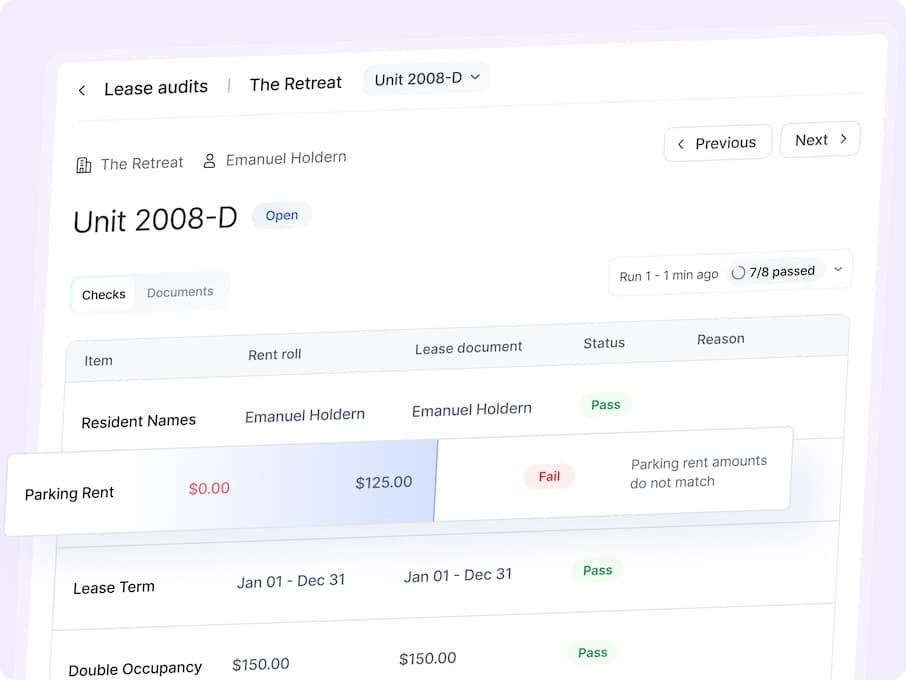
3. Exception Detection
Operators should receive clear findings such as:
- Rent mismatch
- Missing recurring charge
- Incorrect lease date
- Missing addendum
- Incomplete renewal
- Unsupported charge
The output should make it obvious what requires investigation.
4. Portfolio-Level Visibility
A useful audit tool should show whether the same issue is appearing across multiple properties.
This helps distinguish a one-off data problem from a repeatable process failure.
5. Lease Compliance Workflows
Findings should fit into a process for:
- Review
- Assignment
- Investigation
- Remediation
- Tracking
Identifying an issue without a clear path to resolution simply creates another report. Our guide to lease compliance monitoring covers how to set this up.
6. Audit Frequency
Operators should understand how often records can be validated.
The practical meaning of real-time lease auditing depends on:
- PMS connectivity
- Data refresh frequency
- Document availability
- The audit platform’s workflow
A system with direct PMS integration can generally support more frequent validation than one dependent on periodic file transfers. Our guide to real-time lease audit tools covers this in depth.
What Does Real-Time Lease Auditing Actually Mean?
Real-time lease auditing means moving away from audits that happen only once or twice a year. The shift is toward more frequent validation as property data changes.
In practice, “real time” may mean real-time or near-real-time depending on the PMS and integration.
The operational benefit is earlier detection.
Instead of discovering a missing recurring charge six months later, teams can identify the exception closer to when it was introduced.
The same applies to:
- Renewals
- Lease dates
- Concessions
- Documentation
- Other lease changes
For large portfolios, earlier detection can reduce both remediation work and the amount of time an error remains active.
Why Should Operators Avoid Treating Lease Audit Tools as Another PMS?
Because the two systems have different jobs.
A PMS manages property operations.
An automated lease audit tool verifies selected information produced by those operations.
Trying to turn the audit platform into another lease-management system can blur accountability and create unnecessary duplication.
A cleaner technology stack looks like this:
PMS → runs the property
Lease documents → establish contractual obligations
Lease audit layer → validates agreement between the two
Operations team → investigates and resolves exceptions
That separation keeps operator lease management inside the systems already designed for it.
How Do Automated Lease Audit Tools Improve Lease Compliance?
They make it possible to review more records consistently.
Traditional compliance reviews often depend on:
- Manual file inspection
- Sampling
- Spreadsheet tracking
- Periodic audits
Automated lease audit tools can instead apply defined validation rules across larger populations.
That can help identify:
- Missing required documentation
- Conflicting lease terms
- Unsupported charges
- Renewal issues
- Inconsistent concessions
- Other lease-level exceptions
The objective is not to declare every flag a compliance failure.
It is to direct the appropriate team toward records that deserve review.
Continuous monitoring allows organizations to assess risks and controls more frequently instead of relying only on periodic reviews. The Institute of Internal Auditors explains that combining continuous auditing with continuous monitoring can provide ongoing assurance while improving control effectiveness, risk management, and operational efficiency.

What Should Operators Ask Before Choosing a Lease Audit Tool?
The best evaluation questions are operational, not just technical.
Ask:
- Can the tool work with our current PMS?
- Is the connection direct, export-based, or something else?
- Which lease fields can it validate?
- Which document types can it interpret?
- How frequently is data refreshed?
- How are exceptions presented?
- Can findings be reviewed across the portfolio?
- Can we distinguish financial, document, and compliance exceptions?
- How are findings assigned and resolved?
- Does it preserve our PMS as the operating system of record?
- Can it support multiple PMS environments if our portfolio changes?
- What happens when the PMS and lease documents disagree?
These questions reveal far more than a generic feature comparison.
What Is the Best Lease Audit Setup for a Yardi Portfolio?
For a Yardi portfolio, the strongest setup combines direct PMS connectivity with document-level validation and exception-based review.
Operators should prioritize:
- Direct integration
- Lease-to-PMS comparison
- Portfolio-wide visibility
- Frequent validation
- Clear remediation workflows
SurfaceAI fits this architecture by integrating directly with Yardi and adding lease validation around the existing operating environment.
What Is the Best Lease Audit Setup for an Entrata Portfolio?
For Entrata operators, look for the same core architecture: direct access to relevant operating records, reliable document analysis, and exception management. The audit tool should complement Entrata rather than duplicate its leasing functions.
SurfaceAI’s direct Entrata integration lets the audit layer sit alongside the PMS while operations teams keep working inside their existing environment.
What Is the Best Lease Audit Setup for a RealPage Portfolio?
For RealPage operators, the starting point is the data workflow. SurfaceAI does not currently integrate directly with RealPage. So determine how the required operating data and lease documentation would be supplied before evaluating audit frequency or automation.
The right setup should still provide consistent lease-field validation, clear exceptions, portfolio-level review, and a workable remediation process. But the ingestion model will differ from a direct Yardi or Entrata integration.
What About Portfolios Using More Than One PMS?
This is increasingly relevant during acquisitions, management changes, and portfolio consolidation.
A mixed-PMS operator may have:
- Yardi at some properties
- Entrata at others
- RealPage in a newly acquired portfolio
In this situation, the lease audit strategy should focus on standardizing the validation logic, even when the underlying data connections differ.
For example, every property might still be checked for:
- Rent accuracy
- Current lease dates
- Recurring charges
- Concessions
- Required documents
The way those fields are retrieved may vary by PMS.
The audit standard should not.

Where SurfaceAI Fits
SurfaceAI acts as an operational validation layer for multifamily teams that already rely on established property management systems.
For Yardi and Entrata environments, direct integrations allow lease documents and selected PMS data to be evaluated together.
For RealPage environments, SurfaceAI should not be described as directly integrated. The appropriate data-access workflow needs to be established separately.
Across those environments, the objective is consistent:
Surface the leases where documentation and operational records require attention so operators can investigate the exceptions rather than manually recheck every file.
That can include findings related to:
- Rent
- Recurring charges
- Lease dates
- Renewals
- Concessions
- Missing documents
- Other lease compliance conditions
This keeps the PMS at the center of property operations while adding another layer of verification around the data it contains. Our guide to automated lease auditing software covers how the validation layer works.
How Should Operators Compare Lease Audit Tools?
Instead of ranking products by feature count, compare them against your operating environment.
Evaluation Criteria |
Why It Matters |
|---|---|
| PMS compatibility | Determines how operational data reaches the audit platform |
| Lease document analysis | Establishes whether contractual terms can be understood |
| Field-level validation | Enables meaningful PMS-to-lease comparison |
| Exception quality | Determines whether findings are actionable |
| Audit frequency | Affects how quickly issues can be detected |
| Portfolio visibility | Helps identify systemic problems |
| Compliance workflow | Provides a path from finding to resolution |
| Multi-PMS support | Matters for acquisitions and diversified portfolios |
| Implementation model | Determines operational burden on internal teams |
For a broader ranking of AI-driven options, see our guide to the top AI lease audit tools for multifamily. The best tool is the one that fits the systems and workflows the operator actually uses.
Conclusion
Choosing a lease audit tool should begin with the property management environment, not a generic software ranking.
Yardi, Entrata, and RealPage all serve as core PMS platforms for multifamily operators. The lease audit layer has a different responsibility: verify whether selected operational records agree with the executed agreements behind them.
For Yardi and Entrata operators, direct integration can make frequent, automated validation easier. For RealPage environments, teams should first establish how the required data will be made available. SurfaceAI does not currently offer a direct RealPage integration.
Across all three, the criteria remain consistent: reliable document analysis, useful PMS comparison, clear exceptions, portfolio-level visibility, and a practical lease compliance workflow.
Want to add lease-level validation to an existing Yardi or Entrata environment, or discuss the right audit workflow for a broader technology stack? Book a demo to see how SurfaceAI can fit alongside your current property management systems.
Frequently Asked Questions